Author: saqibkhan

  • Architecture

    The design of a DBMS depends on its architecture. It can be centralized or decentralized or hierarchical. The architecture of a DBMS can be seen as either single tier or multi-tier. An n-tier architecture divides the whole system into related but independent n modules, which can be independently modified, altered, changed, or replaced.

    In 1-tier architecture, the DBMS is the only entity where the user directly sits on the DBMS and uses it. Any changes done here will directly be done on the DBMS itself. It does not provide handy tools for end-users. Database designers and programmers normally prefer to use single-tier architecture.

    If the architecture of DBMS is 2-tier, then it must have an application through which the DBMS can be accessed. Programmers use 2-tier architecture where they access the DBMS by means of an application. Here the application tier is entirely independent of the database in terms of operation, design, and programming.

    3-tier Architecture

    A 3-tier architecture separates its tiers from each other based on the complexity of the users and how they use the data present in the database. It is the most widely used architecture to design a DBMS.
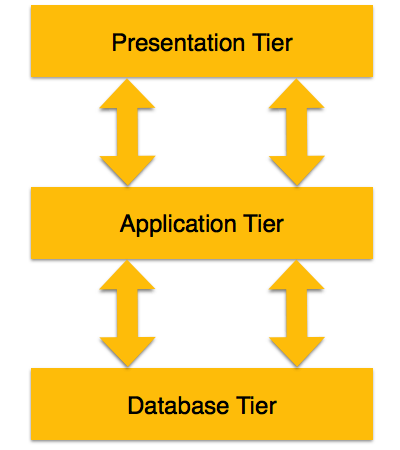
    DBMS Architecture
    • Database (Data) Tier − At this tier, the database resides along with its query processing languages. We also have the relations that define the data and their constraints at this level.
    • Application (Middle) Tier − At this tier reside the application server and the programs that access the database. For a user, this application tier presents an abstracted view of the database. End-users are unaware of any existence of the database beyond the application. At the other end, the database tier is not aware of any other user beyond the application tier. Hence, the application layer sits in the middle and acts as a mediator between the end-user and the database.
    • User (Presentation) Tier − End-users operate on this tier and they know nothing about any existence of the database beyond this layer. At this layer, multiple views of the database can be provided by the application. All views are generated by applications that reside in the application tier.

    Multiple-tier database architecture is highly modifiable, as almost all its components are independent and can be changed independently.
  • Overview

    Database is a collection of related data and data is a collection of facts and figures that can be processed to produce information.

    Mostly data represents recordable facts. Data aids in producing information, which is based on facts. For example, if we have data about marks obtained by all students, we can then conclude about toppers and average marks.

    database management system stores data in such a way that it becomes easier to retrieve, manipulate, and produce information.

    Characteristics

    Traditionally, data was organized in file formats. DBMS was a new concept then, and all the research was done to make it overcome the deficiencies in traditional style of data management. A modern DBMS has the following characteristics −

    • Real-world entity − A modern DBMS is more realistic and uses real-world entities to design its architecture. It uses the behavior and attributes too. For example, a school database may use students as an entity and their age as an attribute.
    • Relation-based tables − DBMS allows entities and relations among them to form tables. A user can understand the architecture of a database just by looking at the table names.
    • Isolation of data and application − A database system is entirely different than its data. A database is an active entity, whereas data is said to be passive, on which the database works and organizes. DBMS also stores metadata, which is data about data, to ease its own process.
    • Less redundancy − DBMS follows the rules of normalization, which splits a relation when any of its attributes is having redundancy in values. Normalization is a mathematically rich and scientific process that reduces data redundancy.
    • Consistency − Consistency is a state where every relation in a database remains consistent. There exist methods and techniques, which can detect attempt of leaving database in inconsistent state. A DBMS can provide greater consistency as compared to earlier forms of data storing applications like file-processing systems.
    • Query Language − DBMS is equipped with query language, which makes it more efficient to retrieve and manipulate data. A user can apply as many and as different filtering options as required to retrieve a set of data. Traditionally it was not possible where file-processing system was used.
    • ACID Properties − DBMS follows the concepts of Atomicity, Consistency, Isolation, and Durability (normally shortened as ACID). These concepts are applied on transactions, which manipulate data in a database. ACID properties help the database stay healthy in multi-transactional environments and in case of failure.
    • Multiuser and Concurrent Access − DBMS supports multi-user environment and allows them to access and manipulate data in parallel. Though there are restrictions on transactions when users attempt to handle the same data item, but users are always unaware of them.
    • Multiple views − DBMS offers multiple views for different users. A user who is in the Sales department will have a different view of database than a person working in the Production department. This feature enables the users to have a concentrate view of the database according to their requirements.
    • Security − Features like multiple views offer security to some extent where users are unable to access data of other users and departments. DBMS offers methods to impose constraints while entering data into the database and retrieving the same at a later stage. DBMS offers many different levels of security features, which enables multiple users to have different views with different features. For example, a user in the Sales department cannot see the data that belongs to the Purchase department. Additionally, it can also be managed how much data of the Sales department should be displayed to the user. Since a DBMS is not saved on the disk as traditional file systems, it is very hard for miscreants to break the code.

    Users

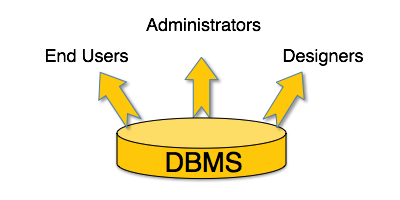
    A typical DBMS has users with different rights and permissions who use it for different purposes. Some users retrieve data and some back it up. The users of a DBMS can be broadly categorized as follows −

    DBMS Users
    • Administrators − Administrators maintain the DBMS and are responsible for administrating the database. They are responsible to look after its usage and by whom it should be used. They create access profiles for users and apply limitations to maintain isolation and force security. Administrators also look after DBMS resources like system license, required tools, and other software and hardware related maintenance.
    • Designers − Designers are the group of people who actually work on the designing part of the database. They keep a close watch on what data should be kept and in what format. They identify and design the whole set of entities, relations, constraints, and views.
    • End Users − End users are those who actually reap the benefits of having a DBMS. End users can range from simple viewers who pay attention to the logs or market rates to sophisticated users such as business analysts.
  • Ruby Is Constantly Evolving with Modern Needs

    Ruby ek old language hone ke bawajood kabhi stagnant nahi hui. Is language ka development hamesha modern computing ke hisaab se evolve hota raha hai. 2013 me Ruby 2.0 release hua jisme keyword arguments aur refinements aaye. Fir 2020 me Ruby 3.0 ne ek bada promise poora kiya — “3x faster than Ruby 2.0”. Is version me performance ke sath multithreading aur type checking ke liye Ruby Signature (RBS) jaisa modern feature add hua. Ruby ab AI aur automation scripts me bhi use ki ja rahi hai. 2025 me bhi Ruby ek stable aur respected language hai jo apne original goal — programmer happiness — ko kabhi compromise nahi karti. Ye adaptability aur long-term consistency hi Ruby ko ek truly timeless language banati hai.

  • Ruby’s Community Is One of the Most Supportive in the World

    Ruby ke paas duniya ke sabse friendly aur passionate developer communities me se ek hai. Is community ki ek khasiyat ye hai ke ye har naye developer ko encourage karti hai aur open-source contribution ko promote karti hai. Ruby conferences jaise “RubyConf” aur “RailsConf” duniya bhar me har saal hoti hain jahan developers apne ideas, innovations aur experiences share karte hain. Yukihiro Matsumoto khud bhi is community ke active member hain aur har waqt emphasize karte hain ke Ruby community me kindness aur cooperation sabse important values hain. Is supportive environment ne Ruby ko ek aisi language banaya jahan seekhna aur grow karna ek positive experience hai.

  • Ruby on Rails Changed the Web Development Industry

    2004 me David Heinemeier Hansson ne Ruby ke liye ek web framework banaya — Ruby on Rails (RoR). Ye framework ne web development ka poora game change kar diya. Pehle web apps banana complicated aur time-consuming hota tha, lekin Rails ne “Convention over Configuration” aur “Don’t Repeat Yourself (DRY)” jaise principles ke zariye is process ko bohot fast aur organized bana diya. Ruby on Rails ne developers ko sirf kuch hi lines of code me full-featured web applications banane ka mauka diya. Isi framework ke wajah se GitHub, Shopify, Basecamp, aur Airbnb jaise bade platforms Ruby par banaye gaye. Rails ne ek naye era ki shuruaat ki jahan startups aur developers apne ideas ko tezi se implement kar sakte the.

  • Everything in Ruby Is an Object

    Ruby ek pure object-oriented language hai, aur ye baat use baaki languages se alag banati hai. C++, Java ya Python me har cheez object nahi hoti, lekin Ruby me numbers, strings, classes, methods, blocks — sab kuch ek object hai. Matlab, jab aap “5” likhte ho to wo bhi ek object hai jiske methods hote hain, jaise 5.times ya 5.to_s. Is concept ne Ruby ko ek clean aur uniform design di, jisme har element ek logical pattern follow karta hai. Ye approach Ruby ke developers ko powerful aur flexible code likhne ki freedom deti hai. Object-oriented design ne Ruby ko un developers ke liye best choice bana diya jo reusability, structure aur readability ko importance dete hain.

  • Ruby Was Created to Make Programmers Happy

    Ruby ke creator Yukihiro “Matz” Matsumoto ka main goal ek aisi programming language banana tha jo sirf functional hi nahi, balki human-friendly bhi ho. 1993 ke dauraan jab zyada tar languages machine ke perspective se design ki ja rahi thi, Matz ne socha ke kyu na ek aisi language banai jaye jo programmer ke perspective se likhi jaye. Unka kehna tha ke programming ek creative aur artistic process hai, aur programmer ko apna code likhte waqt khushi milni chahiye. Isi liye Ruby ki syntax English jaisi natural rakhi gayi, jisse code likhna aur padhna dono asaan ho. Ruby ka motto “Programmer Happiness First” hai — aur ye idea hi Ruby ki popularity ka sabse bada reason bana.

  • Legacy of Yukihiro Matsumoto

    Yukihiro Matsumoto ne Ruby ko banate waqt ek simple idea follow kiya — programming enjoyable honi chahiye. Unhone kaha tha, “Programming should make you feel joy, not frustration.” Ye quote Ruby ke poore ecosystem ko represent karta hai. Ruby aaj bhi developers ke liye ek aisi language hai jisme likhna ek pleasant experience hota hai.

    Matz ki leadership aur community ke efforts ne Ruby ko 30 saal baad bhi relevant banaye rakha hai. Ruby ne programming world ko ye sikhaya ke simplicity aur beauty kabhi outdated nahi hoti.


    Timeline Summary

    YearEvent
    1993Yukihiro Matsumoto ne Ruby ka development start kiya
    1995Ruby ka first public release hua
    2000“Programming Ruby” (Pickaxe Book) publish hui
    2004Ruby on Rails framework launch hua
    2013Ruby 2.0 release hua
    2020Ruby 3.0 release ke sath performance triple hui
    2025Ruby ab bhi ek loved aur developer-friendly language hai
  • Ruby in the Modern Era

    Aaj ke time me Ruby ek mature, stable aur reliable programming language ke roop me establish ho chuki hai. Web development ke alawa ye scripting, automation, DevOps, aur AI tools me bhi use ho rahi hai. Ruby ka ecosystem bohot strong hai, aur iske developers ke liye frameworks, libraries aur tools ka bada collection available hai.

    Ruby community duniya ki sabse active aur helpful communities me se ek hai. Matz ne hamesha emphasize kiya ke Ruby sirf ek technology nahi, balki ek philosophy hai. Ye philosophy kehati hai ke programming sirf logical process nahi, balki ek creative art hai. Ruby ke through programmer apne ideas ko gracefully express kar sakta hai.

  • Continuous Development and Evolution

    Ruby ek continuously evolving language hai. Har version ke sath isme naye features, better performance aur improved tools add kiye gaye.

    • Ruby 1.8 (2003–2011): Ye version Ruby ke widespread use ke liye important tha.
    • Ruby 1.9 (2007): Is version me major performance improvements aur Unicode support add kiya gaya.
    • Ruby 2.0 (2013): Ye version Ruby ke evolution me ek bada step tha jisme keyword arguments aur refinements jaise features aaye.
    • Ruby 2.5 se 2.7 tak: In versions me modern features, error handling improvements aur speed optimization ki gayi.
    • Ruby 3.0 (2020): Ye version “3x faster” goal ke sath launch hua. Isme better concurrency, parallel processing aur Ruby Signature (RBS) jaise advanced features add kiye gaye.

    Yukihiro Matsumoto aur Ruby community ne language ko hamesha modern requirements ke according evolve karte hue maintain kiya. Ruby aaj bhi ek example hai ek language ke liye jo simplicity aur power ka perfect combination hai.