Author: saqibkhan

  • Minimal Cover

    In database management systems (DBMS), a minimal cover (or irreducible set) is a simplified version of a given set of functional dependencies. It preserves the original meaning but eliminates redundancies and unnecessary complexities. One needs to learn the process of finding a minimal cover for database normalization. It helps in creating efficient and well-structured tables.

    In this chapter, we will explain the concept of minimal cover in simple steps, and see the process with an example for a better understanding.

    What is Minimal Cover in Functional Dependency?

    A minimal cover of a set of functional dependencies is an equivalent set that satisfies these conditions −

    • The right-hand side (RHS) of every functional dependency has exactly one attribute.
    • No functional dependency will be redundant.
    • The left-hand side (LHS) of every functional dependency is as small as possible. It means we cannot remove any attribute without losing the dependency.

    With these conditions, a minimal cover helps us in simplifying the design while retaining the same functional relationships as the original set.

    Steps to Find Minimal Cover

    Let us now understand how to find the minimal cover. To compute the minimal cover, we follow three key steps −

    • Decompose the RHS − It shows that every functional dependency has only one attribute on its RHS.
    • Remove Redundant Functional Dependencies − Check and eliminate any dependencies that are not needed.
    • Minimize the LHS − Simplify the LHS of each dependency by removing unnecessary attributes.

    Let us get a good understanding of these steps see these steps down further with an example.

    Example: Finding the Minimal Cover

    Suppose we are given the following functional dependencies −

    • A → B
    • C → B
    • D → A, B, C
    • AC → D

    We aim to find the minimal cover for this set.

    Step 1: Decompose the RHS

    First, we make sure that each functional dependency has only one attribute on its RHS. This is done using the decomposition property.

    • A → B: This is already in the correct form. It has the RHS has a single attribute.
    • C → B: Again, this is fine as is.
    • D → A, B, C: Here, the RHS has three attributes. We decompose it into three separate dependencies:
      • D → A
      • D → B
      • D → C
    • AC → D: The RHS has one attribute. So it remains unchanged.

    After Step 1, our updated set of dependencies looks like this −

    • A → B
    • C → B
    • D → A
    • D → B
    • D → C
    • AC → D

    Step 2: Remove Redundant Dependencies

    Next, we check each functional dependency. To see if it is redundant. A dependency is redundant if it can be removed without changing the meaning of the set. This shows finding closures and verifying if the dependent attribute can still be determined without the removed dependency.

    • Check A → B − Remove A → B and calculate the closure of A using the remaining dependencies. The closure of A only includes A. Since B is not in the closure, A → B is not redundant and must be kept.
    • Check C → B − Remove C → B and calculate the closure of C. The closure of C only includes C. So B cannot be determined. Thus, C → B is not redundant and must be kept.
    • Check D → A − Remove D → A and calculate the closure of D. The closure of D includes D, B, C, but A cannot be determined without this dependency. Therefore, D → A is not redundant and must stay.
    • Check D  B − Remove D → B and calculate the closure of D. The closure of D still includes B. So D → B is redundant and can be removed.
    • Check D → C − Remove D → C and calculate the closure of D. The closure of D does not include C, so D → C is not redundant and must stay.
    • Check AC → D − Remove AC → D and calculate the closure of AC. Without AC → D, D cannot be determined. So this dependency is not redundant and must stay.

    After Step 2, the updated set of dependencies is −

    • A → B
    • C → B
    • D → A
    • D → C
    • AC → D

    Step 3: Minimize the LHS

    In the final step, we minimize the LHS of each dependency. It involves removing attributes from the LHS if they are not needed to determine the RHS.

    Minimize AC → D −

    Check if either A or C can be removed from the LHS.

    • Remove A and calculate the closure of C. The closure of C does not include D, so A cannot be removed.
    • Remove C and calculate the closure of A. The closure of A also does not include D, so C cannot be removed.

    Thus, AC → D remains as is.

    All other dependencies already have a single attribute on the LHS. So, no further minimization is needed.

    Final Minimal Cover

    The minimal cover for the given functional dependencies is −

    • A → B
    • C → B
    • D → A
    • D → C
    • AC → D

    Importance of Minimal Cover

    Minimal cover is needed because it simplifies the set of functional dependencies while maintaining their original meaning. It helps in −

    • Avoiding redundant computations.
    • Reducing the complexity of database design.
    • Making normalization easier.

    By ensuring that both the LHS and RHS of dependencies are as simple as possible, the minimal cover aids in creating efficient and well-organized databases.
  • Functional Dependency

    Functional Dependency is one of the basic but important concepts in databases. It is highly useful in understanding normalization and how attributes in a table relate to one another. We have come across this term “functional dependency” while studying the concepts of Database Design and topics like Keys and Normal Forms.

    In this chapter, we will cover the concepts of functional dependencies in detail with simple explanations and practical examples for a better understanding.

    What is Functional Dependency?

    In short, functional dependency is all about relationships between attributes (columns) in a table. We can say that the value of one attribute (or a group of attributes) can be used to determine the value of another attribute in the same table.

    Think of it this way: If we know the value of A, can we always find the corresponding value of B? If yes, then we say A determines B, or we can represent this with an arrow, A → B. We can also say that B is dependent on A.

    To get a better understanding, let us compare this concept with a function in mathematics. Imagine we have a function f where we input a number ‘a‘, and it calculates the square of that number as the output ‘b‘.

    For example − Input a = 5, the function calculates b = 25. Here, “a uniquely determines b“.

    In databases, it is a little bit different. Instead of calculating a value, we simply use one attribute (or a set of attributes) to find or identify another. Let us see this with a table example.

    Functional Dependency in Action

    Consider a table T with two columns, A and B −

    AB
    1X
    2Y
    3Z

    Here, if someone gives us the value of A, like A = 2, we can look at the table and find that the corresponding value of B is Y. This tells us that A determines B, or A → B.

    Key Components of Functional Dependency

    In functional dependencies we must keep in mind several terms or components −

    • Determinant − The attribute(s) used to determine the other attribute (Left hand attribute)
    • Dependent − The attribute whose value is determined (Right hand attribute)

    In the example above −

    • A is the determinant
    • B is the dependent

    Examples of Functional Dependency

    Let us see more detailed examples and analyze if the dependencies are valid or not.

    Example 1: Roll Number Determines Student Information

    Imagine a table with the following attributes: (Roll Number, Student Name, Department Name, and Department Building).

    Roll NumberStudent NameDepartment NameDepartment Building
    1AliceCSA4
    2BobITB2
    3CarolCSA4

    If we say Roll Number → Student Name, Department Name, Department Building, is this a valid functional dependency?

    Yes, because, each roll number is unique, meaning it can help us identify the student’s name, department, and building. For example −

    If Roll Number = 3, we can easily find that the student is Carol, in the CS department, and her building is A4.

    Example 2: Department Name Determines Department Building

    Using the same table, let us see another example. Check if Department Name → Department Building is a valid functional dependency or not. Observe carefully, the Department Name column has duplicate values: “CS” appears twice. However, for both instances, the corresponding Department Building is the same (A4).

    So, even though there’s redundancy, this is still a valid dependency because CS always maps to A4, no matter how many times it appears.

    Example 3: Different Determinants with the Same Dependent

    Now, consider another functional dependency, say Department Name → Department Building, but we add another department to the table −

    Department NameDepartment Building
    CSA4
    ITB2
    MEB2

    Here, two departments (IT and ME) share the same building (B2). Is this valid?

    Yes, it is also valid. Multiple determinants (IT and ME) can point to the same dependent (B2). This does not violate the rules of functional dependency.

    Example 4: Student Name Determines Department Name

    Consider another example. Here the functional dependency Student Name → Department Name.

    In our table, two students (Bob and another student) could share the same name but belong to different departments. For instance −

    Student NameDepartment Name
    BobCS
    BobIT

    If we ask, “Which department is Bob in?”, there are two possible answers: CS and IT. This makes the dependency invalid. This is because a single determinant (Student Name) does not lead to a unique dependent (Department Name).

    Analyzing Valid and Invalid Cases

    Now let us categorize functional dependency scenarios −

    • Unique Determinant to Unique Dependent − Example: Roll Number → Student Information. This is valid because each roll number is unique and maps to a specific set of values.
    • Same Determinant with Same Dependent − Example: Department Name → Department Building. Valid even with duplicate department names. And as they always map to the same building.
    • Different Determinants with Same Dependent − Example: IT → B2, ME → B2. This is valid because multiple attributes can lead to the same dependent value.
    • Same Determinant with Different Dependents − Example: Student Name → Department Name (with duplicates). This is invalid because one determinant (Student Name) leads to multiple, conflicting values.

    Importance of Functional Dependency

    The functional dependencies are important for database normalization. They help us identify several factors as listed below −

    • Redundancies in data
    • Which attributes should serve as keys
    • How to design efficient, error-free database structures

    Without properly handling functional dependencies, we might design database tables that are prone to anomalies and inefficiencies.

  • Example of Queries on Relational Algebra

    Relational Algebra provides the theoretical foundation of querying. It is used for understanding and manipulating data in relational databases. It is used for a variety of operations to query and transform datasets effectively. By understanding these operations, database users can perform complex queries while maintaining clarity and precision.

    In this chapter, we will see several query examples from relational algebra. Each example is based on a specific scenario and demonstrates the practical application of relational algebra operations such as selection, projection, join, union, and division.

    Let us first take a look at the required tables and their data to express the query in true sense.

    EMPLOYEE Table

    Here’s the EMPLOYEE table that collects the data relevant to all employees –

    FnameMinitLnameSsnBdateAddressSexSalarySuper_ssnDno
    JohnBSmith1234567891965-01-09731 Fondren, Houston, TXM300003334455555
    FranklinTWong3334455551955-12-08638 Voss, Houston, TXM400008886655555
    AliciaJZelaya9998877771968-01-193321 Castle, Spring, TXF250009876543214
    JenniferSWallace9876543211941-06-20291 Berry, Bellaire, TXF430008886655554
    RameshKNarayan6668844441962-09-15975 Fire Oak, Humble, TXM380003334455555
    JoyceAEnglish4534534531972-07-315631 Rice, Houston, TXF250003334455555
    AhmadVJabbar9879879871969-03-29980 Dallas, Houston, TXM250009876543214
    JamesEBorg8886655551937-11-10450 Stone, Houston, TXM55000NULL1

    DEPARTMENT Table

    There are three departments as highlighted in the following DEPARTMENT table –

    DnameDnumberMgr_ssnMgr_start_date
    Research53334455551988-05-22
    Administration49876543211995-01-01
    Headquarters18886655551981-06-19

    PROJECT Table

    The PROJECT table contains the relevant data of all the projects –

    PnamePnumberPlocationDnum
    ProductX1Bellaire5
    ProductY2Sugarland5
    ProductZ3Houston5
    Computerization10Stafford4
    Reorganization20Houston1
    Newbenefits30Stafford4

    WORKS_ON Table

    The WORKS_ON table gathers which employee is working on which project for how many hours –

    EssnPnoHours
    123456789132.5
    12345678927.5
    666884444340.0
    453453453120.0
    453453453220.0
    333445555210.0
    333445555310.0
    3334455551010.0
    3334455552010.0
    9998877773030.0
    9998877771010.0
    9879879871035.0
    987987987305.0
    9876543213020.0
    9876543212015.0
    88866555520NULL

    DEPENDENT Table

    The DEPENDENT table is as follows –

    EssnDependent_nameSexBdateRelationship
    333445555AliceF1986-04-05Daughter
    333445555TheodoreM1983-10-25Son
    333445555JoyF1958-05-03Spouse
    987654321AbnerM1942-02-28Spouse
    123456789MichaelM1988-01-04Son
    123456789AliceF1988-12-30Daughter
    123456789ElizabethF1967-05-05Spouse

    Query Examples on Relational Algebra

    Let us now check some queries that extracts data from the inputs supplied in the above tables –

    Retrieve the Name and Address of Employees in the Research Department

    This query is to identify employees working in the “Research” department and retrieve their names and addresses.

    Steps − Use a selection operation to filter the “Research” department from the DEPARTMENT relation –

    RESEARCHDEPT←σDname=′Research′(DEPARTMENT)

    DnameDnumberMgr_ssnMgr_start_date
    Research53334455551988-05-22

    Join the resulting relation with the EMPLOYEE relation using the department number (Dnumber and Dno) –

    RESEARCHEMPS←RESEARCHDEPT⋈Dnumber=DnoEMPLOYEE

    DnameDnumberMgr_ssnMgr_start_dateFnameMinitLnameSsnBdateAddressSexSalarySuper_ssnDno
    Research53334455551988-05-22JohnBSmith1234567891965-01-09731 Fondren, Houston, TXM300003334455555
    Research53334455551988-05-22FranklinTWong3334455551955-12-08638 Voss, Houston, TXM400008886655555
    Research53334455551988-05-22RameshKNarayan6668844441962-09-15975 Fire Oak, Humble, TXM380003334455555
    Research53334455551988-05-22JoyceAEnglish4534534531972-07-315631 Rice, Houston, TXF250003334455555

    Finally, apply a projection operation to retrieve the desired attributes (first name, last name, and address).

    RESULT←πFname,Lname,Address(RESEARCHEMPS)

    FnameLnameAddress
    JohnSmith731 Fondren, Houston, TX
    FranklinWong638 Voss, Houston, TX
    RameshNarayan975 Fire Oak, Humble, TX
    JoyceEnglish5631 Rice, Houston, TX

    In-Line Expression −

    πFname,Lname,Address(σDname=′Research′(DEPARTMENT⋈Dnumber=DnoEMPLOYEE))

    List Project Details for Stafford

    For projects located in “Stafford,” we are going to retrieve the project number, the controlling department, and the manager’s details (last name, address, and birth date).

    Steps − Filter projects located in “Stafford” using selection.

    STAFFORD_PROJS←σPlocation=′Stafford′(PROJECT)

    PnamePnumberPlocationDnum
    Computerization10Stafford4
    Newbenefits30Stafford4

    Join these projects with their controlling departments based on the department number –

    CONTR_DEPTS←STAFFORD_PROJS⋈Dnum=DnumberDEPARTMENT

    PnamePnumberPlocationDnumDnameDnumberMgr_ssnMgr_start_date
    Computerization10Stafford4Administration49876543211995-01-01
    Newbenefits30Stafford4Administration49876543211995-01-01

    Join the result with the EMPLOYEE relation to retrieve manager details (Mgr_ssn = Ssn) –

    PROJ_DEPT_MGRS←CONTR_DEPTS⋈Mgr_ssn=SsnEMPLOYEE

    PnamePnumberPlocationDnumDnameDnumberMgr_ssnMgr_start_dateFnameMinitLnameSsn
    Computerization10Stafford4Administration49876543211995-01-01JenniferSWallace987654321
    Newbenefits30Stafford4Administration49876543211995-01-01JenniferSWallace987654321

    Finally, use projection to extract the desired attributes.

    RESULT←πPnumber,Dnum,Lname,Address,Bdate(PROJ_DEPT_MGRS)

    PnumberDnumLnameAddressBdate
    104Wallace291 Berry, Bellaire, TX1941-06-20
    304Wallace291 Berry, Bellaire, TX1941-06-20

    Employees Working on All Projects Controlled by Department 5

    This query identifies employees assigned to every project under department number 5.

    Steps − Create a relation with project numbers of all projects controlled by department 5 –

    DEPT5_PROJS←ρ(Pno)(πPnumber(σDnum=5(PROJECT)))

    Pno
    1
    2
    3

    Build a relation of employees and their assigned projects (Ssn and Pno).

    EMP_PROJ←ρ(Ssn,Pno)(πEssn,Pno(WORKS_ON))

    SsnPno
    1234567891
    1234567892
    6668844443
    4534534531
    4534534532
    3334455552
    3334455553
    33344555510
    33344555520
    99988777730
    99988777710
    98798798710
    98798798730
    98765432130
    98765432120
    88866555520

    Apply the division operation to find employees associated with all DEPT5_PROJS.

    RESULT_EMP_SSNS←EMP_PROJ÷DEPT5_PROJS

    Join with the EMPLOYEE relation to retrieve names.

    RESULT←πLname,Fname(RESULT_EMP_SSNS∗EMPLOYEE)

    Project Numbers Involving Smith (As Worker or Manager)

    We want to identify all projects where an employee named “Smith” is involved. This is either as a worker or as a department manager.

    Steps − Retrieve the Social Security Numbers (SSNs) of employees named “Smith” –

    SMITHS(Essn)←πSsn(σLname=′Smith′(EMPLOYEE))

    Essn
    123456789

    Use the Cartesian product to find projects where “Smith” works.

    SMITH_WORKER_PROJS←πPno(WORKS_ON∗SMITHS)

    EssnPnoHours
    123456789132.5
    12345678927.5

    Retrieve SSNs of department managers from the DEPARTMENT relation –

    MGRS←πLname,Dnumber(EMPLOYEE⋈Ssn=Mgr_ssnDEPARTMENT)

    LnameDno
    Wong5
    Wallace4
    Borg1

    Find the departments managed by “Smith” and join them with PROJECT to identify projects –

    SMITH_MANAGED_DEPTS(Dnum)←πDnumber(σLname=′Smith′(MGRS))

    SMITH_MGR_PROJS(Pno)←πPnumber(SMITH_MANAGED_DEPTS∗PROJECT)

    Combine the two project lists using union –

    RESULT←(SMITH_WORKER_PROJS∪SMITH_MGR_PROJS)

    Employees with Two or More Dependents

    The goal is to list employees who have at least two dependents. This requires using aggregate functions, which go beyond basic relational algebra.

    Steps − Count the number of dependents for each employee using COUNT –

    T1(Ssn,No_of_dependents)←EssnℑCOUNTDependent_name(DEPENDENT)

    Filter employees with more than two dependents –

    T2←σNo_of_dependents>2(T1)

    Join with EMPLOYEE to get their names –

    RESULT←πLname,Fname(T2∗EMPLOYEE)

    Employees without Dependents

    This query retrieves employees who have no dependents.

    Steps − Create a relation with all employee SSNs.

    ALL_EMPS←πSsn(EMPLOYEE)

    Create a relation of employees with dependents.

    EMPS_WITH_DEPS(Ssn)←πEssn(DEPENDENT)

    Use the set difference to find employees with no dependents.

    EMPS_WITHOUT_DEPS←(ALLEMPS–EMPS_WITH_DEPS)

    Join with EMPLOYEE to retrieve names.

    RESULT←πLname,Fname(EMPS_WITHOUT_DEPS∗EMPLOYEE)

    Managers with Dependents

    This query lists managers who have at least one dependent.

    Steps − Extract SSNs of department managers –

    MGRS(Ssn)←πMgrssn(DEPARTMENT)

    Extract SSNs of employees with dependents –

    EMPS_WITH_DEPS(Ssn)←πEssn(DEPENDENT)

    Use intersection to find managers with dependents –

    MGRS_WITH_DEPS←(MGRS∩EMPS_WITH_DEPS)

    Retrieve their names –

    RESULT←πLname,Fname(MGRS_WITH_DEPS∗EMPLOYEE)

  • Convert ER Model to Relational Model

    ER Model, when conceptualized into diagrams, gives a good overview of entity-relationship, which is easier to understand. ER diagrams can be mapped to relational schema, that is, it is possible to create relational schema using ER diagram. We cannot import all the ER constraints into relational model, but an approximate schema can be generated.

    There are several processes and algorithms available to convert ER Diagrams into Relational Schema. Some of them are automated and some of them are manual. We may focus here on the mapping diagram contents to relational basics.

    ER diagrams mainly comprise of −

    • Entity and its attributes
    • Relationship, which is association among entities.

    Mapping Entity

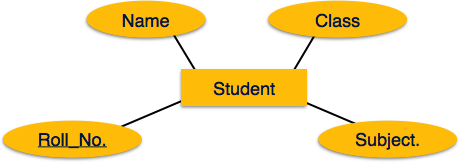
    An entity is a real-world object with some attributes.

    Mapping Entity

    Mapping Process (Algorithm)

    • Create table for each entity.
    • Entity’s attributes should become fields of tables with their respective data types.
    • Declare primary key.

    Mapping Relationship

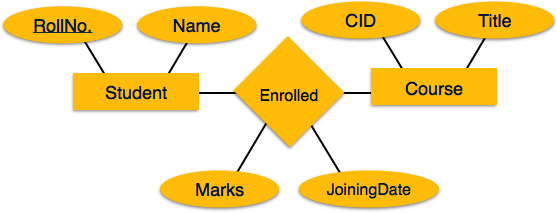
    A relationship is an association among entities.

    Mapping relationship

    Mapping Process

    • Create table for a relationship.
    • Add the primary keys of all participating Entities as fields of table with their respective data types.
    • If relationship has any attribute, add each attribute as field of table.
    • Declare a primary key composing all the primary keys of participating entities.
    • Declare all foreign key constraints.

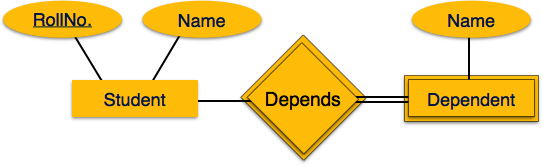
    Mapping Weak Entity Sets

    A weak entity set is one which does not have any primary key associated with it.

    Mapping Weak Entity Sets

    Mapping Process

    • Create table for weak entity set.
    • Add all its attributes to table as field.
    • Add the primary key of identifying entity set.
    • Declare all foreign key constraints.

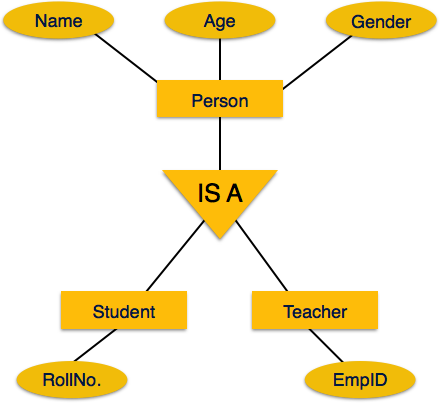
    Mapping Hierarchical Entities

    ER specialization or generalization comes in the form of hierarchical entity sets.

    Mapping hierarchical entities

    Mapping Process

    • Create tables for all higher-level entities.
    • Create tables for lower-level entities.
    • Add primary keys of higher-level entities in the table of lower-level entities.
    • In lower-level tables, add all other attributes of lower-level entities.
    • Declare primary key of higher-level table and the primary key for lower-level table.
    • Declare foreign key constraints.
  • Division Operation

    In relational algebra, several operators are essential due to their unique functionalities. One such operator is the division operator, symbolized by “÷“. This operator is relatively complex but plays a crucial role in solving queries that involve the “all” condition. While many relational algebra operations focus on combining or filtering data, the division operation identifies tuples in one relation that are associated with every tuple in another.

    In this chapter, we’ll explore the concept of the division operator in detail, understand its theoretical foundation, and walk through practical examples to grasp its application.

    Basics of the Division Operator

    The division operation applies to two relations −

    • Numerator Relation (R) − Represents the main dataset and contains the superset of possible combinations.
    • Denominator Relation (S) − Represents the subset or the set of conditions that must be satisfied.

    The result is a relation containing only those tuples from the numerator that are associated with every tuple in the denominator.

    Attributes in Relations

    Let’s define the attributes involved in the division operator −

    • R(Z) is the numerator, where Z = X ∪ Y
    • S(X) is the denominator
    • T(Y) is the result

    Here, T contains the attributes in R that are not in S. For a tuple to appear in T, it must pair with every tuple in S within R.

    To better understand the concept, consider a real-world scenario. Suppose we are organizing a workshop. Participants (R) are linked to sessions (X). We want to find those participants who attended all required sessions (S). The division operator helps identify these individuals by evaluating the “all sessions attended” condition.

    Step-by-Step Explanation of the Division Operator

    The division operation ensures that each result tuple in T(Y) must appear in R(Z) in combination with every tuple in S(X). Any tuple in R that fails to match all tuples in S is excluded from the result.

    Mathematical Representation

    The division operator can be expressed using a combination of projection, Cartesian product, and difference −

    • T1 − Identify all potential result tuples: T1 ← πY(R)
    • T2 − Find tuples in T1 that do not satisfy the pairing condition with S: T2 ← πY((S × T1) − R)
    • Final Result − Subtract the unsatisfying tuples from the potential results. T ← T1 − T2

    Example: Employees Working on All Projects

    Let us take an example to get a clear understanding of how the division operator works.

    Query − Find the names of employees who work on all projects that “John Smith” works on.

    Relations Involved − Following are the relations involved in this query –

    WORKS_ON − Contains tuples of employee IDs (Essn) and project numbers (Pno).

    EssnPnoHours
    123456789132.5
    12345678927.5
    666884444340.0
    453453453120.0
    453453453220.0
    333445555210.0
    333445555310.0
    3334455551010.0
    3334455552010.0
    9998877773030.0
    9998877771010.0
    9879879871035.0
    987987987305.0
    9876543213020.0
    9876543212015.0
    88866555520NULL

    EMPLOYEE − Contains personal details like Fname, Lname, and Ssn.

    FnameMinitLnameSsnBdateAddressSexSalarySuper_ssnDno
    JohnBSmith1234567891965-01-09731 Fondren, Houston, TXM300003334455555
    FranklinTWong3334455551955-12-08638 Voss, Houston, TXM400008886655555
    AliciaJZelaya9998877771968-01-193321 Castle, Spring, TXF250009876543214
    JenniferSWallace9876543211941-06-20291 Berry, Bellaire, TXF430008886655554
    RameshKNarayan6668844441962-09-15975 Fire Oak, Humble, TXM380003334455555
    JoyceAEnglish4534534531972-07-315631 Rice, Houston, TXF250003334455555
    AhmadVJabbar9879879871969-03-29980 Dallas, Houston, TXM250009876543214
    JamesEBorg8886655551937-11-10450 Stone, Houston, TXM55000NULL1

    Now, let’s understand step-by-step how to find the names of employees who work on all projects that “John Smith” works on.

    Retrieve John Smith’s Projects

    Start by filtering the projects linked to “John Smith.”

    SMITH←σFname=′John′ANDLname=′Smith′(EMPLOYEE)

    FnameMinitLnameSsnBdateAddressSexSalarySuper_ssnDno
    JohnBSmith1234567891965-01-09731 Fondren, Houston, TXM300003334455555

    SMITHPNOS←πPno(WORKSON⋈Essn=SsnSMITH)

    Pno
    1
    2

    This gives a relation SMITH_PNOS containing all project numbers “John Smith” is assigned to.

    Create All Employee-Project Relationships

    Extract a relation showing all employees and their associated projects.

    SSNPNOS←πEssn,Pno(WORKSON)

    EssnPno
    1234567891
    1234567892
    6668844443
    4534534531
    4534534532
    3334455552
    3334455553
    33344555510
    33344555520
    99988777730
    99988777710
    98798798710
    98798798730
    98765432130
    98765432120
    88866555520

    Apply Division

    Use the division operator to find employees whose project assignments cover all projects in SMITH_PNOS.

    SSNS(Ssn)←SSNPNOS÷SMITHPNOS

    Ssn
    123456789
    453453453

    Map Employee IDs to Names

    Finally, retrieve the names of these employees.

    RESULT←πFname,Lname(SSNS⋈EMPLOYEE)

    FnameLname
    JohnSmith
    JoyceEnglish

    Final output − The final relation contains the names of employees who work on all the projects that “John Smith” works on.

    Generalized Example: Products and Suppliers

    Scenario − A store sells products (R) supplied by various suppliers (S). We want to identify products available from all suppliers.

    Input Relations

    • R − Contains ProductID and SupplierID
    • S − Contains just SupplierID

    Let’s go through its steps.

    Extract potential products −

    T1←πProductID(R)

    Identify mismatched products −

    T2←πProductID((S×T1)−R)

    Subtract mismatches from potential products −

    T←T1−T2

    Output − If only certain products are supplied by every supplier, those product IDs will appear in the result relation T.

    Key Observations

    • Handling Universal Quantification − The division operator is useful for queries that require “for all” conditions. This is like finding students enrolled in all mandatory courses or employees assigned to every project in a list.
    • Limitations in SQL − SQL does not directly support the division operator. However, similar results can be achieved using NOT EXISTS or complex joins. Although these approaches may lack the power of relational algebra.
    • Practical Relevance − While it is theoretically significant, division is less common in practical database management systems due to its complexity and rare use cases.

    Additional Applications

    • Matching Preferences − Find customers whose preferences match every feature of a product.
    • Cross-Department Participation − Identify employees involved in activities across all departments.
  • Joins

    We understand the benefits of taking a Cartesian product of two relations, which gives us all the possible tuples that are paired together. But it might not be feasible for us in certain cases to take a Cartesian product where we encounter huge relations with thousands of tuples having a considerable large number of attributes.

    Join is a combination of a Cartesian product followed by a selection process. A Join operation pairs two tuples from different relations, if and only if a given join condition is satisfied.

    We will briefly describe various join types in the following sections.

    Theta (θ) Join

    Theta join combines tuples from different relations provided they satisfy the theta condition. The join condition is denoted by the symbol θ.

    Notation

    R1 ⋈θ R2
    

    R1 and R2 are relations having attributes (A1, A2, .., An) and (B1, B2,.. ,Bn) such that the attributes dont have anything in common, that is R1 ∩ R2 = Φ.

    Theta join can use all kinds of comparison operators.

    Student
    SIDNameStd
    101Alex10
    102Maria11
    Subjects
    ClassSubject
    10Math
    10English
    11Music
    11Sports

    Student_Detail −

    STUDENT ⋈Student.Std = Subject.Class SUBJECT
    
    Student_detail
    SIDNameStdClassSubject
    101Alex1010Math
    101Alex1010English
    102Maria1111Music
    102Maria1111Sports

    Equijoin

    When Theta join uses only equality comparison operator, it is said to be equijoin. The above example corresponds to equijoin.

    Natural Join (⋈)

    Natural join does not use any comparison operator. It does not concatenate the way a Cartesian product does. We can perform a Natural Join only if there is at least one common attribute that exists between two relations. In addition, the attributes must have the same name and domain.

    Natural join acts on those matching attributes where the values of attributes in both the relations are same.

    Courses
    CIDCourseDept
    CS01DatabaseCS
    ME01MechanicsME
    EE01ElectronicsEE
    HoD
    DeptHead
    CSAlex
    MEMaya
    EEMira
    Courses ⋈ HoD
    DeptCIDCourseHead
    CSCS01DatabaseAlex
    MEME01MechanicsMaya
    EEEE01ElectronicsMira

    Outer Joins

    Theta Join, Equijoin, and Natural Join are called inner joins. An inner join includes only those tuples with matching attributes and the rest are discarded in the resulting relation. Therefore, we need to use outer joins to include all the tuples from the participating relations in the resulting relation. There are three kinds of outer joins − left outer join, right outer join, and full outer join.

    Left Outer Join(R Left Outer Join S)

    All the tuples from the Left relation, R, are included in the resulting relation. If there are tuples in R without any matching tuple in the Right relation S, then the S-attributes of the resulting relation are made NULL.

    Left
    AB
    100Database
    101Mechanics
    102Electronics
    Right
    AB
    100Alex
    102Maya
    104Mira
    Courses Left Outer Join HoD
    ABCD
    100Database100Alex
    101Mechanics
    102Electronics102Maya

    Right Outer Join: ( R Right Outer Join S )

    All the tuples from the Right relation, S, are included in the resulting relation. If there are tuples in S without any matching tuple in R, then the R-attributes of resulting relation are made NULL.

    Courses Right Outer Join HoD
    ABCD
    100Database100Alex
    102Electronics102Maya
    104Mira

    Full Outer Join: ( R Full Outer Join S)

    All the tuples from both participating relations are included in the resulting relation. If there are no matching tuples for both relations, their respective unmatched attributes are made NULL.

    Courses Full Outer Join HoD
    ABCD
    100Database100Alex
    101Mechanics
    102Electronics102Maya
    104Mira
  • Set Theory Operations

    In relational algebra we use several set theory operations. Since relational model is based on set theory it borrows several concepts from set theory as well in respect to the operations. These include UNION, INTERSECTION, MINUS (also called SET DIFFERENCE), and also the CARTESIAN PRODUCT. In this article, we will see down each operator and work through examples for a better understanding.

    Let us see the following two tables that we will focus in the next examples −

    In relational algebra, several operations are derived from set theory. Since the relational model is based on set theory, it adopts key concepts such as UNION, INTERSECTION, MINUS (also called SET DIFFERENCE), and CARTESIAN PRODUCT.

    In this chapter, we will examine each of these operators with practical examples for better understanding. Let’s begin by reviewing two tables that will be used in the upcoming examples −

    EMPLOYEE Table

    FnameMinitLnameSsnBdateAddressSexSalarySuper_ssnDno
    JohnBSmith1234567891965-01-09731 Fondren, Houston, TXM300003334455555
    FranklinTWong3334455551955-12-08638 Voss, Houston, TXM400008886655555
    AliciaJZelaya9998877771968-01-193321 Castle, Spring, TXF250009876543214
    JenniferSWallace9876543211941-06-20291 Berry, Bellaire, TXF430008886655554
    RameshKNarayan6668844441962-09-15975 Fire Oak, Humble, TXM380003334455555
    JoyceAEnglish4534534531972-07-315631 Rice, Houston, TXF250003334455555
    AhmadVJabbar9879879871969-03-29980 Dallas, Houston, TXM250009876543214
    JamesEBorg8886655551937-11-10450 Stone, Houston, TXM55000NULL1

    DEPENDENT Table

    EssnDependent_nameSexBdateRelationship
    333445555AliceF1986-04-05Daughter
    333445555TheodoreM1983-10-25Son
    333445555JoyF1958-05-03Spouse
    987654321AbnerM1942-02-28Spouse
    123456789MichaelM1988-01-04Son
    123456789AliceF1988-12-30Daughter
    123456789ElizabethF1967-05-05Spouse

    Set Theory Basics in Relational Algebra

    In set theory, each element in a set is unique, and operations like UNION and INTERSECTION combine or compare these elements systematically. Relational algebra applies similar principles by treating each row in a table as a set element.

    However, relational tables have more structure than simple sets, so additional rules apply −

    • Union Compatibility − For operations like UNION and INTERSECTION, the tables must have the same number of attributes, and each attribute must have the same data type.
    • Duplicate Elimination − These operations inherently remove duplicates, as relational algebra operates on sets, not multisets.

    The UNION Operator

    The UNION operator combines rows from two relations, producing a result with all unique rows present in either relation-similar to merging two lists while removing duplicates.

    Syntax and Representation

    In relational algebra, UNION is represented as −

    R ∪ S
    

    Here, R and S are two relations (tables) that must be union compatible.

    Combining Employee and Manager IDs

    Let us consider we want a find of all employees who either work in department 5 or supervise someone in department 5. We use UNION to merge these groups −

    Retrieve Social Security numbers (SSN) of employees in department 5 −

    RESULT1 ← πSsn(σDno =5(EMPLOYEE))
    Ssn
    123456789
    333445555
    666884444
    453453453

    Retrieve SSNs of managers supervising department 5 employees −

    RESULT2 ← πSuper_ssn(σDno =5(EMPLOYEE))
    Super_ssn
    333445555
    888665555
    333445555
    333445555

    Combine both lists −

    RESULT ← RESULT1 ∪ RESULT2
    
    Ssn
    123456789
    333445555
    666884444
    453453453
    333445555
    888665555
    333445555
    333445555

    The final table will include SSNs of all employees who meet either condition. For instance, if RESULT1 contains {123, 456} and RESULT2 contains {456, 789}, the UNION result is {123, 456, 789}.

    The INTERSECTION Operator

    The INTERSECTION operator identifies rows present in both relations. It is like finding the overlap between two groups.

    Syntax and Representation

    INTERSECTION is denoted as −

    R ∩ S
    

    Finding SSN which are common in manager and employee

    Consider the table of SSN of employees who work for department 1 and 5 −

    RESULT1 ← πSsn(σDno =5^ Dno =1(EMPLOYEE))
    Ssn
    123456789
    333445555
    666884444
    453453453
    888665555

    Retrieve SSNs of managers supervising department 5 employees −

    RESULT2 ← πSuper_ssn(σDno =5(EMPLOYEE))
    Super_ssn
    333445555
    888665555
    333445555
    333445555

    The common SSN values are −

    RESULT ← RESULT1 ∩ RESULT2
    
    Ssn
    333445555
    888665555

    The MINUS (SET DIFFERENCE) Operator

    The MINUS operator, also called SET DIFFERENCE, is used to remove rows in one relation that appear in another. It essentially answers the question, “What is in one table but not the other?”

    Syntax and Representation

    In relational algebra, MINUS is represented as −

    R − S
    

    SSN of employees who are not manager

    Consider the table of SSN of employees who work for department 1 and 5 −

    RESULT1 ← πSsn(σDno =5^ Dno =1(EMPLOYEE))
    Ssn
    123456789
    333445555
    666884444
    453453453
    888665555

    Retrieve SSNs of managers supervising department 5 employees −

    RESULT2 ← πSuper_ssn(σDno =5(EMPLOYEE))
    Super_ssn
    333445555
    888665555
    333445555
    333445555

    The SSN of non-managers are −

    RESULT ← RESULT1 − RESULT2
    
    Ssn
    123456789
    666884444
    453453453

    The CARTESIAN PRODUCT (CROSS PRODUCT) Operator

    The CARTESIAN PRODUCT operator combines every row of one table with every row of another. This operation produces all possible combinations of rows between the two tables. This can result in a large and often unwieldy table.

    Syntax and Representation

    In relational algebra, CARTESIAN PRODUCT is represented as −

    R × S
    

    Combining Employees with Dependents

    Suppose we have a table EMPLOYEE and another table DEPENDENT. To pair every employee with every dependent −

    EMP_DEPENDENTS ← EMPLOYEE × DEPENDENT
    

    The resulting table will include every possible combination of rows from EMPLOYEE and DEPENDENT. However, this raw result is rarely useful on its own. Usually, we filter the combined rows using a SELECT operation to create meaningful connections.

    FnameLnameSsnEssnDependent_nameSexBdate
    AliciaZelaya999887777333445555AliceF1986-04-05
    AliciaZelaya999887777333445555TheodoreM1983-10-25
    AliciaZelaya999887777333445555JoyF1958-05-03
    AliciaZelaya999887777987654321AbnerM1942-02-28
    AliciaZelaya999887777123456789MichaelM1988-01-04
    AliciaZelaya999887777123456789AliceF1988-12-30
    AliciaZelaya999887777123456789ElizabethF1967-05-05
    JenniferWallace987654321333445555AliceF1986-04-05
    JenniferWallace987654321333445555TheodoreM1983-10-25
    JenniferWallace987654321333445555JoyF1958-05-03
    JenniferWallace987654321987654321AbnerM1942-02-28
    JenniferWallace987654321123456789MichaelM1988-01-04
    JenniferWallace987654321123456789AliceF1988-12-30
    JenniferWallace987654321123456789ElizabethF1967-05-05
    JoyceEnglish453453453333445555AliceF1986-04-05
    JoyceEnglish453453453333445555TheodoreM1983-10-25
    JoyceEnglish453453453333445555JoyF1958-05-03
    JoyceEnglish453453453987654321AbnerM1942-02-28
    JoyceEnglish453453453123456789MichaelM1988-01-04
    JoyceEnglish453453453123456789AliceF1988-12-30
    JoyceEnglish453453453123456789ElizabethF1967-05-05

    The table is truncated for space otherwise it will be much larger.

    Sequences and Combined Operations

    Relational algebra becomes useful when we combine operators. Sometimes, the result of one operation feeds into another. This is allowing us to answer complex queries.

    Female Employees and Their Dependents

    To find dependents of female employees −

    Filter female employees −

    FEMALE_EMPS ← σSex=′F′(EMPLOYEE)

    Retrieve names and SSNs of female employees −

    EMP_NAMES ← πFname,Lname,Ssn(FEMALE_EMPS)

    Combine with the DEPENDENT table −

    EMP_DEPENDENTS ← EMP_NAMES × DEPENDENT
    

    Match dependents to employees by SSN −

    ACTUAL_DEPENDENTS ← σSsn=Essn(EMP_DEPENDENTS)

    Extract names of employees and their dependents −

    πFname,Lname,Dependent_name(ACTUAL_DEPENDENTS)

    This sequence demonstrates how CARTESIAN PRODUCT and SELECT work together to filter meaningful relationships from raw combinations.

    SQL Equivalents of Set Theory Operators

    These relational operators have direct counterparts in SQL −

    • UNION − Combines results from two queries, removing duplicates unless UNION ALL is used.
    • INTERSECT − Retrieves rows common to both queries.
    • EXCEPT (or MINUS) − Retrieves rows in one query but not the other.
    • CROSS JOIN − Implements CARTESIAN PRODUCT in SQL.

    Example in SQL

    For the UNION operation −

    SELECT Ssn
    FROM EMPLOYEE
    WHERE Dno =5UNIONSELECT Super_ssn
    FROM EMPLOYEE
    WHERE Dno =5;
  • Unary Relational Operations

    The relational model plays a key role in organizing and managing data. At its core lies relational algebra, a set of operations that enables users to efficiently manipulate and query data. Among these are unary operations such as SELECT and PROJECT, which are essential tools for filtering and organizing data.

    In this chapter, we will explore these two unary relational operations (SELECT and PROJECT), understand how they work, and provide examples to make it easier for you to understand.

    In all the examples throughout this chapter, we will use the following Sample Data Table called EMPLOYEE:

    FnameMinitLnameSsnBdateAddressSexSalarySuper_ssnDno
    JohnBSmith1234567891965-01-09731 Fondren, Houston, TXM300003334455555
    FranklinTWong3334455551955-12-08638 Voss, Houston, TXM400008886655555
    AliciaJZelaya9998877771968-01-193321 Castle, Spring, TXF250009876543214
    JenniferSWallace9876543211941-06-20291 Berry, Bellaire, TXF430008886655554
    RameshKNarayan6668844441962-09-15975 Fire Oak, Humble, TXM380003334455555
    JoyceAEnglish4534534531972-07-315631 Rice, Houston, TXF250003334455555
    AhmadVJabbar9879879871969-03-29980 Dallas, Houston, TXM250009876543214
    JamesEBorg8886655551937-11-10450 Stone, Houston, TXM55000NULL1

    Understanding the SELECT Operation

    The SELECT operation allows us to retrieve a subset of rows (or tuples) from a table (or relation) that satisfy a specific condition. It acts like a filter. It is keeping only the rows that meet the specified criteria while discarding the rest. The resulting table keeps all the original attributes of the filtered rows.

    Syntax and Representation

    In relational algebra, the representation of SELECT operation is very simple:

    σcondition(R)

    Here:

    • σ (sigma): Symbolizes the SELECT operation
    • condition: Specifies the criteria to filter the rows
    • R: Name of the relation or table being operated upon

    Example: Filtering by Department Number

    Suppose we have a table named EMPLOYEE with attributes such as department number (Dno) and salary.

    To retrieve the rows for employees in department 4, we write:

    σDno=4(EMPLOYEE)

    It will fetch the following records –

    FnameMinitLnameSsnBdateAddressSexSalarySuper_ssnDno
    AliciaJZelaya9998877771968-01-193321 Castle, Spring, TXF250009876543214
    JenniferSWallace9876543211941-06-20291 Berry, Bellaire, TXF430008886655554
    AhmadVJabbar9879879871969-03-29980 Dallas, Houston, TXM250009876543214

    Example: Filtering by Salary

    To retrieve employees earning more than $30,000, we can write the query as follows:

    σSalary>30000(EMPLOYEE)

    It will fetch the following records –

    FnameMinitLnameSsnBdateAddressSexSalarySuper_ssnDno
    FranklinTWong3334455551955-12-08638 Voss, Houston, TXM400008886655555
    JenniferSWallace9876543211941-06-20291 Berry, Bellaire, TXF430008886655554
    RameshKNarayan6668844441962-09-15975 Fire Oak, Humble, TXM380003334455555
    JamesEBorg8886655551937-11-10450 Stone, Houston, TXM55000NULL1

    Combining Multiple Conditions

    The SELECT operation supports combining multiple conditions using Boolean operators like AND, OR, and NOT.

    Example: Complex Filtering

    Let us see another example where we merge multiple conditions. To find employees working in department 4 with a salary above 25,000orindepartment5withasalaryabove30,000, we can write the following complex query:

    σ(Dno=4∧Salary>25000)∨(Dno=5∧Salary>30000)(EMPLOYEE)

    It will fetch the following records –

    FnameMinitLnameSsnBdateAddressSexSalarySuper_ssnDno
    FranklinTWong3334455551955-12-08638 Voss, Houston, TXM400008886655555
    JenniferSWallace9876543211941-06-20291 Berry, Bellaire, TXF430008886655554
    RameshKNarayan6668844441962-09-15975 Fire Oak, Humble, TXM380003334455555

    This operation results in a filtered table with only those rows that satisfy at least one of the conditions.

    From the corresponding examples, one thing we understood that the SELECT operation is commutative, which means,

    σcond1(σcond2(R))=σcond2(σcond1(R))

    SELECT does not alter the structure of the table; only the number of rows changes.

    Understanding the PROJECT Operation

    The PROJECT operation targets columns. It creates a new table with only the specified attributes, discarding all others. This operation is useful when we need to focus on specific fields from a dataset.

    Syntax and Representation

    In relational algebra, the PROJECT operation can be denoted as:

    πattribute_list(R)

    Here:

    • π (pi): symbolizes the PROJECT operation.
    • attribute_list: specifies the columns to include in the result.
    • R is the relation being projected.

    Example: Retrieving Specific Attributes

    Let us see some examples from simpler to complex. If we want to list only the first name, last name, and salary of employees from the EMPLOYEE table, we write the query in the following format.

    πFname,Lname,Salary(EMPLOYEE)

    The resulting table will contain only the selected columns –

    FnameLnameSalary
    JohnSmith30000
    FranklinWong40000
    AliciaZelaya25000
    JenniferWallace43000
    RameshNarayan38000
    JoyceEnglish25000
    AhmadJabbar25000
    JamesBorg55000

    Duplicate Elimination in PROJECT

    A critical aspect of PROJECT is that it eliminates duplicate rows. If two rows in the original table have the same values for the projected columns, only one will appear in the result.

    Example: Duplicate Elimination

    To list unique combinations of gender (Sex) and salary, use:

    πSex,Salary(EMPLOYEE)

    This gives that any duplicate rows in the Sex and Salary columns are removed in the output.

    SexSalary
    M30000
    M40000
    F25000
    F43000
    M38000
    M25000
    M55000

    “F 25000” is removed since it is duplicate.

    Sequences and Naming in Operations

    For more complex queries, we often combine SELECT and PROJECT operations. These sequences can either be written as nested expressions or broken down into steps with intermediate results.

    Example: Combining SELECT and PROJECT

    To find the first name, last name, and salary of employees in department 5, we can write:

    First, apply the SELECT operation:

    TEMP⟵σDno=5(EMPLOYEE)

    It will fetch the following records –

    FnameMinitLnameSsnBdateAddressSexSalarySuper_ssnDno
    JohnBSmith1234567891965-01-09731 Fondren, Houston, TXM300003334455555
    FranklinTWong3334455551955-12-08638 Voss, Houston, TXM400008886655555
    RameshKNarayan6668844441962-09-15975 Fire Oak, Humble, TXM380003334455555
    JoyceAEnglish4534534531972-07-315631 Rice, Houston, TXF250003334455555

    Next, apply the PROJECT operation:

    RESULT⟵πFname,Lname,Salary(TEMP)

    It will fetch the following records –

    FnameLnameSalary
    JohnSmith30000
    FranklinWong40000
    RameshNarayan38000
    JoyceEnglish25000

    Alternatively, this can be combined into a single inline expression:

    πFname,Lname,Salary(σDno=5(EMPLOYEE))

    Renaming the Attributes

    Sometimes, the resulting table from a sequence of operations needs attribute names to be changed for clarity. The RENAME operation, denoted by “ρ” (rho), allows us to rename the attributes or the table itself.

    For example:

    ρ(First_Name, Last_Name, Salary)⟵πFname,Lname,Salary(EMPLOYEE)

    Applications of SELECT and PROJECT Operations in SQL

    In SQL, the SELECT and PROJECT operations are mirrored in the SELECT clause and the WHERE clause of a query. For example:

    The relational algebra expression “σDno=4∧Salary>25000(EMPLOYEE)” corresponds to:

    SELECT*FROM EMPLOYEE 
    WHERE Dno =4AND Salary >25000;

    The PROJECT operation “πSex,Salary(EMPLOYEE)” translates to:

    SELECTDISTINCT Sex, Salary 
    FROM EMPLOYEE;
  • Data Abstraction and Knowledge Representation

    Relational database systems are expected to be equipped with a query language that can assist its users to query the database instances. There are two kinds of query languages − relational algebra and relational calculus.

    Relational Algebra

    Relational algebra is a procedural query language, which takes instances of relations as input and yields instances of relations as output. It uses operators to perform queries. An operator can be either unary or binary. They accept relations as their input and yield relations as their output. Relational algebra is performed recursively on a relation and intermediate results are also considered relations.

    The fundamental operations of relational algebra are as follows −

    • Select
    • Project
    • Union
    • Set different
    • Cartesian product
    • Rename

    We will discuss all these operations in the following sections.

    Select Operation (σ)

    It selects tuples that satisfy the given predicate from a relation.

    Notation − σp(r)

    Where σ stands for selection predicate and r stands for relation. p is prepositional logic formula which may use connectors like and, or, and not. These terms may use relational operators like − =, ≠, ≥, < ,  >,  ≤.

    For example −

    σsubject = "database"(Books)
    

    Output − Selects tuples from books where subject is ‘database’.

    σsubject = "database" and price = "450"(Books)
    

    Output − Selects tuples from books where subject is ‘database’ and ‘price’ is 450.

    σsubject = "database" and price = "450" or year > "2010"(Books)
    

    Output − Selects tuples from books where subject is ‘database’ and ‘price’ is 450 or those books published after 2010.

    Project Operation (∏)

    It projects column(s) that satisfy a given predicate.

    Notation − ∏A1, A2, An (r)

    Where A1, A2 , An are attribute names of relation r.

    Duplicate rows are automatically eliminated, as relation is a set.

    For example −

    subject, author (Books)
    

    Selects and projects columns named as subject and author from the relation Books.

    Union Operation (∪)

    It performs binary union between two given relations and is defined as −

    r ∪ s = { t | t ∈ r or t ∈ s}
    

    Notation − r U s

    Where r and s are either database relations or relation result set (temporary relation).

    For a union operation to be valid, the following conditions must hold −

    • r, and s must have the same number of attributes.
    • Attribute domains must be compatible.
    • Duplicate tuples are automatically eliminated.
    author (Books) ∪ ∏ author (Articles)
    

    Output − Projects the names of the authors who have either written a book or an article or both.

    Set Difference (−)

    The result of set difference operation is tuples, which are present in one relation but are not in the second relation.

    Notation − r − s

    Finds all the tuples that are present in r but not in s.

    author (Books) − ∏ author (Articles)
    

    Output − Provides the name of authors who have written books but not articles.

    Cartesian Product (Χ)

    Combines information of two different relations into one.

    Notation − r Χ s

    Where r and s are relations and their output will be defined as −

    r Χ s = { q t | q ∈ r and t ∈ s}

    σauthor = 'tutorialspoint'(Books Χ Articles)
    

    Output − Yields a relation, which shows all the books and articles written by tutorialspoint.

    Rename Operation (ρ)

    The results of relational algebra are also relations but without any name. The rename operation allows us to rename the output relation. ‘rename’ operation is denoted with small Greek letter rho ρ.

    Notation − ρ x (E)

    Where the result of expression E is saved with name of x.

    Additional operations are −

    • Set intersection
    • Assignment
    • Natural join

    Relational Calculus

    In contrast to Relational Algebra, Relational Calculus is a non-procedural query language, that is, it tells what to do but never explains how to do it.

    Relational calculus exists in two forms −

    Tuple Relational Calculus (TRC)

    Filtering variable ranges over tuples

    Notation − {T | Condition}

    Returns all tuples T that satisfies a condition.

    For example −

    { T.name |  Author(T) AND T.article = 'database' }
    

    Output − Returns tuples with ‘name’ from Author who has written article on ‘database’.

    TRC can be quantified. We can use Existential (∃) and Universal Quantifiers (∀).

    For example −

    { R| ∃T   ∈ Authors(T.article='database' AND R.name=T.name)}
    

    Output − The above query will yield the same result as the previous one.

    Domain Relational Calculus (DRC)

    In DRC, the filtering variable uses the domain of attributes instead of entire tuple values (as done in TRC, mentioned above).

    Notation −

    { a1, a2, a3, …, an | P (a1, a2, a3, … ,an)}

    Where a1, a2 are attributes and P stands for formulae built by inner attributes.

    For example −

    { |  ∈ TutorialsPoint ∧ subject = 'database'}
    

    Output − Yields Article, Page, and Subject from the relation TutorialsPoint, where subject is database.

    Just like TRC, DRC can also be written using existential and universal quantifiers. DRC also involves relational operators.

    The expression power of Tuple Relation Calculus and Domain Relation Calculus is equivalent to Relational Algebra.

  • Specialization and Generalization in Extended ER Model

    The Enhanced Entity-Relationship (EER) model is used to get more advanced features into database design, and help database designers map real-world scenarios more effectively. There are two core concepts in the EER Model – specialization and generalization – that help refine or abstract the entities and help designers create schemas that are both flexible and intuitive.

    In this chapter, we will throw some light on these two core concepts, specialization and generalization, and highlight how they are different from each other, using practical examples for a better understanding.

    What is Specialization in the Extended ER Model?

    Specialization focuses on dividing a general entity type, or superclass, into smaller, more specific categories called subclasses. This process is quite useful when entities in the superclass have distinct characteristics or relationships, and the relationships only apply to certain members.

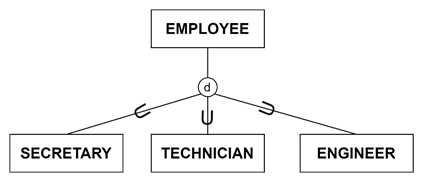
    Specialization is like zooming in on a larger picture to highlight its finer details. Specialization takes a broad category and splits it into meaningful subcategories based on distinguishing attributes or roles. For example, from the EMPLOYEE entity type, we can define subclasses such as SECRETARY, ENGINEER, and TECHNICIAN.

    Specialization in the Extended ER Model

    Types of Specialization

    Specialization could be either attribute-defined or user-defined –

    • Attribute-Defined Specialization − In this type of specialization, the membership in subclasses is determined by the value of a specific attribute in the superclass. Like consider the attribute Job_type in EMPLOYEE. If Job_type = “Technician”, then the employee is part of the TECHNICIAN subclass.
    • User-Defined Specialization − In this type, the subclass membership is manually assigned by users. For example, managers might decide which EMPLOYEES belong to a specific training group.

    Examples of Specialization

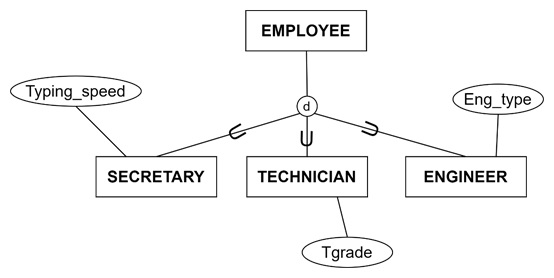
    Let’s consider the company database. EMPLOYEE is specialized into subclasses, such as:

    • SECRETARY with an attribute Typing_speed
    • ENGINEER with an attribute Eng_type
    • TECHNICIAN with attributes like Tgrade
    Examples of Specialization

    These subclasses allow the database to store data more efficiently by associating unique attributes with only the relevant groups.

    Constraints on Specialization

    While working on specializations, we face some constraints. Specialization constraints could be –

    • Disjoint − Entities can belong to only one subclass. Like, an EMPLOYEE cannot simultaneously be a TECHNICIAN and an ENGINEER.
    • Overlapping − Entities can belong to multiple subclasses. For instance, a salaried engineer could belong to both SALARIED_EMPLOYEE and ENGINEER.

    Specializations may also be:

    • Total − Every entity in the superclass must belong to at least one subclass. For example, all EMPLOYEES are either HOURLY_EMPLOYEES or SALARIED_EMPLOYEES.
    • Partial − Some entities may not belong to any subclass. For example, not every EMPLOYEE is a SECRETARY, ENGINEER, or TECHNICIAN.

    What is Generalization in the Extended ER Model?

    Generalization combines multiple entity types into a single, broader entity type by identifying shared characteristics. Generalization is like stepping back to see the bigger picture. It suppresses the differences among entities and emphasizes what they have in common.

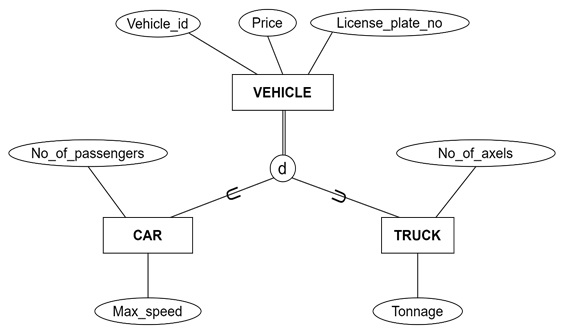
    For instance, in a vehicle database, the CAR and TRUCK share attributes like Vehicle_id and License_plate_no. These can be generalized into a VEHICLE superclass.

    Generalization in the Extended ER Model

    Process of Generalization

    Generalization is simple. All that is needed is to identify common attributes or relationships among two or more entity types. So, we need to define a new superclass that captures these shared features, representing the original entity types as subclasses of the new superclass.

    In the previous transportation database example, we have seen the following –

    Entity Types − CAR and TRUCK

    • CAR has attributes like No_of_passengers.
    • TRUCK has attributes like Tonnage and No_of_axles.

    Here, the VEHICLE includes shared attributes such as Vehicle_id and License_plate_no.

    This approach avoids redundancy by grouping shared data at the superclass level while preserving unique characteristics in the subclasses.

    Combining Specialization and Generalization

    Specialization and generalization are applied within the same database design. These two processes are not mutually exclusive; they are complementary.

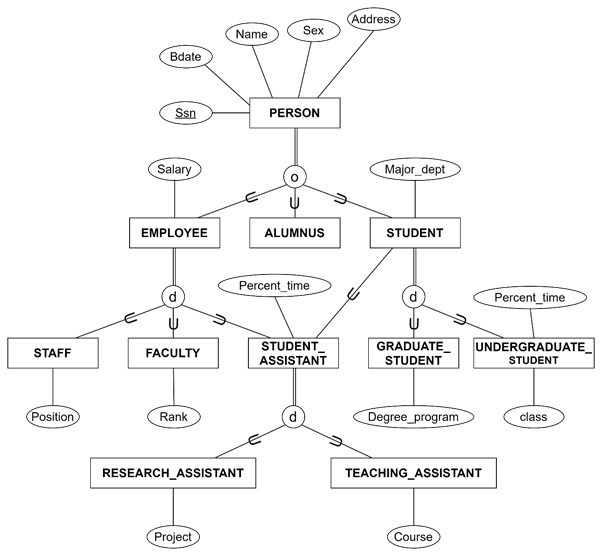
    Consider the university database. Let’s see how specialization and generalization are applied here –

    • Specialization − The PERSON entity type is specialized into STUDENT, EMPLOYEE, and ALUMNUS. EMPLOYEE is further divided into FACULTY, STAFF, and STUDENT_ASSISTANT.
    • Generalization − FACULTY and STAFF are generalized into EMPLOYEE.

    By combining these processes, designers can make a more structured and accurate representation of the data.

    Combining Specialization and Generalization

    Diagrammatic Representation of Specialization and Generalization

    In EER diagrams, we visualize specialization and generalization clearly.

    Specialization − The superclass connects to subclasses through a circle. The lines indicating subclass relationships. Subclass-specific attributes, such as Typing_speed for SECRETARY, are attached to the respective subclass.

    Generalization − The subclasses connect to the generalized superclass. It highlights shared attributes. For instance:

    • In a specialization diagram, EMPLOYEE connects to subclasses like ENGINEER and SECRETARY.
    • In a generalization diagram, CAR and TRUCK converge into a VEHICLE superclass.

    Differences between Specialization and Generalization

    Specialization focuses on highlighting the differences between entities. It breaks down a superclass into specific subclasses. For example: EMPLOYEE → SECRETARY, ENGINEER.

    Generalization emphasizes the commonalities between entities. It combines specific subclasses into a generalized superclass. For example: CAR, TRUCK → VEHICLE.

    Real-World Applications of Specialization and Generalization

    The concepts of specialization and generalization are widely used in various domains:

    Example 1: Company Database

    • Specialization − EMPLOYEE entity type is specialized into categories like SALARIED_EMPLOYEE and HOURLY_EMPLOYEE.
    • Generalization − TEMP_WORKER and PERMANENT_WORKER are generalized into EMPLOYEE.

    Example 2: Vehicle Registration

    • Specialization − VEHICLE entity type is specialized into PASSENGER_CAR and COMMERCIAL_VEHICLE.
    • Generalization − CAR and TRUCK are generalized into VEHICLE.

    Advantages of Specialization and Generalization

    Following are the advantages of using specialization and generalization features in the Extended ER Model –

    • Data Organization − Ensures logical grouping of attributes and relationships, making the database easier to manage.
    • Flexibility − Accommodates both unique and shared characteristics of entities.
    • Efficiency − Reduces redundancy by storing shared attributes in a superclass.
    • Real-World Representation − Mirrors how entities are structured in real life.