Author: saqibkhan

  •  File Handling

    File handling is a very important part of building a desktop application. Almost all desktop apps interact with files.

    We will create a form in our app that will take as input, a Name and an Email address. This form will be saved to a file and a list will be created that will show this as output.

    Set up your main process using the following code in the main.js file −

    const {app, BrowserWindow} = require('electron')
    const url = require('url')
    const path = require('path')
    
    let win
    
    function createWindow() {
       win = new BrowserWindow({width: 800, height: 600})
       win.loadURL(url.format ({
    
      pathname: path.join(__dirname, 'index.html'),
      protocol: 'file:',
      slashes: true
    })) } app.on('ready', createWindow)

    Now open the index.html file and enter the following code in it −

    <!DOCTYPE html>
    <html>
       <head>
    
      &lt;meta charset = "UTF-8"&gt;
      &lt;title&gt;File System&lt;/title&gt;
      &lt;link rel = "stylesheet" 
         href = "./bower_components/bootstrap/dist/css/bootstrap.min.css" /&gt;
      
      &lt;style type = "text/css"&gt;
         #contact-list {
            height: 150px;
            overflow-y: auto;
         }
      &lt;/style&gt;
    </head> <body>
      &lt;div class = "container"&gt;
         &lt;h1&gt;Enter Names and Email addresses of your contacts&lt;/h1&gt;
         &lt;div class = "form-group"&gt;
            &lt;label for = "Name"&gt;Name&lt;/label&gt;
            &lt;input type = "text" name = "Name" value = "" id = "Name" 
               placeholder = "Name" class = "form-control" required&gt;
         &lt;/div&gt;
         
         &lt;div class = "form-group"&gt;
            &lt;label for = "Email"&gt;Email&lt;/label&gt;
            &lt;input type = "email" name = "Email" value = "" id = "Email" 
               placeholder = "Email" class = "form-control" required&gt;
         &lt;/div&gt;
         
         &lt;div class = "form-group"&gt;
            &lt;button class = "btn btn-primary" id = "add-to-list"&gt;Add to list!&lt;/button&gt;
         &lt;/div&gt;
         
         &lt;div id = "contact-list"&gt;
            &lt;table class = "table-striped" id = "contact-table"&gt;
               &lt;tr&gt;
                  &lt;th class = "col-xs-2"&gt;S. No.&lt;/th&gt;
                  &lt;th class = "col-xs-4"&gt;Name&lt;/th&gt;
                  &lt;th class = "col-xs-6"&gt;Email&lt;/th&gt;
               &lt;/tr&gt;
            &lt;/table&gt;
         &lt;/div&gt;
         
         &lt;script src = "./view.js" &gt;&lt;/script&gt;
      &lt;/div&gt;
    </body> </html>

    Now we need to handle the addition event. We will do this in our view.js file.

    We will create a function loadAndDisplayContacts() that will initially load contacts from the file. After creating the loadAndDisplayContacts() function, we will create a click handler on our add to list button. This will add the entry to both the file and the table.

    In your view.js file, enter the following code −

    let $ = require('jquery')
    let fs = require('fs')
    let filename = 'contacts'
    let sno = 0
    
    $('#add-to-list').on('click', () => {
       let name = $('#Name').val()
       let email = $('#Email').val()
    
       fs.appendFile('contacts', name + ',' + email + '\n')
    
       addEntry(name, email)
    })
    
    function addEntry(name, email) {
       if(name && email) {
    
      sno++
      let updateString = '&lt;tr&gt;&lt;td&gt;'+ sno + '&lt;/td&gt;&lt;td&gt;'+ name +'&lt;/td&gt;&lt;td&gt;' 
         + email +'&lt;/td&gt;&lt;/tr&gt;'
      $('#contact-table').append(updateString)
    } } function loadAndDisplayContacts() { //Check if file exists if(fs.existsSync(filename)) {
      let data = fs.readFileSync(filename, 'utf8').split('\n')
      
      data.forEach((contact, index) =&gt; {
         let &#91; name, email ] = contact.split(',')
         addEntry(name, email)
      })
    } else {
      console.log("File Doesn\'t Exist. Creating new file.")
      fs.writeFile(filename, '', (err) =&gt; {
         if(err)
            console.log(err)
      })
    } } loadAndDisplayContacts()

    Now run the application, using the following command −

    $ electron ./main.js
    

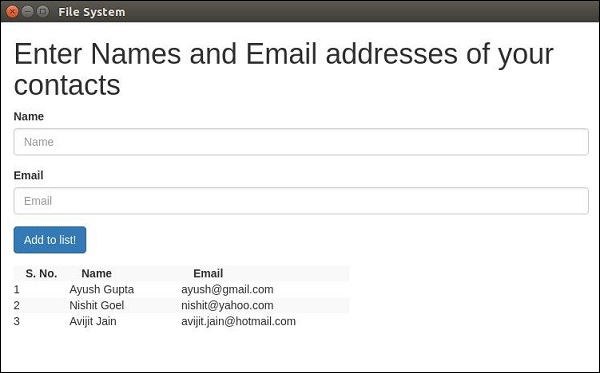
    Once you add some contacts to it, the application will look like −

    File

    For more fs module API calls, please refer to Node File System tutorial.

    Now we can handle files using Electron. We will look at how to call the save and open dialog boxes(native) for files in the dialogs chapter.

  •  Building UIs

    The User Interface of Electron apps is built using HTML, CSS and JS. So we can leverage all the available tools for front-end web development here as well. You can use the tools such as Angular, Backbone, React, Bootstrap, and Foundation, to build the apps.

    You can use Bower to manage these front-end dependencies. Install bower using −

    $ npm install -g bower
    

    Now you can get all the available JS and CSS frameworks, libraries, plugins, etc. using bower. For example, to get the latest stable version of bootstrap, enter the following command −

    $ bower install bootstrap
    

    This will download bootstrap in bower_components. Now you can reference this library in your HTML. Let us create a simple page using these libraries.

    Let us now install jquery using the npm command −

    $ npm install --save jquery
    

    Further, this will be required in our view.js file. We already have a main.js setup as follows −

    const {app, BrowserWindow} = require('electron')
    const url = require('url')
    const path = require('path')
    
    let win
    
    function createWindow() {
       win = new BrowserWindow({width: 800, height: 600})
       win.loadURL(url.format ({
    
      pathname: path.join(__dirname, 'index.html'),
      protocol: 'file:',
      slashes: true
    })) } app.on('ready', createWindow)

    Open your index.html file and enter the following code in it −

    <!DOCTYPE html>
    <html>
       <head>
    
      &lt;meta charset = "UTF-8"&gt;
      &lt;title&gt;Hello World!&lt;/title&gt;
      &lt;link rel = "stylesheet" 
         href = "./bower_components/bootstrap/dist/css/bootstrap.min.css" /&gt;
    </head> <body>
      &lt;div class = "container"&gt;
         &lt;h1&gt;This page is using Bootstrap and jQuery!&lt;/h1&gt;
         &lt;h3 id = "click-counter"&gt;&lt;/h3&gt;
         &lt;button class = "btn btn-success" id = "countbtn"&gt;Click here&lt;/button&gt;
         &lt;script src = "./view.js" &gt;&lt;/script&gt;
      &lt;/div&gt;
    </body> </html>

    Create view.js and enter the click counter logic in it −

    let $ = require('jquery')  // jQuery now loaded and assigned to $
    let count = 0
    $('#click-counter').text(count.toString())
    $('#countbtn').on('click', () => {
       count ++ 
       $('#click-counter').text(count)
    }) 

    Run the app using the following command −

    $ electron ./main.js
    

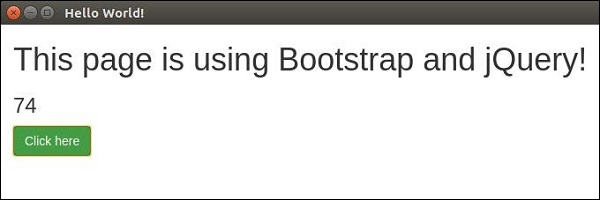
    The above command will generate the output as in the following screenshot −

    UI

    You can build your native app just like you build websites. If you do not want users to be restricted to an exact window size, you can leverage the responsive design and allow users to use your app in a flexible manner

  • How Electron Works

    Electron takes a main file defined in your package.json file and executes it. This main file creates application windows which contain rendered web pages and interaction with the native GUI (graphical user interface) of your Operating System.

    As you start an application using Electron, a main process is created. This main process is responsible for interacting with the native GUI of the Operating System. It creates the GUI of your application.

    Just starting the main process does not give the users of your application any application window. These are created by the main process in the main file by using the BrowserWindow module. Each browser window then runs its own renderer process. The renderer process takes an HTML file which references the usual CSS files, JavaScript files, images, etc. and renders it in the window.

    The main process can access the native GUI through modules available directly in Electron. The desktop application can access all Node modules like the file system module for handling files, request to make HTTP calls, etc.

    Difference between Main and Renderer processes

    The main process creates web pages by creating the BrowserWindow instances. Each BrowserWindow instance runs the web page in its own renderer process. When a BrowserWindow instance is destroyed, the corresponding renderer process is also terminated.

    The main process manages all web pages and their corresponding renderer processes. Each renderer process is isolated and only cares about the web page running in it.

  •  Installation

    To get started with developing using the Electron, you need to have Node and npm(node package manager) installed. If you do not already have these, head over to Node setup to install node on your local system. Confirm that node and npm are installed by running the following commands in your terminal.

    node --version
    npm --version
    

    The above command will generate the following output −

    v6.9.1
    3.10.8
    

    Whenever we create a project using npm, we need to provide a package.json file, which has all the details about our project. npm makes it easy for us to set up this file. Let us set up our development project.

    • Fire up your terminal/cmd, create a new folder named hello-world and open that folder using the cd command.
    • Now to create the package.json file using npm, use the following command.
    npm init
    
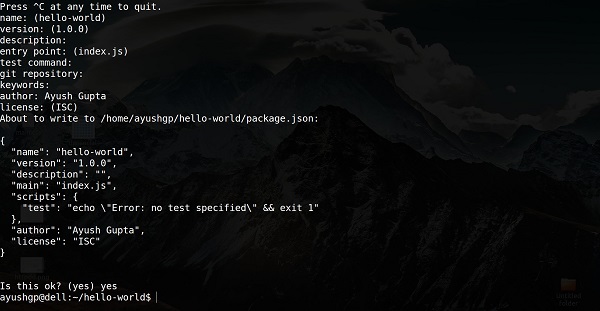
    • It will ask you for the following information −
    Package.json creation

    Just keep pressing Enter, and enter your name at the “author name” field.

    Create a new folder and open it using the cd command. Now run the following command to install Electron globally.

    $ npm install -g electron-prebuilt
    

    Once it executes, you can check if Electron is installed the right way by running the following command −

    $ electron --version
    

    You should get the output −

    v1.4.13
    

    Now that we have set up Electron, let us move on to creating our first app using it.

  •  Overview

    Why Electron?

    Electron enables you to create desktop applications with pure JavaScript by providing a runtime with rich native (operating system) APIs.

    This does not mean Electron is a JavaScript binding to graphical user interface (GUI) libraries. Instead, Electron uses web pages as its GUI, so you can also see it as a minimal Chromium browser, controlled by JavaScript. So all the electron apps are technically web pages running in a browser that can leverage your OS APIs.

    Who Uses Electron?

    Github developed Electron for creating the text editor Atom. They were both open sourced in 2014. Electron is used by many companies like Microsoft, Github, Slack, etc.

    Electron has been used to create a number of apps. Following are a few notable apps −

    • Slack desktop
    • WordPress desktop app
    • Visual Studio Code
    • Caret Markdown Editor
    • Nylas Email App
    • GitKraken git client
  • Materialize CSS Collapsible

    Collapsible or accordion is used to get various predefined visuals and behavioral enhancements to display various types of accordions. Materialize CSS provides different CSS classes to apply these collapsible.

    IndexClass nameDescription
    collapsibleIt is used to identify an element as a materialize collapsible component. Required for ul element.
    collapsible-headerIt is used to set div as a section header.
    collapsible-bodyIt is used to set div as a section content container.
    popoutIt is used to create a popout collapsible.
    activeIt is used to open a section.
    expandableIt is used to mark a collapsible component as expandable.
    accordionIt is used to mark a collapsible component as accordion.

    Example

    Let’s take an example to demonstrate collapsible in Materialize CSS:

    <html>  
    
       <head>  
    
          <title>The Materialize Collapsible Example</title>  
    
          <meta name = "viewport" content = "width = device-width, initial-scale = 1">        
    
          <link rel = "stylesheet"  
    
             href = "https://fonts.googleapis.com/icon?family=Material+Icons">  
    
          <link rel = "stylesheet"  
    
             href = "https://cdnjs.cloudflare.com/ajax/libs/materialize/0.97.3/css/materialize.min.css">  
    
          <script type = "text/javascript"  
    
             src = "https://code.jquery.com/jquery-2.1.1.min.js"></script>             
    
          <script src = "https://cdnjs.cloudflare.com/ajax/libs/materialize/0.97.3/js/materialize.min.js">  
    
          </script>  
    
       </head>  


       <body class = "container">   
    
          <h4>Simple Accordion</h4>  
    
          <ul class = "collapsible" data-collapsible = "accordion">  
    
             <li>  
    
                <div class = "collapsible-header">  
    
                   <i class = "material-icons">filter_drama</i>First Section</div>  
    
                <div class = "collapsible-body"><p>This is first section.</p></div>  
    
             </li>  


             <li>  
    
                <div class = "collapsible-header">  
    
                   <i class = "material-icons">place</i>Second Section</div>  
    
                <div class = "collapsible-body"><p>This is second section.</p></div>  
    
             </li>  


             <li>  
    
                <div class = "collapsible-header">  
    
                   <i class = "material-icons">whatshot</i>Third Section</div>  
    
                <div class = "collapsible-body"><p>This is third section.</p></div>  
    
             </li>  
    
          </ul>  


          <h4>Popout Accordion</h4>  
    
          <ul class = "collapsible popout" data-collapsible = "accordion">  
    
             <li>  
    
                <div class = "collapsible-header">  
    
                   <i class = "material-icons">filter_drama</i>First Section</div>  
    
                <div class = "collapsible-body"><p>This is first section.</p></div>  
    
             </li>  


             <li>  
    
                <div class = "collapsible-header">  
    
                   <i class = "material-icons">place</i>Second Section</div>  
    
                <div class = "collapsible-body"><p>This is second section.</p></div>  
    
             </li>  


             <li>  
    
                <div class = "collapsible-header">  
    
                   <i class = "material-icons">whatshot</i>Third Section</div>  
    
                <div class = "collapsible-body"><p>This is third section.</p></div>  
    
             </li>  
    
          </ul>  


          <h4>Accordion with Preselected Section</h4>  
    
          <ul class = "collapsible" data-collapsible = "accordion">  
    
             <li>  
    
                <div class = "collapsible-header">  
    
                   <i class = "material-icons">filter_drama</i>First Section</div>  
    
                <div class = "collapsible-body"><p>This is first section.</p></div>  
    
             </li>  


             <li>  
    
                <div class = "collapsible-header active">  
    
                   <i class = "material-icons">place</i>Second Section</div>  
    
                <div class = "collapsible-body"><p>This is second section.</p></div>  
    
             </li>  


             <li>  
    
                <div class = "collapsible-header">  
    
                   <i class = "material-icons">whatshot</i>Third Section</div>  
    
                <div class = "collapsible-body"><p>This is third section.</p></div>  
    
             </li>  
    
          </ul>  


          <h4>Expandables</h4>  
    
          <ul class = "collapsible" data-collapsible = "expandable">  
    
             <li>  
    
                <div class = "collapsible-header">  
    
                   <i class = "material-icons">filter_drama</i>First Section</div>  
    
                <div class = "collapsible-body"><p>This is first section.</p></div>  
    
             </li>  


             <li>  
    
                <div class = "collapsible-header">  
    
                   <i class = "material-icons">place</i>Second Section</div>  
    
                <div class = "collapsible-body"><p>This is second section.</p></div>  
    
             </li>  


             <li>  
    
                <div class = "collapsible-header">  
    
                   <i class = "material-icons">whatshot</i>Third Section</div>  
    
                <div class = "collapsible-body"><p>This is third section.</p></div>  
    
             </li>  
    
          </ul>               
    
       </body>    
    
    </html>

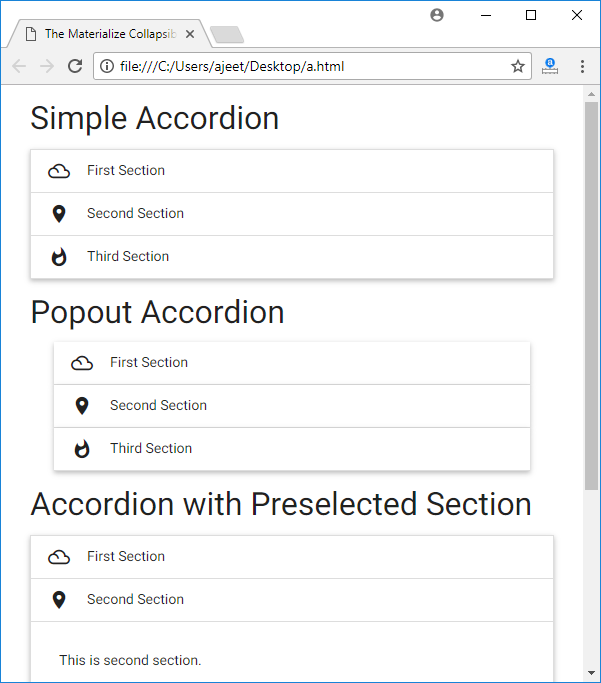
    Output:

    Materialize collapsible 1
  • JavaScript Objects

    What is an Object?

    JavaScript is an object-based language and in JavaScript almost everything is an object or acts like an object. So, to work with JavaScript effectively and efficiently we need to understand how objects work as well as how to create your own objects and use them.

    A JavaScript object is just a collection of named values. These named values are usually referred to as properties of the object. If you remember from the JavaScript arrays chapter, an array is a collection of values, where each value has an index (a numeric key) that starts from zero and increments by one for each value. An object is similar to an array, but the difference is that you define the keys yourself, such as name, age, gender, and so on. In the following sections we’ll learn about objects in detail.

    Creating Objects

    An object can be created with curly brackets {} with an optional list of properties. A property is a “key: value” pair, where the key (or property name) is always a string, and value (or property value) can be any data type, like strings, numbers, Booleans or complex data type like arrays, functions, and other objects. Additionally, properties with functions as their values are often called methods to distinguish them from other properties. A typical JavaScript object may look like this:

    Example

    let person = {
    
    name: "Peter",
    age: 28,
    gender: "Male",
    displayName: function() {
        alert(this.name);
    }
    };

    The above example creates an object called person that has three properties nameage, and gender and one method displayName(). The displayName() method displays the value of this.name, which resolves to person.name. This is the easiest and preferred way to create a new object in JavaScript, which is known as object literals syntax.

    The property names generally do not need to be quoted unless they are reserved words, or if they contain spaces or special characters (anything other than letters, numbers, and the _ and $ characters), or if they start with a number, as shown in the following example:

    Example

    let person = {
    
    "first name": "Peter",
    "current age": 28,
    gender: "Male"
    };

    Note: Since ECMAScript 5, reserved words can be used as object’s property names without quoting. However, you should avoid doing this for better compatibility.


    Accessing Object’s Properties

    To access or get the value of a property, you can use the dot (.), or square bracket ([]) notation, as demonstrated in the following example:

    Example

    let book = {
    
    "name": "Harry Potter and the Goblet of Fire",
    "author": "J. K. Rowling",
    "year": 2000
    }; // Dot notation document.write(book.author); // Prints: J. K. Rowling // Bracket notation document.write(book["year"]); // Prints: 2000

    The dot notation is easier to read and write, but it cannot always be used. If the name of the property is not valid (i.e. if it contains spaces or special characters), you cannot use the dot notation; you’ll have to use bracket notation, as shown in the following example:

    Example

    let book = {
    
    name: "Harry Potter and the Goblet of Fire",
    author: "J. K. Rowling",
    "publication date": "8 July 2000"
    }; // Bracket notation document.write(book["publication date"]); // Prints: 8 July 2000

    The square bracket notation offers much more flexibility than dot notation. It also allows you to specify property names as variables instead of just string literals, as shown in the example below:

    Example

    let person = {
    
    name: "Peter",
    age: 28,
    gender: "Male"
    }; let key = prompt("Enter any property name to get its value"); alert(person[key]); // Outputs: Peter (if enter "name")

    Looping Through Object’s Properties

    You can iterate through the key-value pairs of an object using the for...in loop. This loop is specially optimized for iterating over object’s properties. Here’s an example:

    Example

    let person = {
    
    name: "Peter",
    age: 28,
    gender: "Male"
    }; // Iterating over object properties for(let i in person) {
    document.write(person&#91;i] + "&lt;br&gt;"); // Prints: name, age and gender
    }

    Setting Object’s Properties

    Similarly, you can set the new properties or update the existing one using the dot (.) or bracket ([]) notation, as demonstrated in the following example:

    Example

    let person = {
    
    name: "Peter",
    age: 28,
    gender: "Male"
    }; // Setting a new property person.country = "United States"; document.write(person.country); // Prints: United States person["email"] = "[email protected]"; document.write(person.email); // Prints: [email protected] // Updating existing property person.age = 30; document.write(person.age); // Prints: 30 person["name"] = "Peter Parker"; document.write(person.name); // Prints: Peter Parker

    Deleting Object’s Properties

    The delete operator can be used to completely remove properties from an object. Deleting is the only way to actually remove a property from an object. Setting the property to undefined or null only changes the value of the property. It does not remove property from the object.

    Example

    let person = {
    
    name: "Peter",
    age: 28,
    gender: "Male",
    displayName: function() {
        alert(this.name);
    }
    }; // Deleting property delete person.age; alert(person.age); // Outputs: undefined

    Note: The delete operator only removes an object property or array element. It has no effect on variables or declared functions. However, you should avoid delete operator for deleting an array element, as it doesn’t change the array’s length, it just leaves a hole in the array.


    Calling Object’s Methods

    You can access an object’s method the same way as you would access properties—using the dot notation or using the square bracket notation. Here’s an example:

    Example

    let person = {
    
    name: "Peter",
    age: 28,
    gender: "Male",
    displayName: function() {
        alert(this.name);
    }
    }; person.displayName(); // Outputs: Peter person["displayName"](); // Outputs: Peter

    Manipulating by Value vs. Reference

    JavaScript objects are reference types that mean when you make copies of them, you’re really just copying the references to that object. Whereas primitive values like strings and numbers are assigned or copied as a whole value. To better understand all this, let’s check out the following example:

    Example

    let message = "Hello World!";
    
    let greet = message; // Assign message variable to a new variable
    greet = "Hi, there!";
    
    document.write(message);  // Prints: Hello World!
    document.write(greet);  // Prints: Hi, there!

    In the above example, we have made a copy of a variable message and changed the value of that copy (i.e. variable greet). The two variables remain distinct and separate. But, if we do the same thing with an object, we will get a different result, as you see in the following example:

    Example

    let person = {
    
    name: "Peter",
    age: 28,
    gender: "Male"
    }; let user = person; // Assign person variable to a new variable user.name = "Harry"; document.write(person.name); // Prints: Harry document.write(user.name); // Prints: Harry

    You can clearly see, any changes made to the variable user also change the person variable; it happens because both variables reference the same object. So, simply copying the object does not actually clone it but copies the reference to that object.

  • JavaScript Functions

    What is Function?

    A function is a group of statements that perform specific tasks and can be kept and maintained separately form main program. Functions provide a way to create reusable code packages which are more portable and easier to debug. Here are some advantages of using functions:

    • Functions reduces the repetition of code within a program — Function allows you to extract commonly used block of code into a single component. Now you can perform the same task by calling this function wherever you want within your script without having to copy and paste the same block of code again and again.
    • Functions makes the code much easier to maintain — Since a function created once can be used many times, so any changes made inside a function automatically implemented at all the places without touching the several files.
    • Functions makes it easier to eliminate the errors — When the program is subdivided into functions, if any error occur you know exactly what function causing the error and where to find it. Therefore, fixing errors becomes much easier.

    The following section will show you how to define and call functions in your scripts.

    Defining and Calling a Function

    The declaration of a function start with the function keyword, followed by the name of the function you want to create, followed by parentheses i.e. () and finally place your function’s code between curly brackets {}. Here’s the basic syntax for declaring a function:

    function functionName() {
    // Code to be executed
    }

    Here is a simple example of a function, that will show a hello message:

    Example

    // Defining function
    function sayHello() {
    
    alert("Hello, welcome to this website!");
    } // Calling function sayHello(); // 0utputs: Hello, welcome to this website!

    Once a function is defined it can be called (invoked) from anywhere in the document, by typing its name followed by a set of parentheses, like sayHello() in the example above.

    Note: A function name must start with a letter or underscore character not with a number, optionally followed by the more letters, numbers, or underscore characters. Function names are case sensitive, just like variable names.


    Adding Parameters to Functions

    You can specify parameters when you define your function to accept input values at run time. The parameters work like placeholder variables within a function; they’re replaced at run time by the values (known as argument) provided to the function at the time of invocation.

    Parameters are set on the first line of the function inside the set of parentheses, like this:

    function functionName(parameter1parameter2parameter3) {
    // Code to be executed
    }

    The displaySum() function in the following example takes two numbers as arguments, simply add them together and then display the result in the browser.

    Example

    // Defining function
    function displaySum(num1, num2) {
    
    let total = num1 + num2;
    alert(total);
    } // Calling function displaySum(6, 20); // 0utputs: 26 displaySum(-5, 17); // 0utputs: 12

    You can define as many parameters as you like. However for each parameter you specify, a corresponding argument needs to be passed to the function when it is called, otherwise its value becomes undefined. Let’s consider the following example:

    Example

    // Defining function
    function showFullname(firstName, lastName) {
    
    alert(firstName + " " + lastName);
    } // Calling function showFullname("Clark", "Kent"); // 0utputs: Clark Kent showFullname("John"); // 0utputs: John undefined

    Default Values for Function Parameters ES6

    With ES6, now you can specify default values to the function parameters. This means that if no arguments are provided to function when it is called these default parameters values will be used. This is one of the most awaited features in JavaScript. Here’s an example:

    Example

    function sayHello(name = 'Guest') {
    
    alert('Hello, ' + name);
    } sayHello(); // 0utputs: Hello, Guest sayHello('John'); // 0utputs: Hello, John

    While prior to ES6, to achieve the same we had to write something like this:

    Example

    function sayHello(name) {
    
    let name = name || 'Guest'; 
    alert('Hello, ' + name);
    } sayHello(); // 0utputs: Hello, Guest sayHello('John'); // 0utputs: Hello, John

    To learn about other ES6 features, please check out the JavaScript ES6 features chapter.


    Returning Values from a Function

    A function can return a value back to the script that called the function as a result using the return statement. The value may be of any type, including arrays and objects.

    The return statement usually placed as the last line of the function before the closing curly bracket and ends it with a semicolon, as shown in the following example.

    Example

    // Defining function
    function getSum(num1, num2) {
    
    let total = num1 + num2;
    return total;
    } // Displaying returned value alert(getSum(6, 20)); // 0utputs: 26 alert(getSum(-5, 17)); // 0utputs: 12

    A function can not return multiple values. However, you can obtain similar results by returning an array of values, as demonstrated in the following example.

    Example

    // Defining function
    function divideNumbers(dividend, divisor){
    
    let quotient = dividend / divisor;
    let arr = &#91;dividend, divisor, quotient];
    return arr;
    } // Store returned value in a variable let all = divideNumbers(10, 2); // Displaying individual values alert(all[0]); // 0utputs: 10 alert(all[1]); // 0utputs: 2 alert(all[2]); // 0utputs: 5

    Working with Function Expressions

    The syntax that we’ve used before to create functions is called function declaration. There is another syntax for creating a function that is called a function expression.

    Example

    // Function Declaration
    function getSum(num1, num2) {
    
    let total = num1 + num2;
    return total;
    } // Function Expression let getSum = function(num1, num2) {
    let total = num1 + num2;
    return total;
    };

    Once function expression has been stored in a variable, the variable can be used as a function:

    Example

    let getSum = function(num1, num2) {
    
    let total = num1 + num2;
    return total;
    }; alert(getSum(5, 10)); // 0utputs: 15 let sum = getSum(7, 25); alert(sum); // 0utputs: 32

    Note: There is no need to put a semicolon after the closing curly bracket in a function declaration. But function expressions, on the other hand, should always end with a semicolon.

    Tip: In JavaScript functions can be stored in variables, passed into other functions as arguments, passed out of functions as return values, and constructed at run-time.

    The syntax of the function declaration and function expression looks very similar, but they differ in the way they are evaluated, check out the following example:

    Example

    declaration(); // Outputs: Hi, I'm a function declaration!
    function declaration() {
    
    alert("Hi, I'm a function declaration!");
    } expression(); // Uncaught TypeError: undefined is not a function let expression = function() {
    alert("Hi, I'm a function expression!");
    };

    As you can see in the above example, the function expression threw an exception when it was invoked before it is defined, but the function declaration executed successfully.

    JavaScript parse declaration function before the program executes. Therefore, it doesn’t matter if the program invokes the function before it is defined because JavaScript has hoisted the function to the top of the current scope behind the scenes. The function expression is not evaluated until it is assigned to a variable; therefore, it is still undefined when invoked.

    ES6 has introduced even shorter syntax for writing function expression which is called arrow function, please check out the JavaScript ES6 features chapter to learn more about it.


    Understanding the Variable Scope

    However, you can declare the variables anywhere in JavaScript. But, the location of the declaration determines the extent of a variable’s availability within the JavaScript program i.e. where the variable can be used or accessed. This accessibility is known as variable scope.

    By default, variables declared within a function have local scope that means they cannot be viewed or manipulated from outside of that function, as shown in the example below:

    Example

    // Defining function
    function greetWorld() {
    
    let greet = "Hello World!";
    alert(greet);
    } greetWorld(); // Outputs: Hello World! alert(greet); // Uncaught ReferenceError: greet is not defined

    However, any variables declared in a program outside of a function has global scope i.e. it will be available to all script, whether that script is inside a function or outside. Here’s an example:

    Example

    let greet = "Hello World!";
     
    // Defining function
    function greetWorld() {
    
    alert(greet);
    } greetWorld(); // Outputs: Hello World! alert(greet); // Outputs: Hello World!
  • JavaScript Loops

    Different Types of Loops in JavaScript

    Loops are used to execute the same block of code again and again, as long as a certain condition is met. The basic idea behind a loop is to automate the repetitive tasks within a program to save the time and effort. JavaScript now supports five different types of loops:

    • while — loops through a block of code as long as the condition specified evaluates to true.
    • do…while — loops through a block of code once; then the condition is evaluated. If the condition is true, the statement is repeated as long as the specified condition is true.
    • for — loops through a block of code until the counter reaches a specified number.
    • for…in — loops through the properties of an object.
    • for…of — loops over iterable objects such as arrays, strings, etc.

    In the following sections, we will discuss each of these loop statements in detail.


    The while Loop

    This is the simplest looping statement provided by JavaScript.

    The while loop loops through a block of code as long as the specified condition evaluates to true. As soon as the condition fails, the loop is stopped. The generic syntax of the while loop is:

    while(condition) {
    // Code to be executed
    }

    The following example defines a loop that will continue to run as long as the variable i is less than or equal to 5. The variable i will increase by 1 each time the loop runs:

    Example

    let i = 1;
    while(i <= 5) {    
    
    document.write("&lt;p&gt;The number is " + i + "&lt;/p&gt;");
    i++;
    }

    Note: Make sure that the condition specified in your loop eventually goes false. Otherwise, the loop will never stop iterating which is known as infinite loop. A common mistake is to forget to increment the counter variable (variable i in our case).


    The do…while Loop

    The do-while loop is a variant of the while loop, which evaluates the condition at the end of each loop iteration. With a do-while loop the block of code executed once, and then the condition is evaluated, if the condition is true, the statement is repeated as long as the specified condition evaluated to is true. The generic syntax of the do-while loop is:

    do {
    // Code to be executed
    }
    while(condition);

    The JavaScript code in the following example defines a loop that starts with i=1. It will then print the output and increase the value of variable i by 1. After that the condition is evaluated, and the loop will continue to run as long as the variable i is less than, or equal to 5.

    Example

    let i = 1;
    do {
    
    document.write("&lt;p&gt;The number is " + i + "&lt;/p&gt;");
    i++;
    } while(i <= 5);

    Difference Between while and do…while Loop

    The while loop differs from the do-while loop in one important way — with a while loop, the condition to be evaluated is tested at the beginning of each loop iteration, so if the conditional expression evaluates to false, the loop will never be executed.

    With a do-while loop, on the other hand, the loop will always be executed once even if the conditional expression evaluates to false, because unlike the while loop, the condition is evaluated at the end of the loop iteration rather than the beginning.


    The for Loop

    The for loop repeats a block of code as long as a certain condition is met. It is typically used to execute a block of code for certain number of times. Its syntax is:

    for(initializationconditionincrement) {
    // Code to be executed
    }

    The parameters of the for loop statement have following meanings:

    • initialization — it is used to initialize the counter variables, and evaluated once unconditionally before the first execution of the body of the loop.
    • condition — it is evaluated at the beginning of each iteration. If it evaluates to true, the loop statements execute. If it evaluates to false, the execution of the loop ends.
    • increment — it updates the loop counter with a new value each time the loop runs.

    The following example defines a loop that starts with i=1. The loop will continued until the value of variable i is less than or equal to 5. The variable i will increase by 1 each time the loop runs:

    Example

    for(let i=1; i<=5; i++) {
    
    document.write("&lt;p&gt;The number is " + i + "&lt;/p&gt;");
    }

    The for loop is particularly useful for iterating over an array. The following example will show you how to print each item or element of the JavaScript array.

    Exampl

    // An array with some elements
    let fruits = ["Apple", "Banana", "Mango", "Orange", "Papaya"];
     
    // Loop through all the elements in the array 
    for(let i=0; i<fruits.length; i++) {
    
    document.write("&lt;p&gt;" + fruits&#91;i] + "&lt;/p&gt;");
    }

    The for…in Loop

    The for-in loop is a special type of a loop that iterates over the properties of an object, or the elements of an array. The generic syntax of the for-in loop is:

    for(variable in object) {
    // Code to be executed
    }

    The loop counter i.e. variable in the for-in loop is a string, not a number. It contains the name of current property or the index of the current array element.

    The following example will show you how to loop through all properties of a JavaScript object.

    Example

    // An object with some properties 
    let person = {"name": "Clark", "surname": "Kent", "age": "36"};
     
    // Loop through all the properties in the object  
    for(let prop in person) {  
    
    document.write("&lt;p&gt;" + prop + " = " + person&#91;prop] + "&lt;/p&gt;"); 
    }

    Similarly, you can loop through the elements of an array, like this:

    Example

    // An array with some elements
    let fruits = ["Apple", "Banana", "Mango", "Orange", "Papaya"];
     
    // Loop through all the elements in the array 
    for(let i in fruits) {  
    
    document.write("&lt;p&gt;" + fruits&#91;i] + "&lt;/p&gt;");
    }

    Note: The for-in loop should not be used to iterate over an array where the index order is important. You should better use a for loop with a numeric index.


    The for…of Loop ES6

    ES6 introduces a new for-of loop which allows us to iterate over arrays or other iterable objects (e.g. strings) very easily. Also, the code inside the loop is executed for each element of the iterable object.

    The following example will show you how to loop through arrays and strings using this loop.

    Example

    // Iterating over array
    let letters = ["a", "b", "c", "d", "e", "f"];
    
    for(let letter of letters) {
    
    console.log(letter); // a,b,c,d,e,f
    } // Iterating over string let greet = "Hello World!"; for(let character of greet) {
    console.log(character); // H,e,l,l,o, ,W,o,r,l,d,!
    }

    To learn about other ES6 features, please check out the JavaScript ES6 features chapter.

  • JavaScript Sorting Arrays

    Sorting an Array

    Sorting is a common task when working with arrays. It would be used, for instance, if you want to display the city or county names in alphabetical order.

    The JavaScript Array object has a built-in method sort() for sorting array elements in alphabetical order. The following example demonstrates how it works:

    Example

    let fruits = ["Banana", "Orange", "Apple", "Papaya", "Mango"];
    let sorted = fruits.sort();
    
    alert(fruits); // Outputs: Apple,Banana,Mango,Orange,Papaya
    alert(sorted); // Outputs: Apple,Banana,Mango,Orange,Papaya

    Reversing an Array

    You can use the reverse() method to reverse the order of the elements of an array.

    This method reverses an array in such a way that the first array element becomes the last, and the last array element becomes the first. Here’s an example:

    Example

    let counts = ["one", "two", "three", "four", "five"];
    let reversed = counts.reverse(); 
    
    alert(counts); // Outputs: five,four,three,two,one
    alert(reversed); // Output: five,four,three,two,one

    Note: The sort() and reverse() method modifies the original array and return a reference to the same array, as you can see in the above examples.


    Sorting Numeric Arrays

    The sort() method may produce unexpected result when it is applied on the numeric arrays (i.e. arrays containing numeric values). For instance:

    Example

    let numbers = [5, 20, 10, 75, 50, 100];
    numbers.sort(); // Sorts numbers array
    alert(numbers); // Outputs: 10,100,20,5,50,75

    As you can see, the result is different from what we’ve expected. It happens because, the sort() method sorts the numeric array elements by converting them to strings (i.e. 20 becomes “20”, 100 becomes “100”, and so on), and since the first character of string “20” (i.e. “2”) comes after the first character of string “100” (i.e. “1”), that’s why the value 20 is sorted after the 100.

    To fix this sorting problem with numeric array, you can pass a compare function, like this:

    Example

    let numbers = [5, 20, 10, 75, 50, 100];
    
    // Sorting an array using compare function
    numbers.sort(function(a, b) {
    
    return a - b;
    }); alert(numbers); // Outputs: 5,10,20,50,75,100

    As you can see, this time we’ve got the correct result. Let’s see how it works.

    When compare function is specified, array elements are sorted according to the return value of the compare function. For example, when comparing a and b:

    • If the compare function returns a value less than 0, then a comes first.
    • If the compare function returns a value greater than 0, then b comes first.
    • If the compare function returns 0, a and b remain unchanged with respect to each other, but sorted with respect to all other elements.

    Hence, since 5 - 20 = -15 which is less than 0, therefore 5 comes first, similarly 20 - 10 = 10 which is greater than 0, therefore 10 comes before 20, likewise 20 - 75 = -55 which is less than 0, so 20 comes before 75, similarly 50 comes before 75, and so on.


    Finding the Maximum and Minimum Value in an Array

    You can use the apply() method in combination with the Math.max() and Math.min() to find the maximum and minimum value inside an array, like this:

    Example

    let numbers = [3, -7, 10, 8, 15, 2];
    
    // Defining function to find maximum value
    function findMax(array) {
    
    return Math.max.apply(null, array);
    } // Defining function to find minimum value function findMin(array) {
    return Math.min.apply(null, array);
    } alert(findMax(numbers)); // Outputs: 15 alert(findMin(numbers)); // Outputs: -7

    The apply() method provides a convenient way to pass array values as arguments to a function that accepts multiple arguments in an array-like manner, but not an array (e.g. Math.max() and Math.min() methods here). So, the resulting statement Math.max.apply(null, numbers) in the example above is equivalent to the Math.max(3, -7, 10, 8, 15, 2).


    Sorting an Array of Objects

    The sort() method can also be used for sorting object arrays using the compare function.

    The following example will show you how to sort an array of objects by property values:

    Example

    let persons = [
    
    { name: "Harry", age: 14 },
    { name: "Ethan", age: 30 },
    { name: "Peter", age: 21 },
    { name: "Clark", age: 42 },
    { name: "Alice", age: 16 }
    ]; // Sort by age persons.sort(function (a, b) {
    return a.age - b.age;
    }); console.log(persons); // Sort by name persons.sort(function(a, b) {
    let x = a.name.toLowerCase(); // ignore upper and lowercase
    let y = b.name.toLowerCase(); // ignore upper and lowercase
    if(x &lt; y) {
        return -1;
    }
    if(x &gt; y) {
        return 1;
    }
    // names must be equal
    return 0;
    }); console.log(persons);