Author: saqibkhan

  • How to analyze keywords

    Having access to millions of keyword ideas is all well and good. But how do you know which ones are best? After all, going through them all by hand will be a near-impossible task.

    The solution is simple: Use SEO metrics to narrow things down and separate the wheat from the chaff before adding them to your keyword list.

    Let’s explore four keyword metrics you can use to do this.

    Search volume

    Search volume tells you the average number of times a keyword gets searched per month. For example, “donald trump” has a monthly search volume of 3.1 million in the U.S. alone.
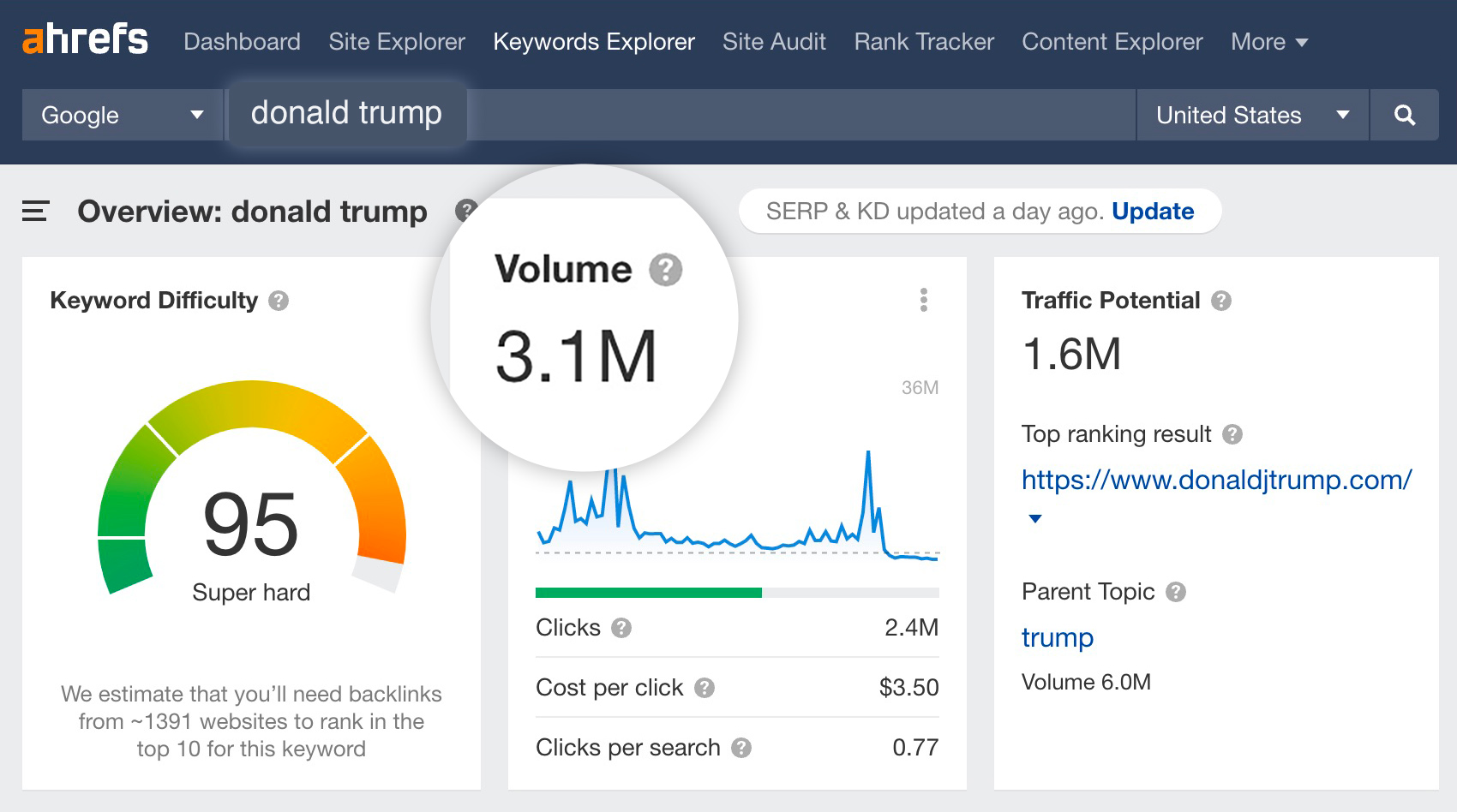
    Overview of "donald trump," via Ahrefs' Keywords Explorer

    There are four important things to know about the search volume metric:

    1. It’s the number of searches, not the number of people who searched – There are cases where someone might search for a keyword multiple times a month (e.g., “weather in singapore”). All such occurrences contribute to the search volume of that keyword, even though it’s the same person making searches.
    2. It doesn’t equal how many visits it will send you if you rank for it – Even if you manage to rank #1, your traffic from that one keyword will rarely exceed 30% of its search volume. And that’s if you’re lucky.
    3. It’s an annual average – If there are 120K searches for a keyword in December and none for the remaining 11 months of the year, its reported monthly search volume will be 10K (120K/12 months).
    4. It’s country-specific – Keyword tools often display search volume for the selected country. But some of them also have an option to show you the global search volume, which is the sum of search volumes across all countries.

    Almost every keyword research tool will have a search volume filter to let you focus on the keyword ideas with a specific range of popularity. It has two main use cases:

    1. Filtering out super high-volume keywords – If your site is new, then you probably don’t want to waste your time looking at keywords with 10K+ monthly searches because they’re likely to be too competitive for you.
    2. Filtering specifically for lower-volume keywords – Perhaps you want to find uncompetitive, low-volume keywords where you can easily get a little bit of traffic. These are often referred to as “long-tail keywords.”

    Long-tail keywords are a household name in SEO. And yet they’re often overlooked. It seems no one wants to go after a keyword unless it gets at least a hundred searches per month. Let alone if it comes up as having zero search volume.
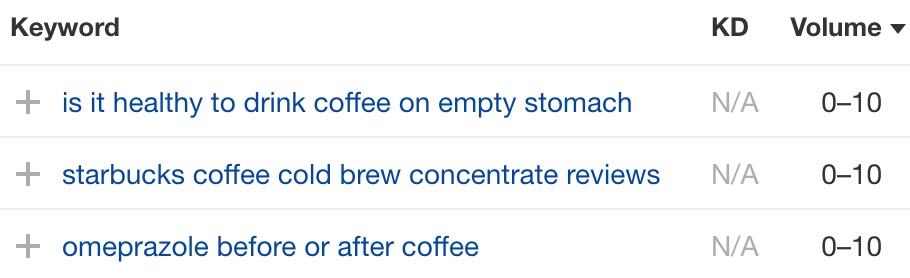
    List of keywords showing corresponding search volume of 0–10

    Such “zero volume” keywords will only bring a few visitors per month if you rank for them. But the thing is they add up! If you publish a hundred articles targeting such keywords, your annual total traffic may actually add up to a few thousand highly targeted visitors.

    It’s a common rookie mistake to disregard low search volume keywords. They’re just as useful as their more popular counterparts. Often even more useful, since they’re more specific and often have high commercial value.

    Another important thing to remember about search volumes is that they may vary slightly from tool to tool. That’s because each tool calculates and updates this metric in different ways. 

    All in all, search volume is an incredibly important metric in SEO. So I highly recommend that you read this dedicated article that I wrote about it.

    KEEP AN EYE ON SEARCH VOLUME TRENDS

    Given that search volume is an annual average, it can often lead you astray in terms of the future search demand of a given search query. If some keyword had a big spike in popularity, this would inflate its average search volume while the popularity might actually decline from there. 
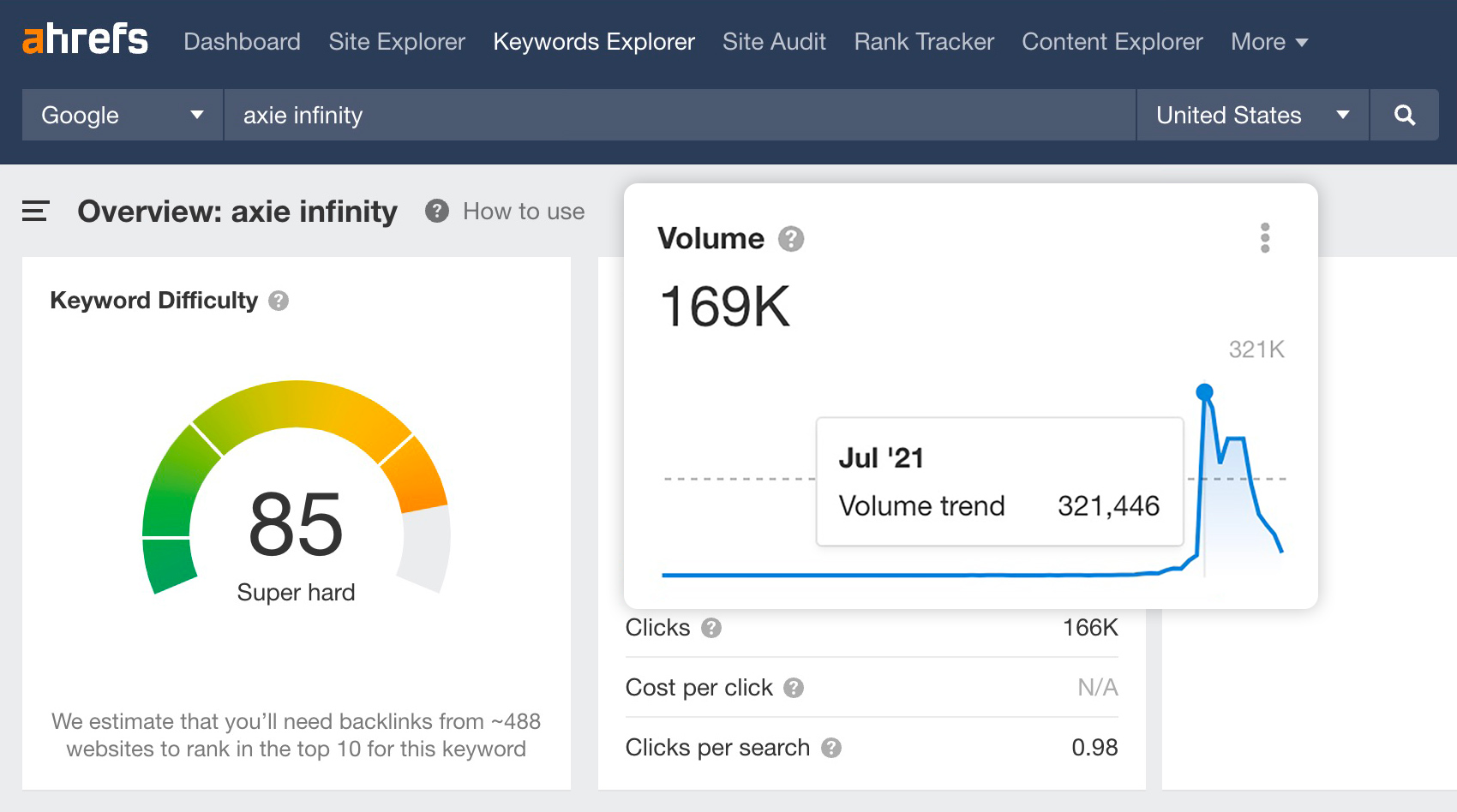
    Overview of "axie infinity," via Ahrefs' Keywords Explorer

    The infamous NFT game, Axie Infinity, had a big spike in search volume in July 2021. But from there, it’s only been going downhill. So even though the annual average search volume is reported as a solid 169K, last month’s search volume was actually just 39K and is likely to drop even further in the coming months.

    If you haven’t heard about it before, Google Trends is a nice free tool for analyzing trending searches. And we have written a pretty extensive guide on how to use it.

    Traffic Potential

    The U.S. search volumes of the following two keywords are nearly equal:
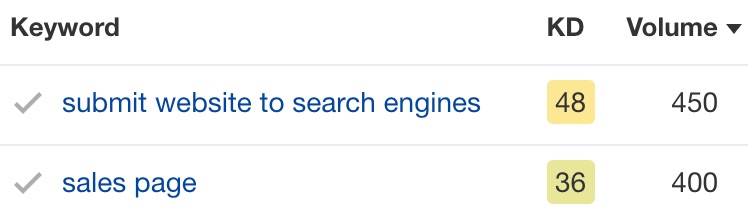
    Two keywords with nearly identical search volumes

    Which means that the amount of search traffic that you may get from targeting each of them should also be nearly equal, right?

    Well, not quite.

    Let’s take the top-ranking pages for each of these keywords and compare how much search traffic they get in the U.S. This can easily be done by copying their URLs into Ahrefs’ Site Explorer.
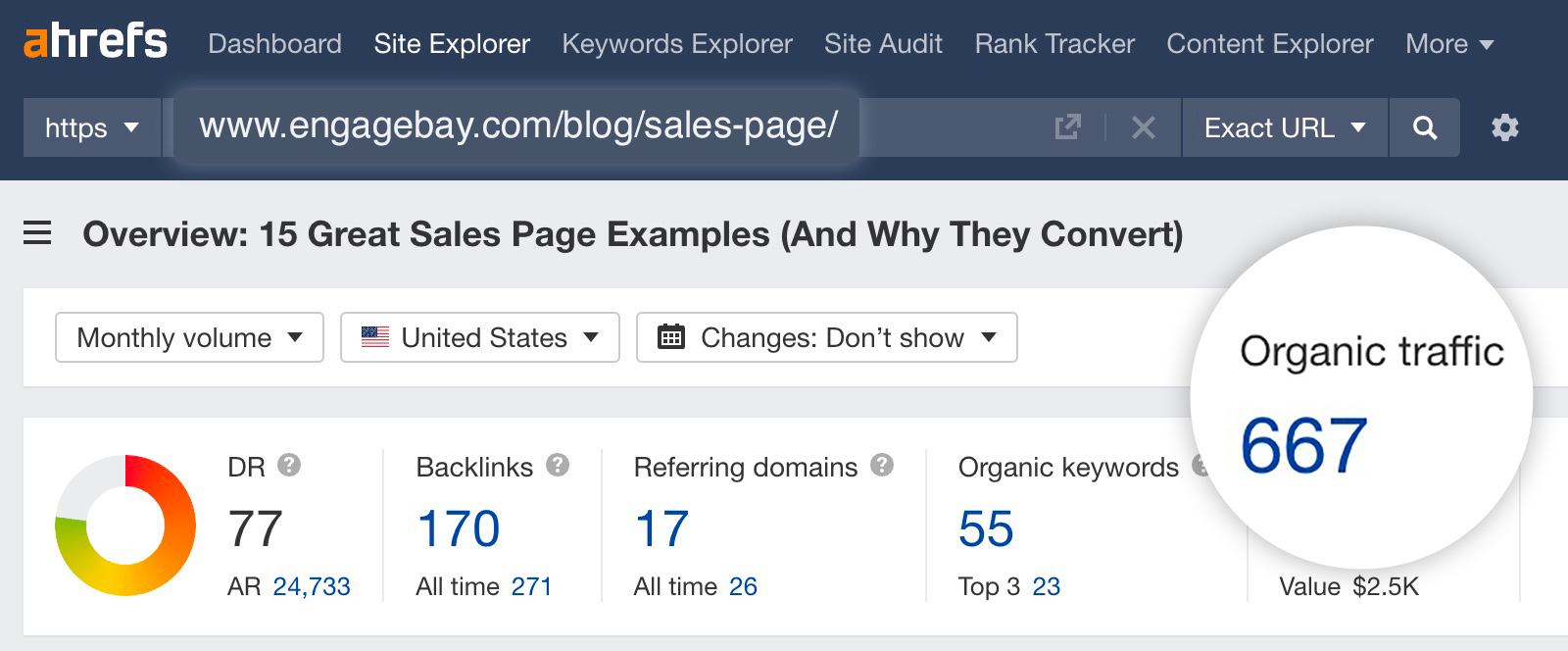
    Overview of a post about sales pages, via Ahrefs' Site Explorer
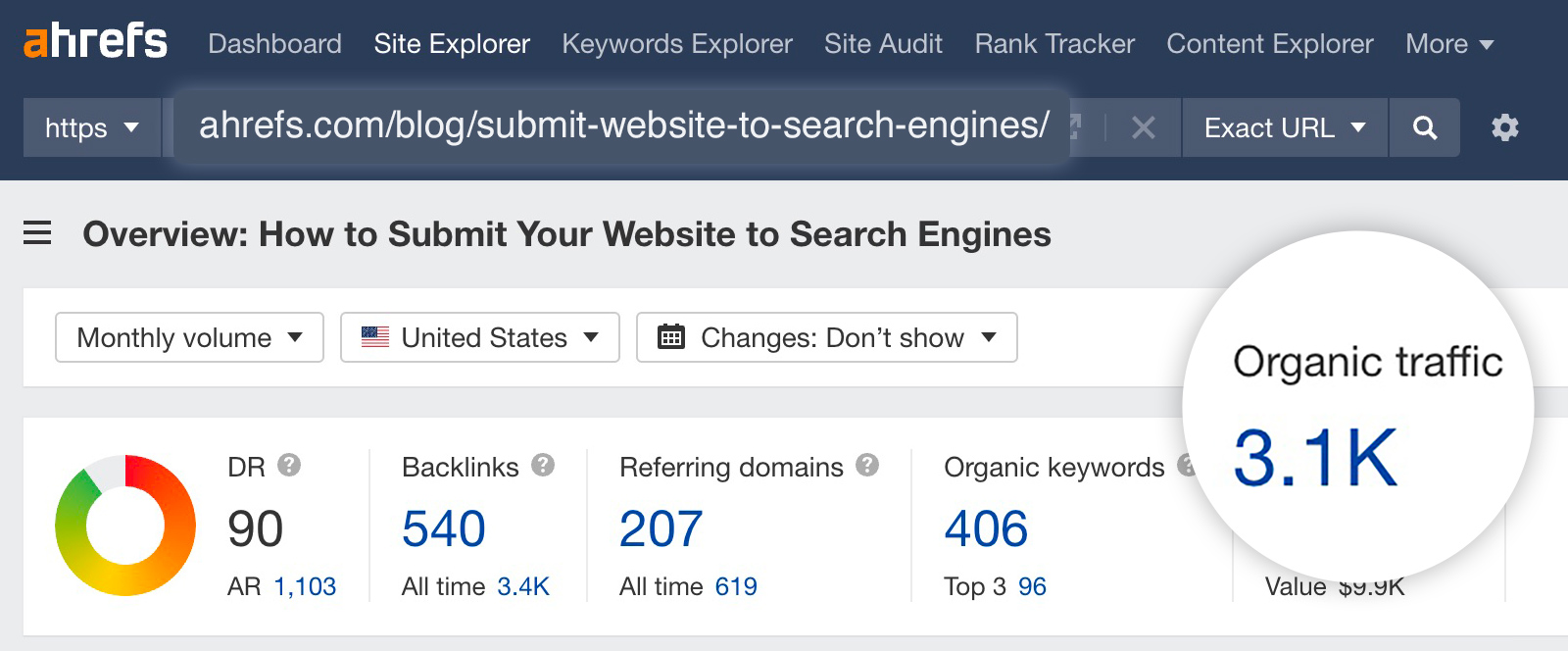
    Overview of an Ahrefs blog post about submitting your website to search engines, via Ahrefs' Site Explorer

    And it turns out that one of these pages is actually getting nearly 5X more search traffic than the other.

    How can that be?

    Well, webpages don’t rank in Google for just a single keyword. If you look at the two screenshots above attentively, you’ll see that the top-ranking page for “sales page” is ranking in Google for 55 keywords (check the “Organic keywords” tile). While the top-ranking page for “submit website to search engines” ranks in Google for a total of 406 different keywords.

    Here are some of them (as seen in the Organic keywords report in Site Explorer):

    Organic keywords report results, via Ahrefs' Site Explorer

    Whatever search query you have in mind, different people will phrase it differently while, essentially, looking for the same thing. Google is smart enough to understand that. And it, therefore, ranks the same page for all these similar search queries.

    We studied this “phenomenon” back in the day, and it turned out that the average top-ranking page would also rank for about a thousand similar keywords.

    This means that you should not blindly rely on the search volume of a single keyword when estimating the search traffic that your page is going to get if it ranks for it. What you need to do instead is examine the top-ranking pages for that keyword and see how much search traffic they get in total from all the variations of that keyword, which they rank for.

    Here at Ahrefs, we thought it was such an important thing to consider when analyzing keywords that we have developed a dedicated metric to address it.

    It’s called “Traffic Potential,” and it shows how much search traffic the top-ranking page for your keyword gets.
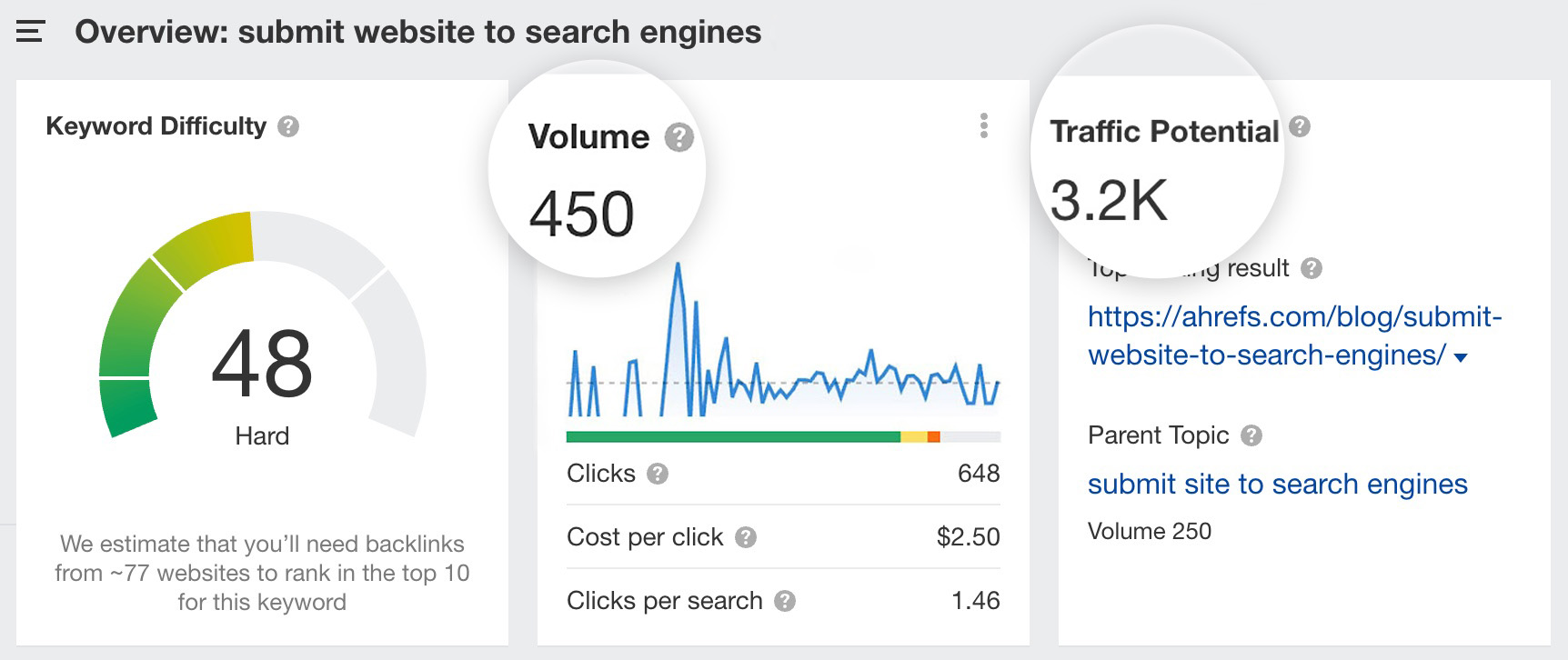
    Overview of "submit website to search engines," via Ahrefs' Keywords Explorer

    In Ahrefs’ Keywords Explorer, the Traffic Potential metric is located right next to the search volume. This saves you lots of time looking up what page ranks #1 for that keyword and how much search traffic it gets in total.

    Both the search volume and Traffic Potential metrics are country-specific, though. So if you need to gauge the worldwide search traffic of a top-ranking page, you’ll need to use Site Explorer with “All countries” mode selected.

    Keyword Difficulty

    Experienced SEO professionals typically gauge the ranking difficulty of each keyword manually. That is, by looking at the search results for each keyword and analyzing them. They account for many different factors to judge how hard or easy it’ll be to rank:

    • Search intent
    • Content depth, relevance, freshness, authority
    • Number (and quality) of backlinks
    • Domain Rating
    • SERP features
    • Etc

    This process varies from person to person, and there’s no consensus on precisely what is and isn’t important here. 

    One person might believe that Domain Rating is important, and another might think that relevance plays more of a role. 

    The opinions might also vary depending on the type of search query that they’re analyzing, because for different kinds of queries Google gives preference to different things.

    All of that makes life a little difficult for SEO tool creators, who try to distill the complex and intricate concept of ranking difficulty down to a simple two-digit number. 

    But after talking to many professional SEOs about the signals that an actionable Keyword Difficulty (KD) score should factor in, we realized that everyone agreed on at least one thing: Backlinks are very important for ranking. 

    So, in the end, we decided to base our Keyword Difficulty (KD) score on the number of unique websites linking to the top 10 ranking pages.
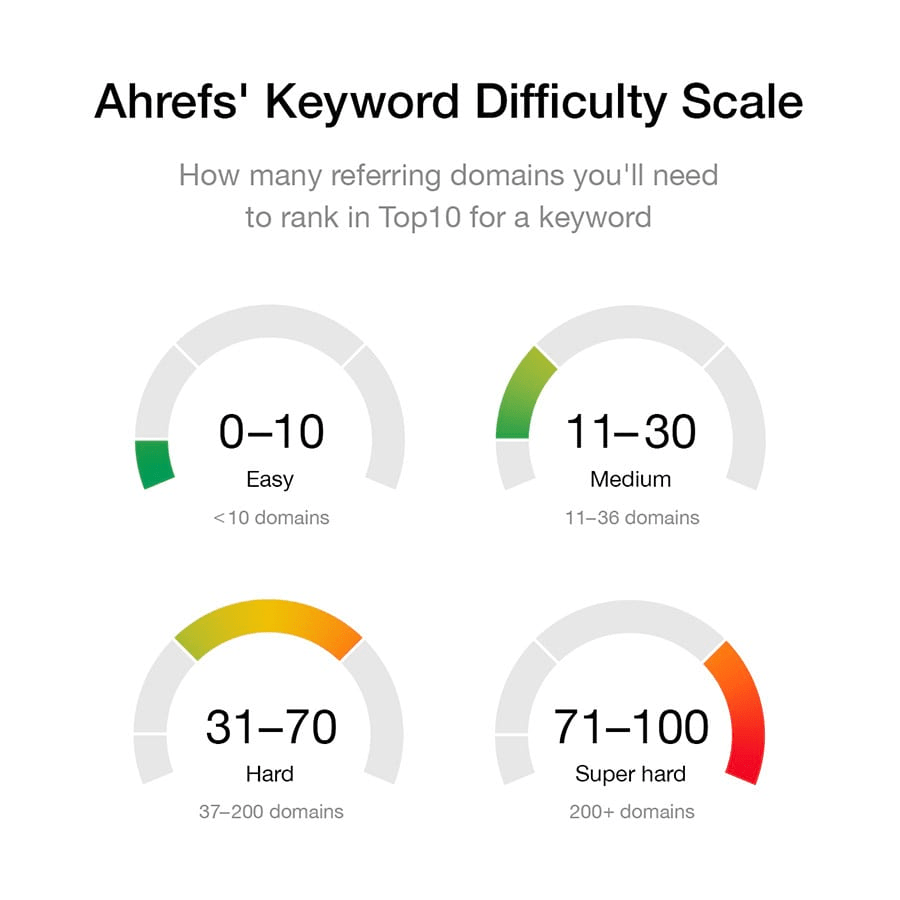
    Infographic showing the four ranges (easy, medium, hard, super hard) of Ahrefs' keyword difficulty scale

    As you can see in the image above, KD relates to the estimated number of linking websites your page needs to rank in the top 10. 

    Did you get that? It’s not the estimated number of linking websites you need to rank #1. It’s the estimated number you need to rank in the top 10. Getting to #1 is an entirely different battle.

    Many people misuse the KD metric by setting the filter from 0 to 10 and focusing solely on the easy keyword ideas. But here’s why avoiding high-KD keywords might be a mistake:

    1. You should go after high-KD keywords sooner, not later – You’ll need lots of backlinks to rank for high-KD keywords, which takes a lot of time and resources. So it pays to create your page and begin promoting it as soon as possible. The sooner you start, the sooner you’ll get there.
    2. Look at high-KD keywords as link opportunities – The fact that the top-ranking pages for some keywords have lots of backlinks is a sign of a “link-worthy” topic. If you create something original on that topic, there’s a good chance lots of people will link to you.

    The bottom line is this: KD is not there to deter you from targeting specific keywords. It’s there to help you understand what it’ll take to rank for a given query (as well as the “link-worthiness” of a given topic).

    Just know that you should always manually assess keywords before going after them and not rely solely on any tool’s difficulty score to make your final decision. No single score can distill the complexity of Google’s ranking algorithm into a single number. Be wary of tool creators who suggest otherwise.

    Cost Per Click (CPC)

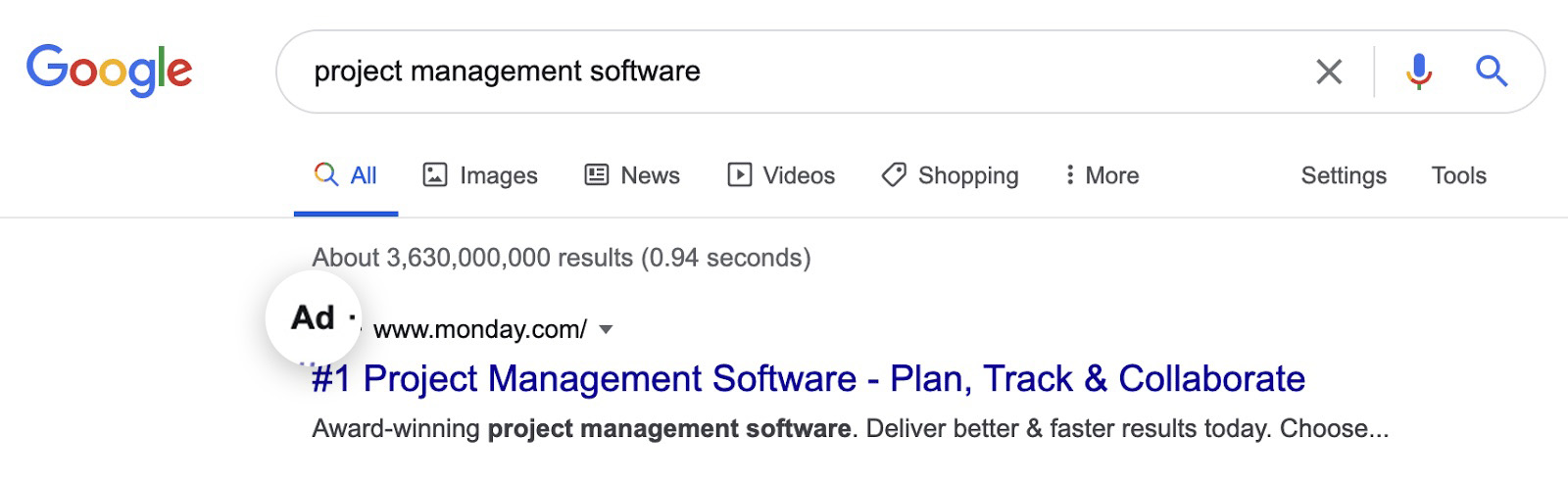
    Cost Per Click (CPC) shows how much advertisers are willing to pay for a click on an ad displayed on top of search results for a given keyword. It’s more a metric for advertisers than SEOs, but it can serve as a useful proxy for a keyword’s value.
    Ad on a Google SERP

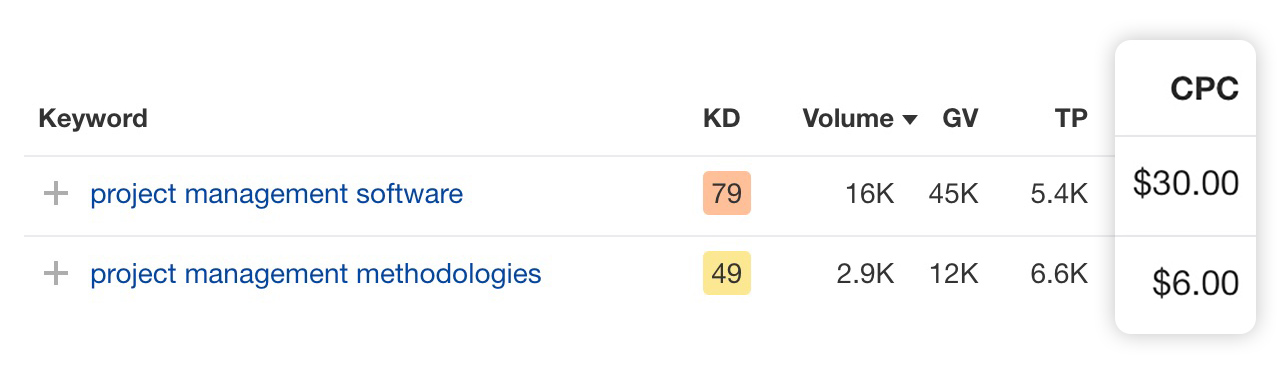
    For example, the keyword “project management software” has a pretty high CPC of $30. That’s because people searching for it seem to be looking for a product to buy. 
    List of two keywords. One with a high CPC, the other with a low CPC

    But it’s a different story for “project management methodologies.” This is clearly an informational search query, and the odds of selling your project management software to these people are not as high—hence, the much lower CPC of $6.

    One important thing to know about CPC is that it’s much more volatile than search volume. While the search demand for most keywords stays roughly the same from month to month, their CPC can change any minute as more companies display ads for them. 

    This means that the CPC values that you see in various SEO tools are merely snapshots in time and aren’t particularly precise. If you want to get real-time CPC data, it is recommended that you use AdWords.
  • How to find keyword ideas

    Keyword research starts from putting yourself in the shoes of your customers. What words and phrases might they use to find solutions to their problems? Plug these into a keyword research tool like Ahrefs’ Keywords Explorer, and you’ll find thousands more relevant keyword ideas on top of what you just brainstormed.

    It’s a simple process, but you need two things to do it well:

    1. Good knowledge of your industry
    2. An understanding of how keyword research tools work

    That’s what this chapter is all about.

    1. Brainstorm “seed” keywords

    Seed keywords are the starting point of your keyword research process. They define your niche and help you identify your competitors. Every keyword research tool asks for a seed keyword, which it then uses to generate a huge list of keyword ideas (more on that shortly).

    If you already have a product or business that you want to promote online, coming up with seed keywords is easy. Just think about what people type into Google to find what you offer.

    For example, if you sell coffee and coffee-making equipment, then your seed keywords might be:

    • coffee
    • cappuccino
    • french press
    • nespresso
    • etc

    Note that seed keywords themselves won’t necessarily be worth targeting with pages on your website. As the name suggests, you’ll use them as “seeds” for the next steps in this process. So don’t obsess too much over your seed keywords. It should only take a few minutes to pinpoint them. As soon as you have a handful of broad ideas related to your website’s topic, move on to the next step.

    2. See what keywords your competitors rank for

    Looking at which keywords already send traffic to your competitors is usually the best way to accelerate your keyword research. But first, you need to identify those competitors. That’s where your brainstormed list of keywords comes in handy. Just search Google for one of your seed keywords and see who ranks on the front page.

    If none of the top-ranking websites for your seed keywords resemble your site (or where you’re trying to take it), then you should try searching for slightly more specific things.

    For example, if you sell coffee-making equipment on your website, you may find more actual competitors in the search results for “cappuccino maker” rather than “cappuccino.” That’s because there are mostly e-commerce stores like yours ranking for the former and blogs ranking for the latter.

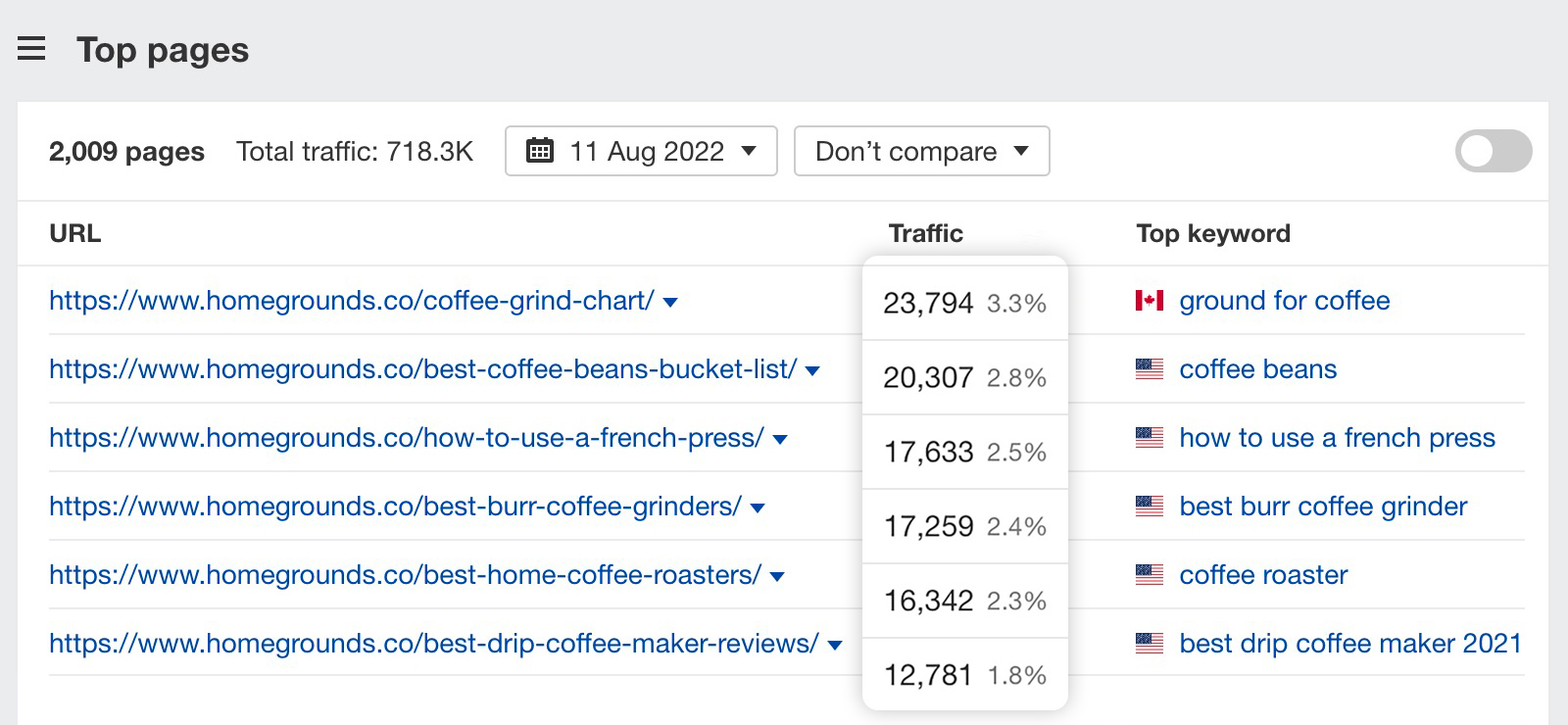
    Once you find a competitor website that fits the bill, you should plug it into a competitive intelligence tool like Ahrefs’ Site Explorer to check which pages bring it the most traffic and what keywords these pages are targeting. 

    Top pages report results, via Ahrefs' Site Explorer

    After repeating the process with a few of your competitors, you’ll find yourself with a pretty sizable list of relevant keywords. And you’ve barely even started your keyword research!

    Whether these keyword ideas are purely informational (i.e., blog articles) or have commercial intent (i.e., product pages) is something we’re going to determine in later stages of our keyword research process. For now, your goal is to collect as many relevant keyword ideas as you can.

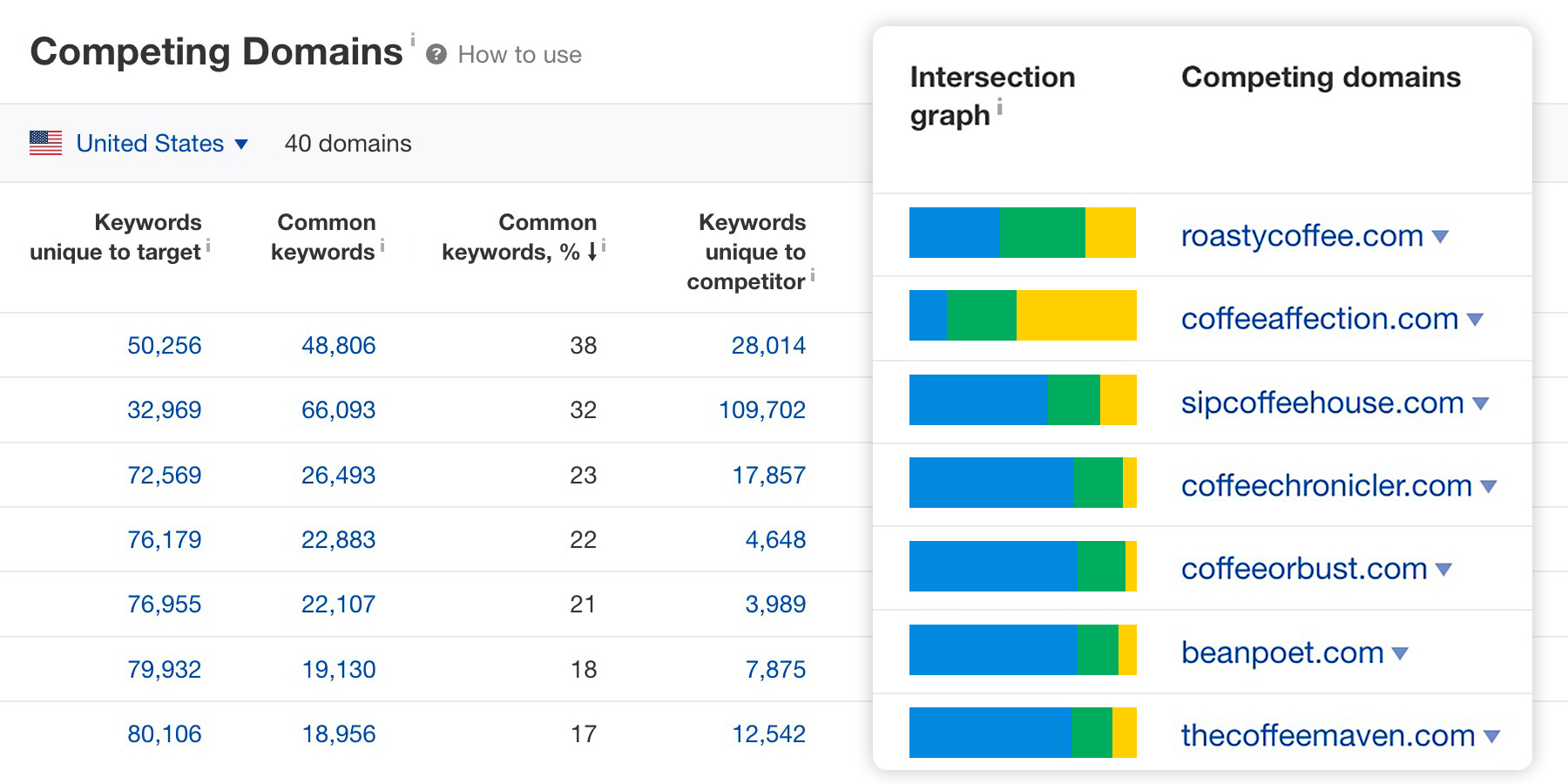
    Make sure to repeat this process for as many competitors as you can. We have a handy report in Site Explorer, which will help you discover more of them. It’s called “Competing Domains” and shows you similar websites to the one you’ve entered based on the common keywords that they rank for in Google.

    Competing Domains report results via Ahrefs' Site Explorer

    ARE YOU SEEING A LOT OF TOPICS YOU’VE ALREADY COVERED?

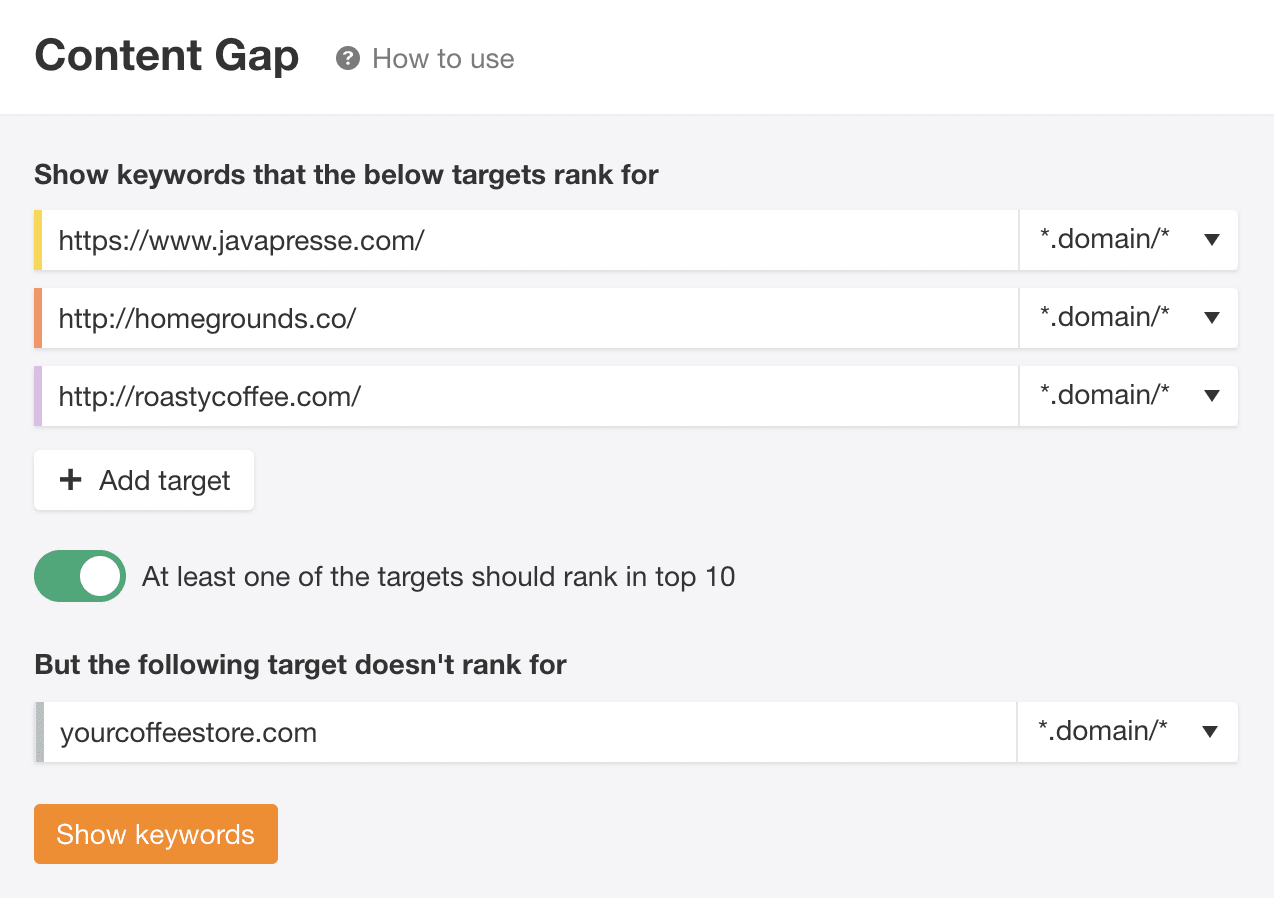
    If you’re doing keyword research for an established website, you may find that you’ve already covered most of your competitors’ keywords. In this case, you should try using the Content Gap report in Ahrefs’ Site Explorer. It finds keywords that one or more of your competitors rank for, but you don’t. 

    To use it, plug a few of your competitors’ websites into the top section, then paste your own site into the bottom field and click “Show keywords.”

    Content Gap tool, via Ahrefs' Site Explorer

    3. Use keyword research tools

    Competitors can be a great source of keyword ideas. But it’s very likely that there are many keywords that your competitors haven’t covered yet. You can find these using various keyword research tools.

    Keyword research tools all work the same way. You plug in a seed keyword, and they pull keyword ideas from their databases based on that keyword.

    Google Keyword Planner (GKP for short) is perhaps the most well-known keyword tool. It’s free to use, and although it’s made for people who want to display paid advertisements in Google, you can also use it to find keywords for SEO purposes.

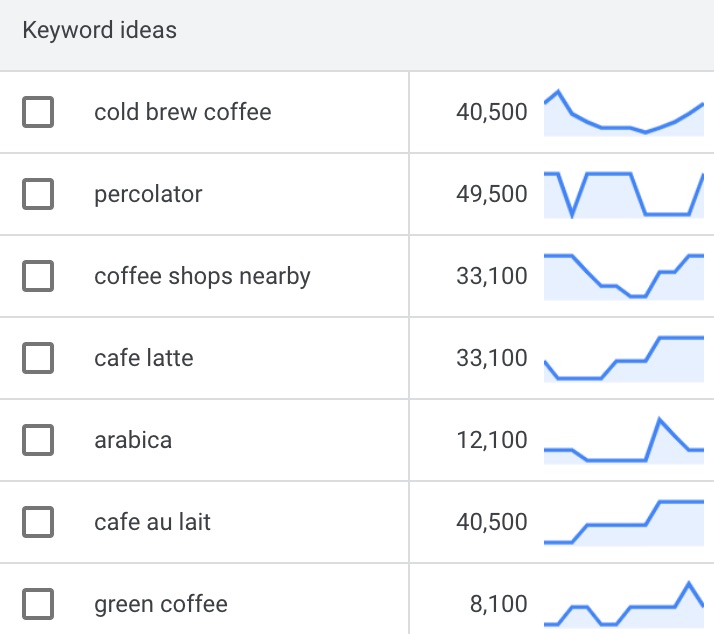
    Here are some keyword ideas that GKP has given me for the seed keyword “coffee”:

    List of keyword ideas, via GKP

    It is important to note that GKP is capable of generating keyword ideas that don’t necessarily contain your seed keyword in them. Take the keyword “percolator,” for example. Unless you’re a hardcore coffee connoisseur, you probably won’t know this relates to coffee. Which makes GKP quite a useful tool for discovering non-obvious keyword ideas.

    And whenever you discover an interesting keyword like that, try using it as your new seed keyword and see what kind of new keyword ideas you’ll get from it.

    Beyond Keyword Planner, there are quite a few other free keyword research tools. These are great if you’re just starting out, but you’ll soon realize that they’re quite limited in terms of data and functionality.

    Thus, if you decide to commit to growing the search traffic to your website, you may as well skip the free tier and use a “professional” keyword research tool. Like Ahrefs’ Keywords Explorer.

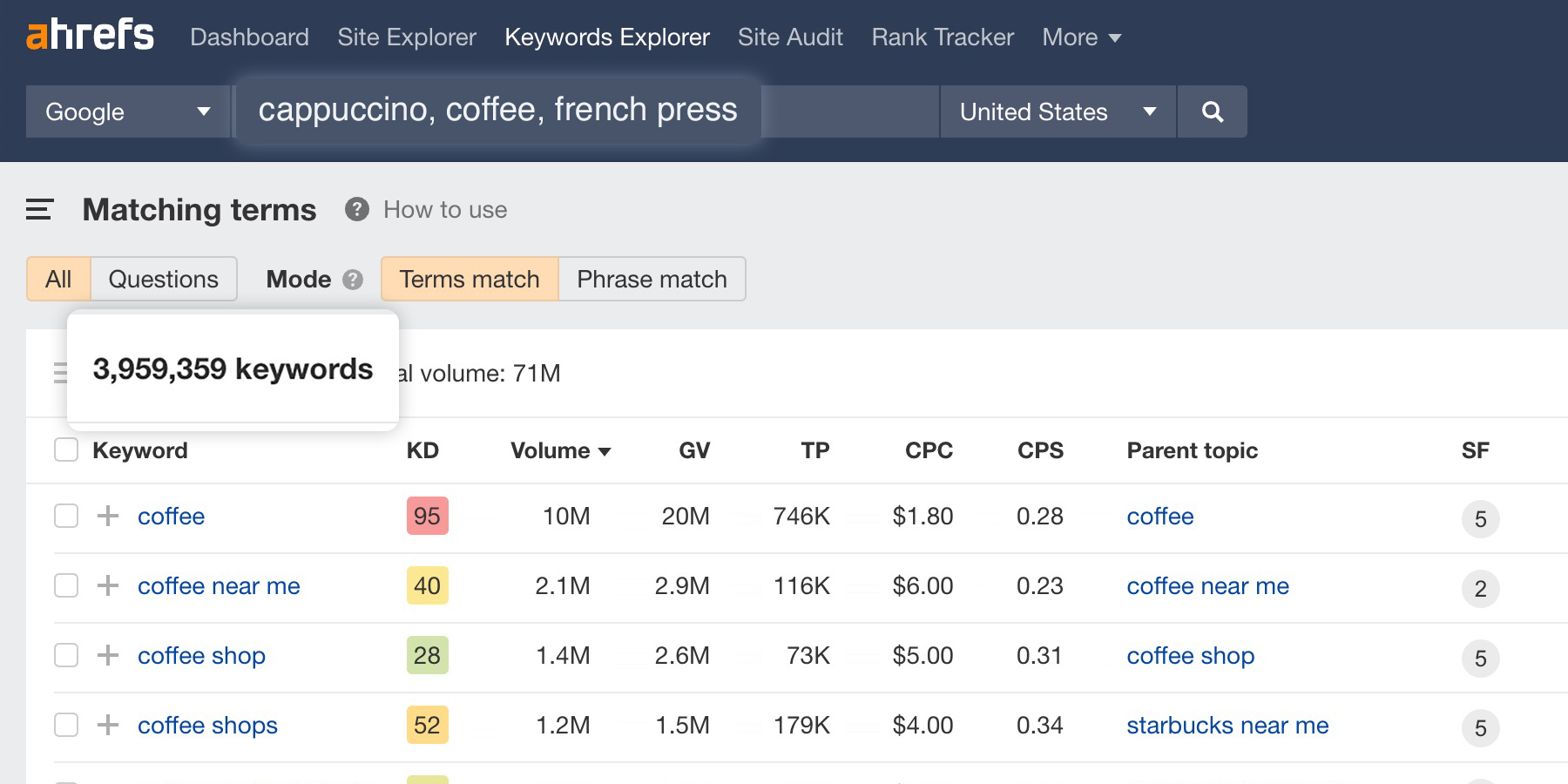
    Let’s enter a few of our seed keywords and see how many keyword ideas it gives us.

    Matching terms report results, via Ahrefs' Keywords Explorer

    3.9 million keywords! No free tool will let you work with such a vast number of keyword ideas.

    That may seem like an overwhelming number of keywords to work with. And it is. But don’t worry. You’ll learn how to narrow them down right in the tool later in this guide.

    For now, let me briefly explain the differences between the two main types of keyword idea reports that we have in Keywords Explorer.

    Matching terms

    This report will only show you the keyword ideas that contain your seed keywords in them. It has two modes: “Terms match” and “Phrase match.”

    “Terms match” shows keyword ideas that contain all words of your seed keyword in them, regardless of where exactly they are and what order they’re in. So if our seed keyword is “coffee machine,”  we’ll get the following keyword ideas:

    • coffee vending machine
    • machine gun kelly coffee shop

    “Phrase match” only returns keyword ideas that have the words of your seed keyword in the exact order as you entered them. Like so:

    • best coffee machine
    • coffee machine with grinder

    Related terms

    This report will show keyword ideas that don’t necessarily contain your seed keywords in them. It also has two modes: “Also rank for” and “Also talk about.”

    • “Also rank for” shows you search queries that the top-ranking pages for your seed keyword also rank for.
    • “Also talk about” shows you words and phrases that are frequently mentioned on the top-ranking pages for your seed keywords.

    4. Study your niche

    Everything we’ve discussed so far is enough to generate an almost unlimited number of keyword ideas. But at the same time, the process kind of keeps you “in the box.”

    You can solve this by going to the places where your target audience hangs out—industry forums, groups, and Q&A sites—and studying their conversations.

    For example, here’s a thread I found on the /r/coffee subreddit:

    Post about AeroPress on /r/coffee subreddit

    A quick check in Keywords Explorer, and I found this search query: “aeropress coffee to water ratio.” It only gets 150 searches per month, but the fact that this topic got 42 upvotes on Reddit means that people really appreciate this knowledge. Plus, the content of that Reddit thread can serve as a foundation for my future piece of content.

    Other than browsing industry forums, your existing customers can also be a great source of keyword ideas. So the next time you talk to them, remember to pay attention to the language they use and the common questions they ask. That might lead you to some original keyword ideas to cover on your website.

  • Keyword research basics

    What is keyword research?

    Keyword research is the process of discovering valuable search queries that your target customers type into search engines like Google to look for products, services, and information. 

    Why is keyword research important?

    If you publish a page on a topic that no one is searching for, that article won’t receive any traffic from Google (or other search engines).

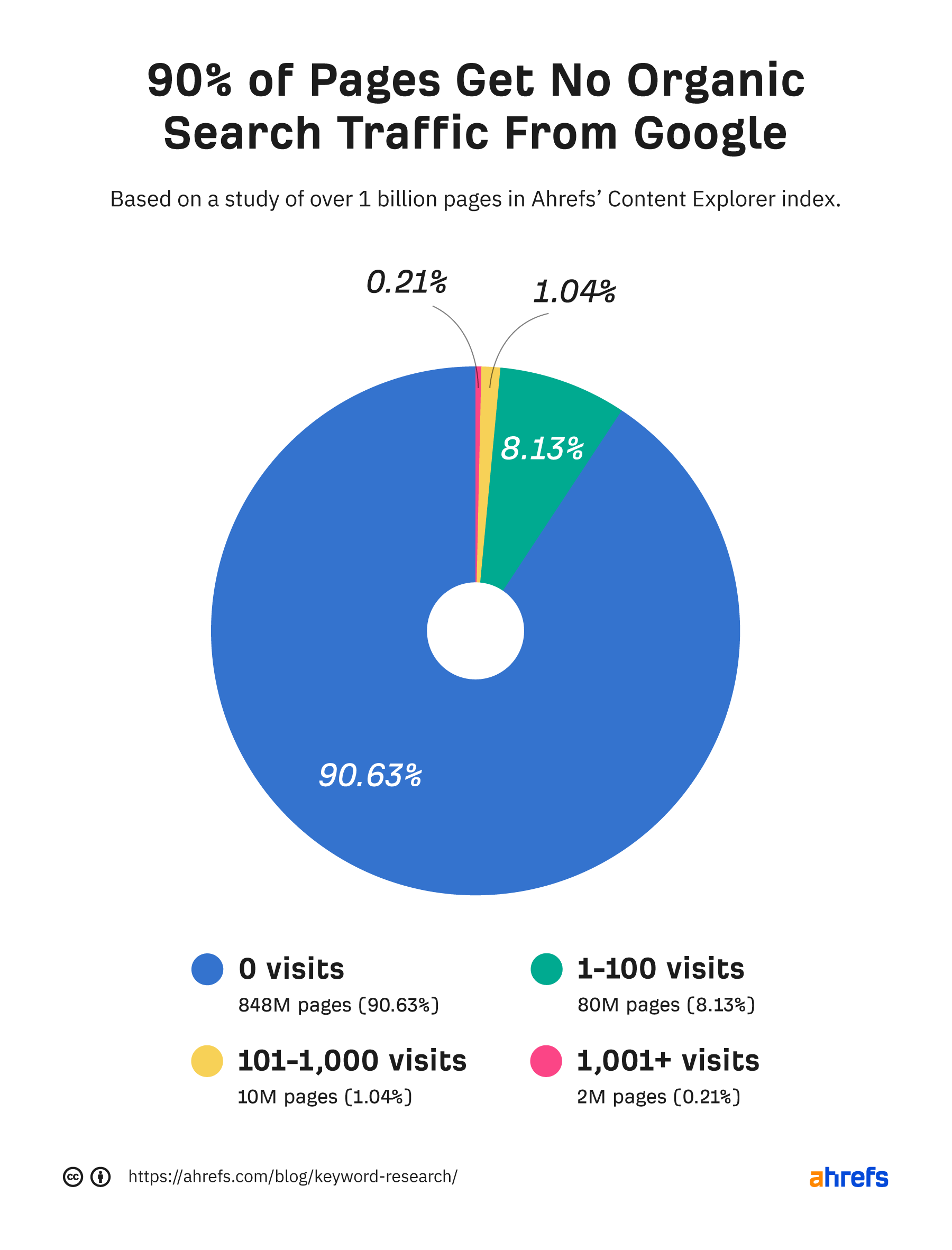
    Many website owners make that mistake, and it’s part of the reason why 90.63% of pages on the internet get no traffic from Google, according to our study.

    Pie chart showing 90.63% of pages get no search traffic from Google

    Keyword research helps you ensure that there is a search demand for whatever you want to write about. Thus, if your page ends up ranking well in Google for its target keyword, you’ll be enjoying a consistent stream of highly targeted visitors to it.

  • How to track SEO success

    Organic traffic

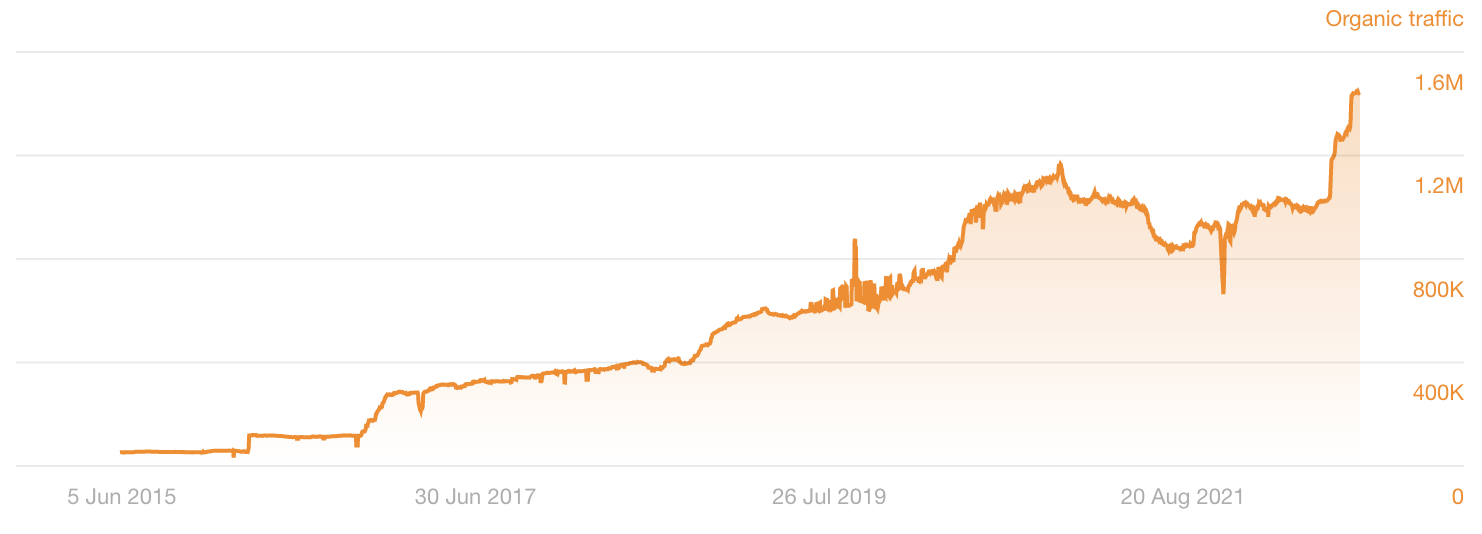
    Let’s start with the obvious one. If organic traffic is going up, you’re doing something right. You can track this in GSC for free. If you don’t have access to GSC, sign up for a free Ahrefs Webmaster Tools (AWT) account. Then plug your domain into Site Explorer for an estimate. 

    Estimated organic search traffic trend via Ahrefs' Site Explorer

    Keyword rankings

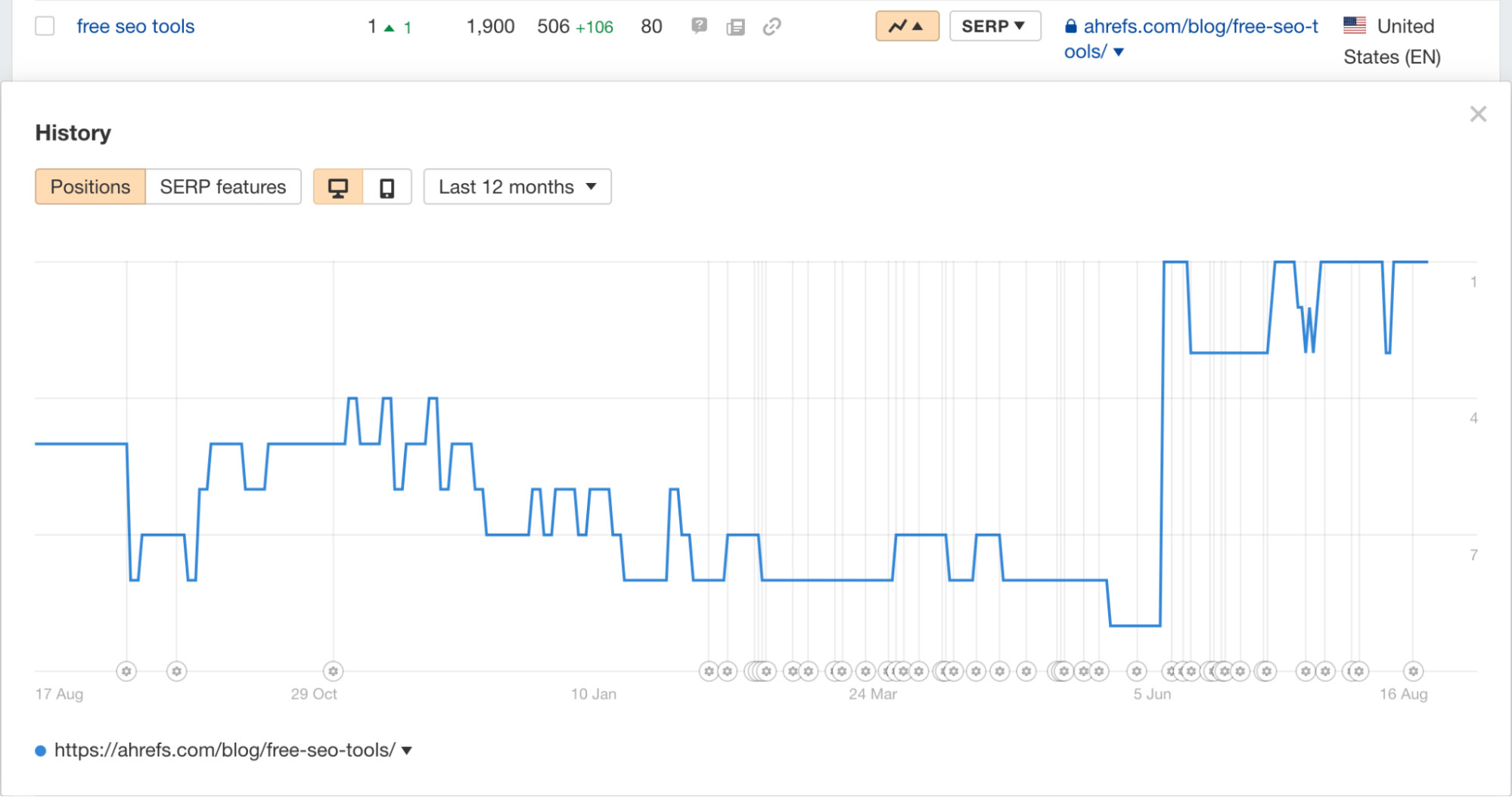
    If rankings are on the rise for your target keywords, that’s another sign that you’re doing something right. You can track average keyword rankings for free in GSC. If you want more accurate tracking, you’ll need a rank tracking tool like Ahrefs’ Rank Tracker.

    Rank tracking in Ahrefs' Rank Tracker

    Did you know?

    Organic traffic and keyword rankings are “vanity metrics.” There’s no harm in keeping an eye on them, but they often bear no relationship with marketing or business goals. It’s much better to track metrics that have actual business impact. We cover two of these below.

    Visibility

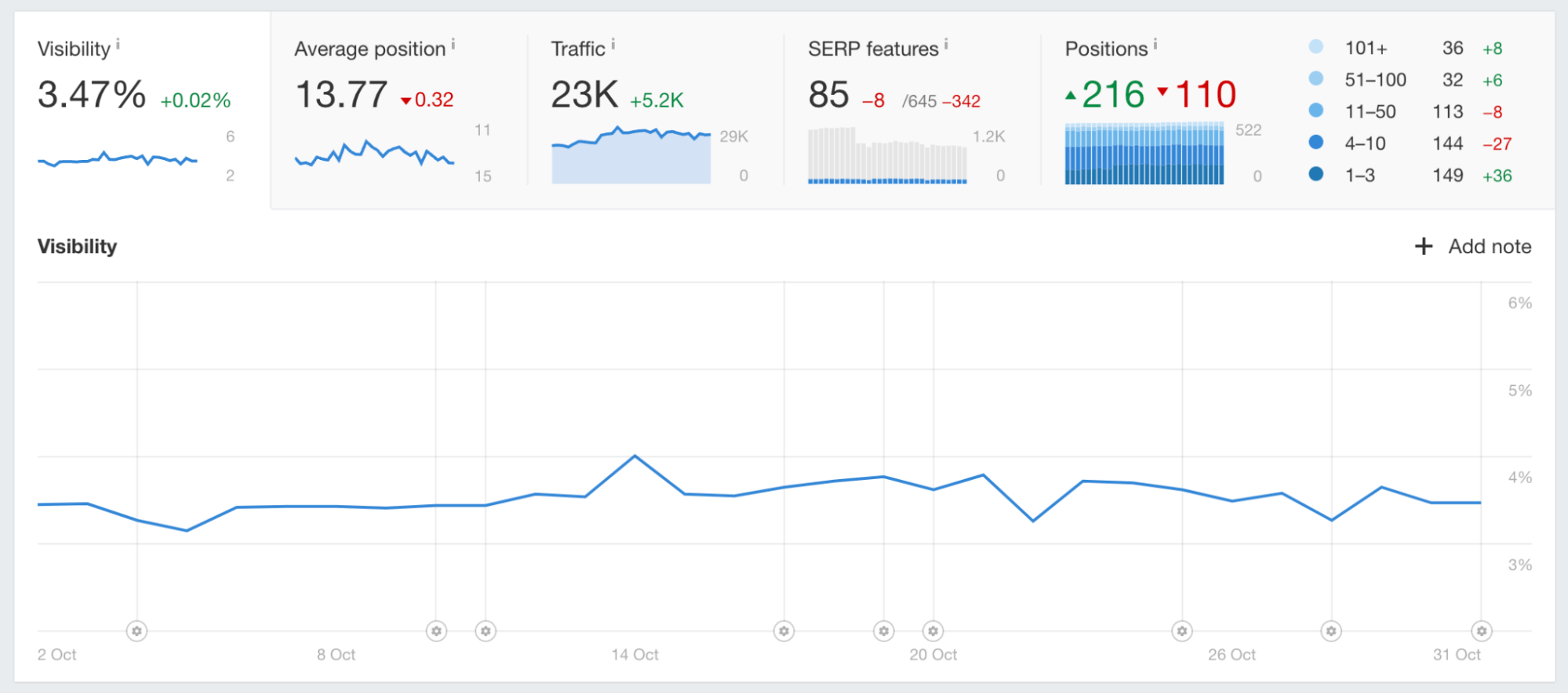
    This metric in Ahrefs’ Rank Tracker shows what percentage of all clicks for the tracked keywords land on your website.

    Visibility in Ahrefs' Rank Tracker

    For example, let’s say you track one keyword, and all the top positions in Google are occupied by pages on your website. Because your website gets all possible traffic from that keyword, your Visibility is 100%.

    Now let’s say your website only occupies one spot in Google, with the rest occupied by competitors. Because some clicks go to other websites, your Visibility is lower than 100%. 

    If your Visibility is increasing, this is yet another good sign your SEO is on the right track.

  • Getting on Google

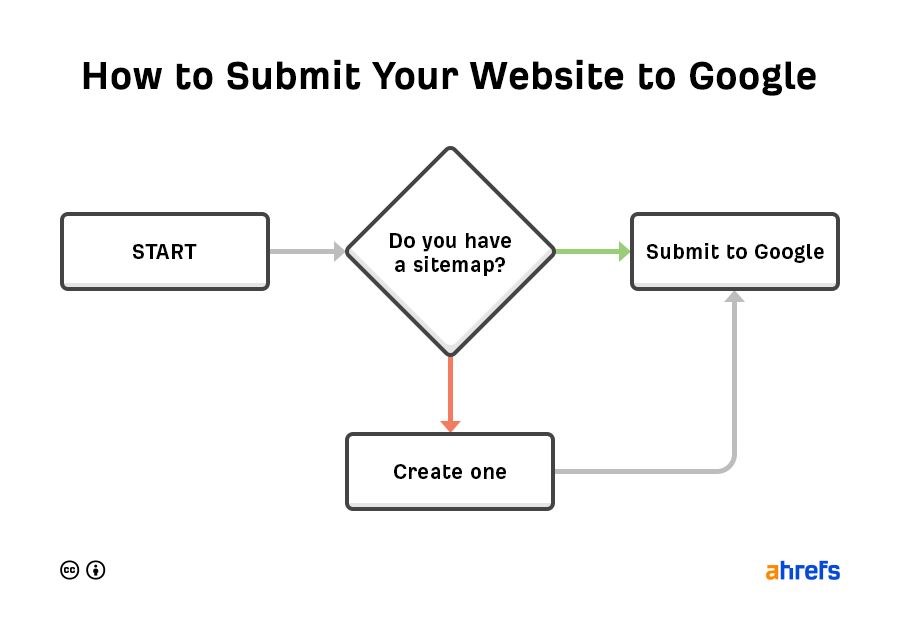
    Having a website set up for SEO success will help Google crawl and index your pages. But submitting your site to Google can speed up this process further. That’s because this helps Google find your website even if it has no backlinks. 

    How to submit your website to Google

    Finding or creating a sitemap

    Sitemaps list the important pages on your website that you want search engines to index. If you already have a sitemap, it’ll likely be at one of these URLs:

    • site.com/sitemap.xml
    • site.com/sitemap_index.xml

    If you can’t find it there, check site.com/robots.txt where it’s usually listed.

    Example of a sitemap listed in robots.txt

    If you still can’t find it, you likely don’t have one and need to create one.

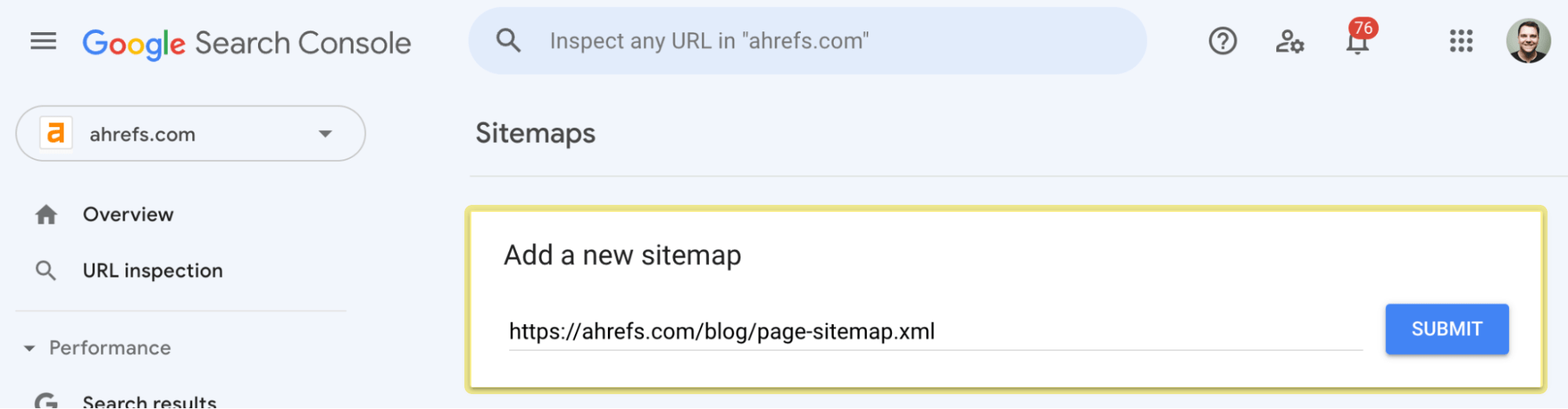
    Submitting your sitemap

    You do this via Google Search Console (GSC). It takes about two seconds.

    How to submit your sitemap to Google
  • Setting up for SEO success

    Get a good domain

    Most domains are fine for SEO, so don’t panic if you already have one. But if you’re still shopping around, keep these two elements of a good domain in mind.

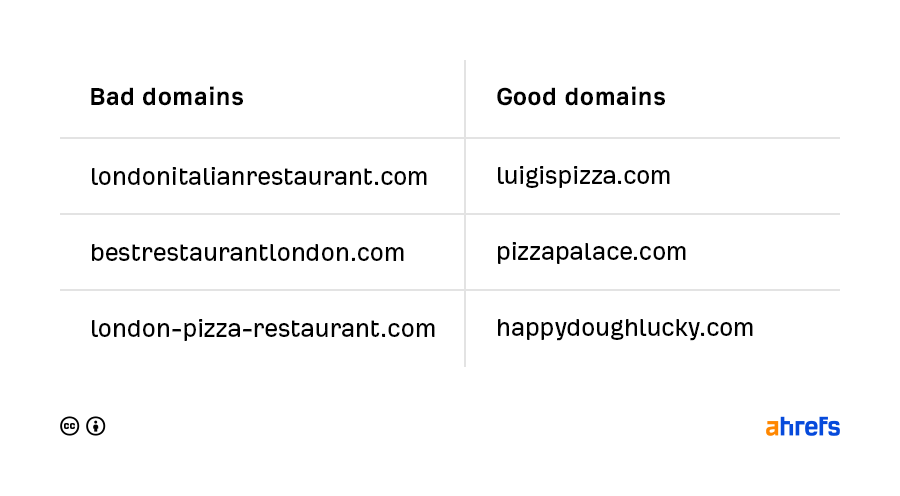
    Domain name

    Something short and memorable is best here. Don’t try to shoehorn keywords. Your business name without hyphens or special characters is usually a good bet.

    Examples of good and bad domains

    Top-level domain (TLD)

    This is the part after the name, like .com. Your choice of TLD makes no difference for SEO.  But we think .com is best for most people, as it’s the most recognizable and trusted. For charities, .org or your local equivalent also works. If you only do business in one country outside the U.S., your country code top-level domain (ccTLD), like .co.uk, is fine too. 

    It’s best to stay clear of TLDs like .info and .biz that people tend to associate with spam. But it’s not the end of the world if you have one. You can still build a legit website that ranks.

    Use a website platform

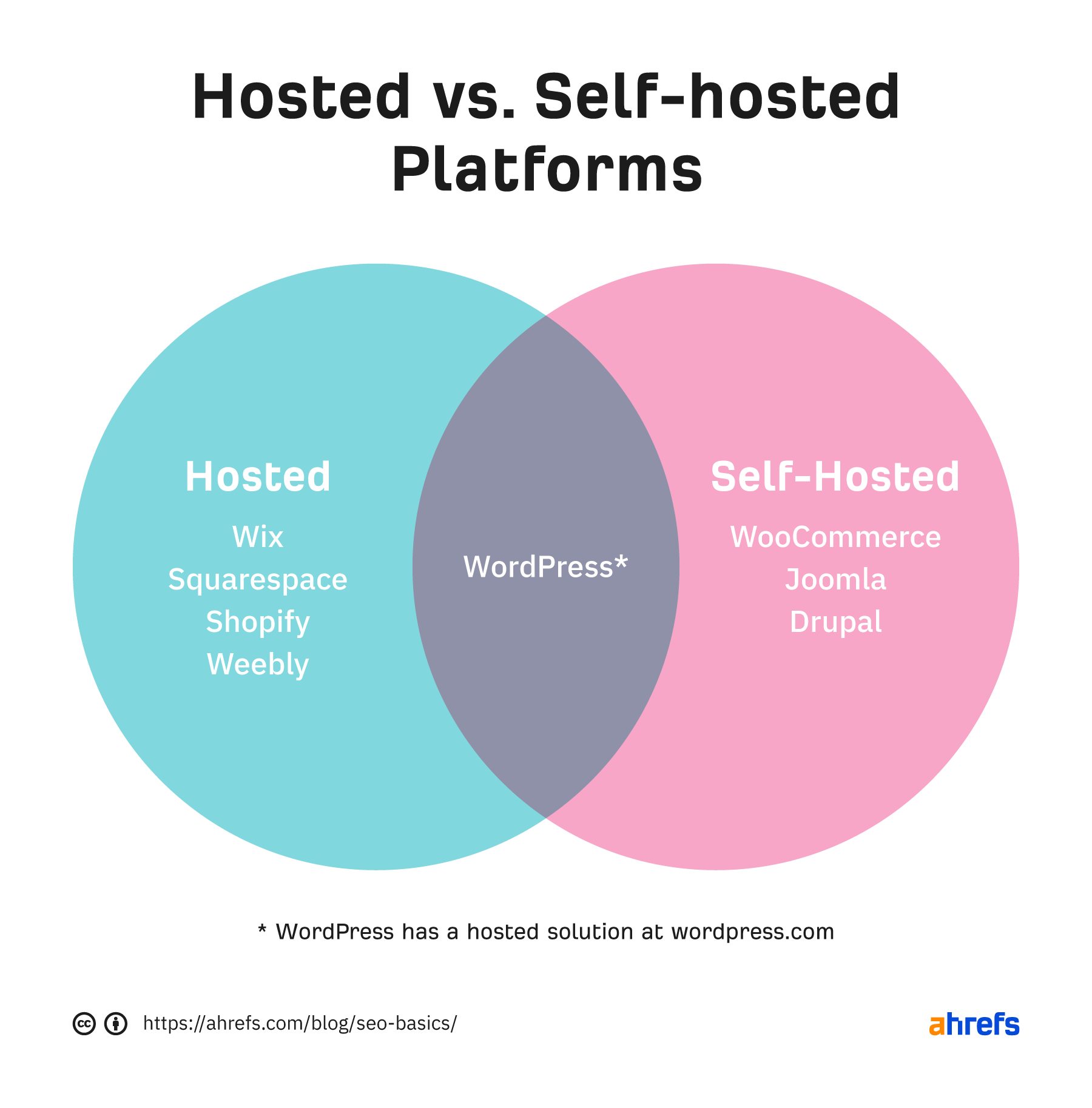
    Website platforms let you create and manage a website with ease. There are two types:

    1. Hosted platforms. Everything’s done for you. They host the site, give you ready-made designs, and let you add and edit content without touching code.
    2. Self-hosted platforms. These also let you add and edit content without code. The difference is that you have to host and install them yourself.
    Examples of hosted vs. self-hosted website platforms

    Most SEOs recommend a self-hosted, open-source platform like WordPress because:

    • It’s customizable. You can edit the open-source code how you like. There’s also a vast community of developers who know the platform inside out.
    • It’s extensible. There are millions of plugins for extending its functionality, including many SEO plugins.

    That said, if you value ease of use and support, a hosted solution might be a better fit. All the big ones provide enough SEO capabilities for most people.

    Use a good web host

    If you’re using a hosted solution, you’ll need a web host. These store your site on a hard drive that anyone with an internet connection can access. Consider the three S’s when choosing one:

    1. Security. Make sure you get a free SSL/TLS certificate. Or, at the very least, support for Let’s Encrypt—a nonprofit supplying free certificates.
    2. Server location. It takes time for data to travel between the server and visitor. So it’s best to choose a host with servers in the same country as most of your traffic.
    3. Support. 24/7 support is ideal. Test how good their support is by asking the above before you sign up.

    DID YOU KNOW?

    You can optimize server location with a content distribution network (CDN). This creates copies of your site on servers around the world so it’s always served from close to the user. So don’t fret about this too much. If you find that speed is an issue, you can invest in a CDN later on.

    Create a positive user experience

    Google wants to rank pages that give visitors a positive experience. Let’s look at a few ways to do this. 

    Use HTTPS

    Nothing is worse for visitors than their personal data being susceptible to hackers. Always encrypt your site with SSL/TLS.

    Choose an appealing design

    Nobody wants to visit a website that looks like it’s from the ’90s. So while there’s no need to redesign your website every few months, it should look good and reflect your brand.

    Make sure it’s mobile-friendly

    More searches are now done on mobile than desktop. So it’s critical that your website is as pleasant to use on mobile as on desktop.

    Use a readable font size

    People browse the web using all kinds of devices. Make sure your content is readable across the board.

    Avoid intrusive pop-ups and ads

    Everyone hates ads, but sometimes you need them. If that’s the case, avoid intrusive interstitials. Pages with these may not rank as highly.

    Make sure it loads fast

    Page speed is a ranking factor on desktop and mobile. But this doesn’t mean your site needs to load lightning fast. It only affects pages that deliver the slowest experience to users.

    Create a logical site structure

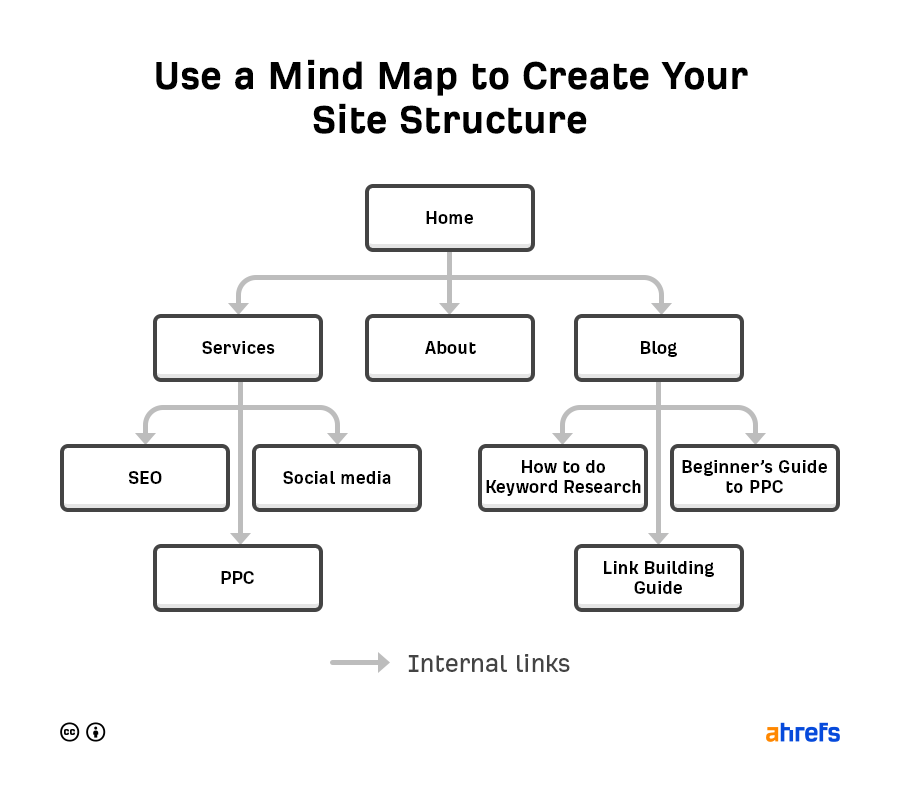
    It should be easy for visitors and search engines to find content on your site. That’s why it’s important to create a logical hierarchy for your content. You can do this by sketching a mind map.

    How to structure your website

    Each branch on the map becomes an internal link, which is a link from one page on a website to another. 

    Internal links are crucial for UX and SEO for a few reasons:

    • They help search engines find new pages. Google can’t index pages it can’t find. 
    • They help pass PageRank around your site. PageRank is the foundation of Google search. It judges the quality of a page by analyzing the quantity and quality of links that point to it. It’s still used by Google today.
    • They help search engines understand what your page is about. Google looks at the clickable words in the link for this, otherwise known as anchor text.

    Use a logical URL structure

    URLs are important, as they help searchers understand the content and context of a page. Many website platforms let you choose how to structure your URLs. These are the five main options for URLs in WordPress:

    • Plain: website.com/?p=123
    • Day and name: website.com/2021/03/04/seo-basics/
    • Month and name: website.com/03/04/seo-basics/
    • Numeric: website.com/865/
    • Post name: website.com/seo-basics/

    If you’re setting up a new site, go with the clearest and most descriptive structure. That’s post name. If you’re working with an existing website, it’s rarely a good idea to change the URL structure; it may break things.

    Install an SEO plugin

    Most website platforms handle basic SEO functionality out of the box. But if you’re using WordPress, install an SEO plugin. It’s hard to put even basic SEO best practices in place without one. Both Yoast and Rank Math are good options.

  • SEO fundamentals

    What is SEO?

    Search engine optimization (SEO) is the process of growing a website’s organic search traffic. It’s where you do things that help you show up and rank higher in a search engine’s organic results.

    Why is SEO important?

    People are likely searching for what you do, and you can attract customers by ranking for those terms. But you’re unlikely to rank without effort, as others are trying to do the same. This is why SEO matters. It helps show Google that you most deserve to rank.

    What are the benefits of SEO?

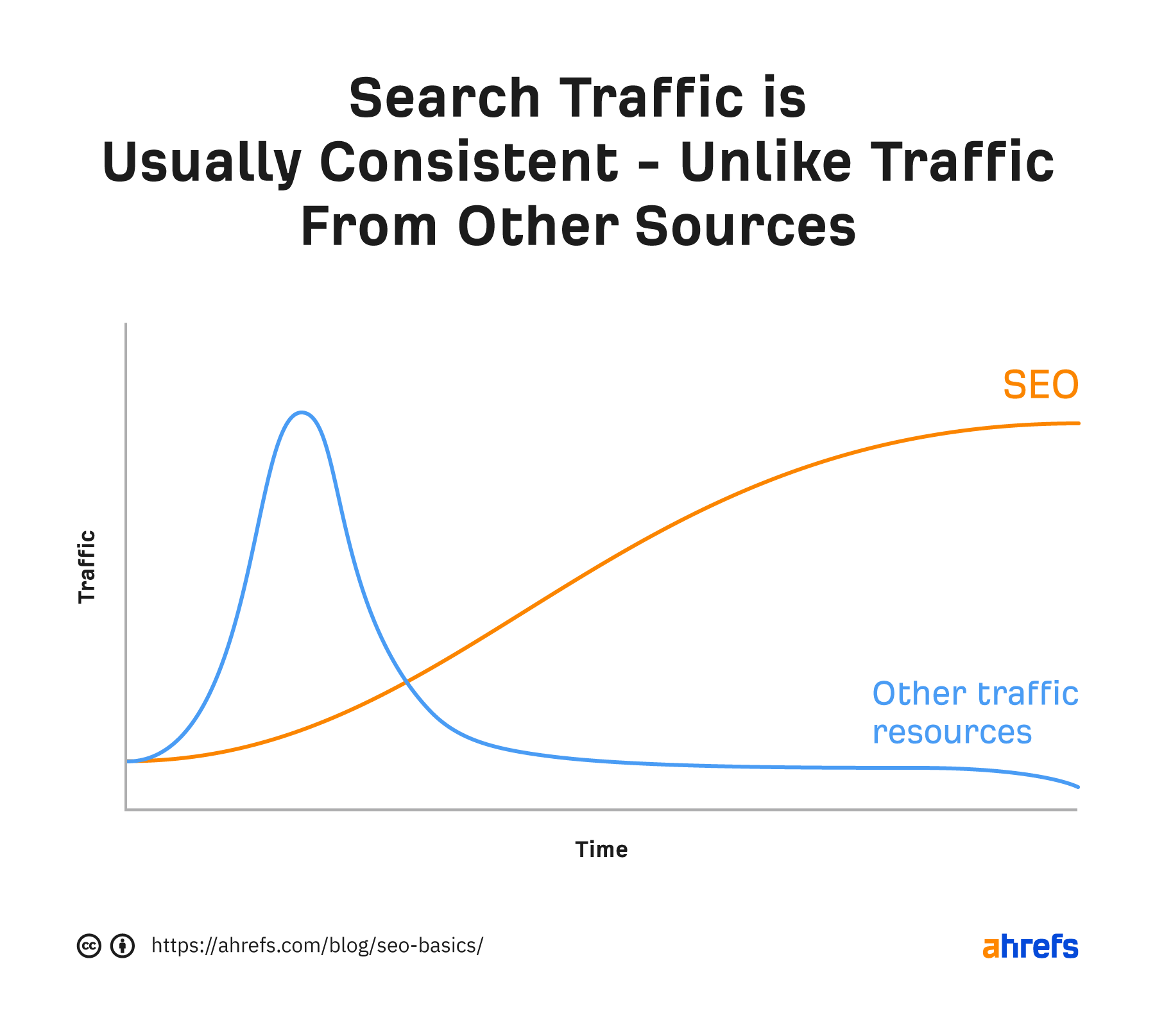
    Most people click one of the first few search results, so higher rankings usually lead to more traffic. Unlike other channels, search traffic tends to be consistent and passive. That’s because the number of searches is usually quite consistent month to month.

    How traffic from search compares to traffic from other traffic sources

    Search traffic is also “free.” That’s a big deal because ads can be expensive. 

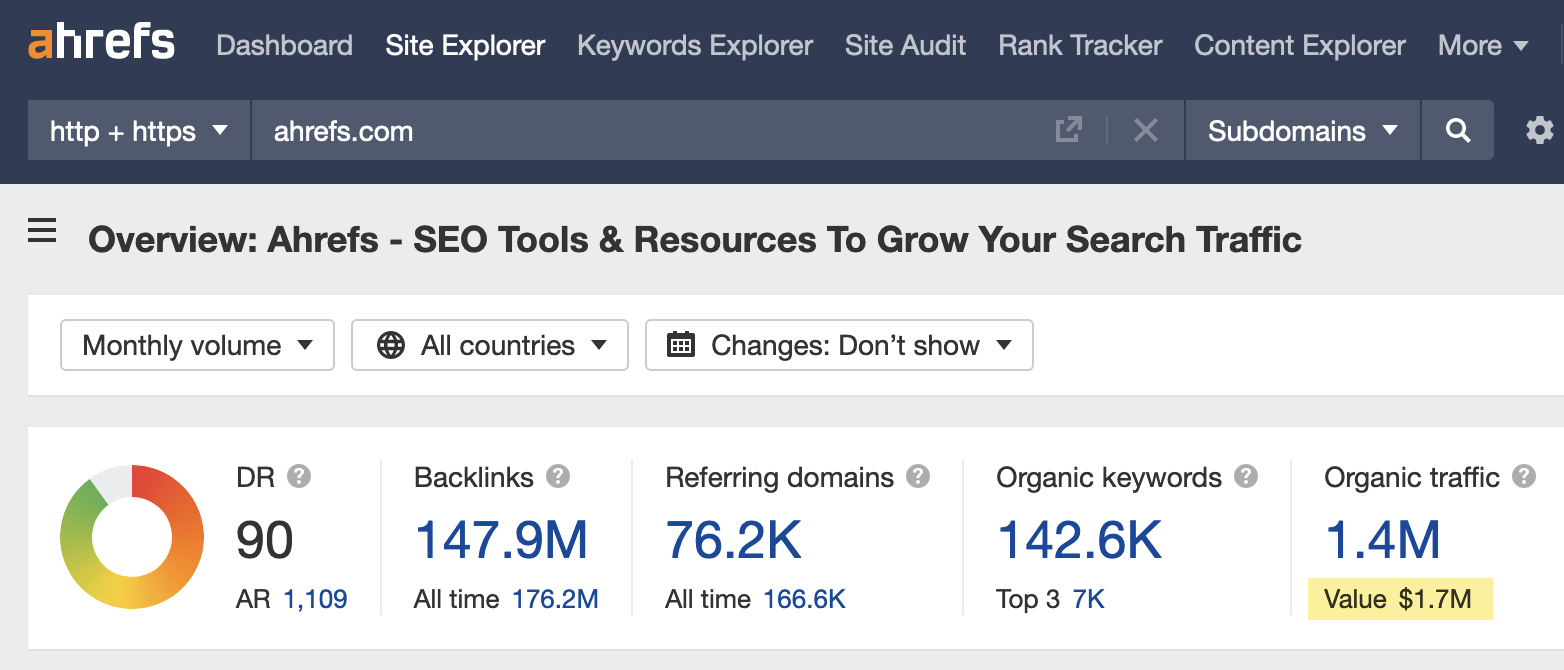
    For example, we get an estimated 1.4M monthly visits from organic search. It would cost us an estimated $1.7M per month to get that same traffic from search ads.

    Estimated value of the organic traffic to ahrefs.com

    Sidenote.

     No source of traffic is truly free. SEO costs time and effort.

    How do you do SEO?

    SEO involves five main steps: 

    1. Keyword research. Find what people search for.
    2. Content creation. Craft content for searchers.
    3. On-page SEO. Make your content as clear as possible.
    4. Link building. Build trust and authority from other websites.
    5. Technical SEO. Help search engines find, crawl, and index your content efficiently. 
  • How search engines personalize results

    Location

    Google uses your location to personalize the results for searches with local intent. That’s why all results for “italian restaurant” are from or about local restaurants. Google knows you’re unlikely to fly halfway around the world for lunch.

    Language

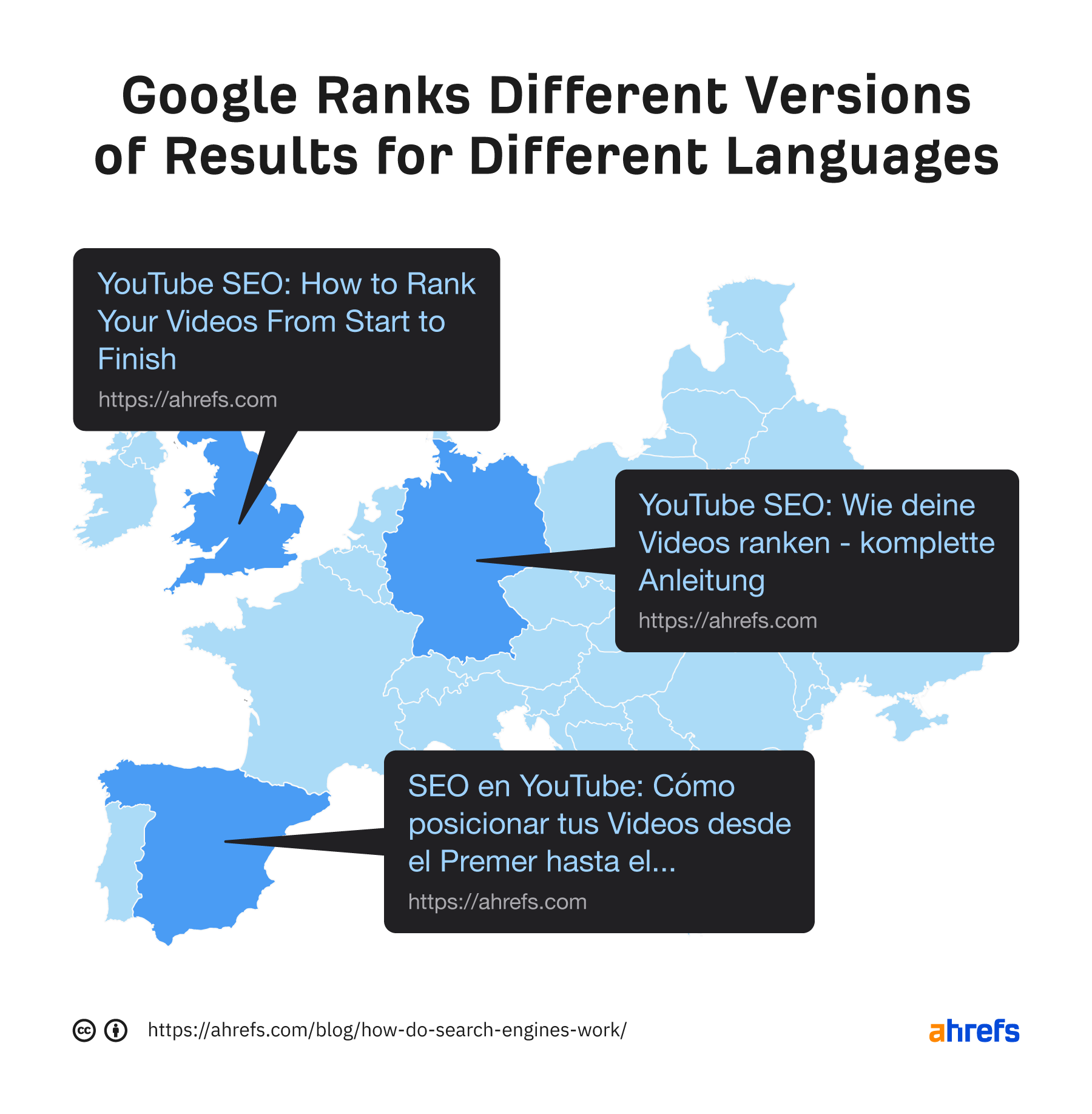
    Google knows there’s no point in showing English results to Spanish users. That’s why it ranks localized versions of content (if available) to users who speak different languages.

    Google ranks different versions of pages for different languages

    Search history

    Google saves the things you do and places you go to give you a more personalized search experience. You can opt out of this, but most people probably don’t. 

  • How search engines rank pages

    Discovering, crawling, and indexing content only make up the first part of the puzzle. Search engines also need a way to rank matching results when a user performs a search. This is the job of search algorithms.

    What are search algorithms?

    Search algorithms are formulas that match and rank relevant results from the index. Google uses many factors in its algorithms.

    Key Google ranking factors

    Nobody knows every Google ranking factor because Google hasn’t disclosed them. But we do know some key ones. Let’s look at a few of them.

    Backlinks

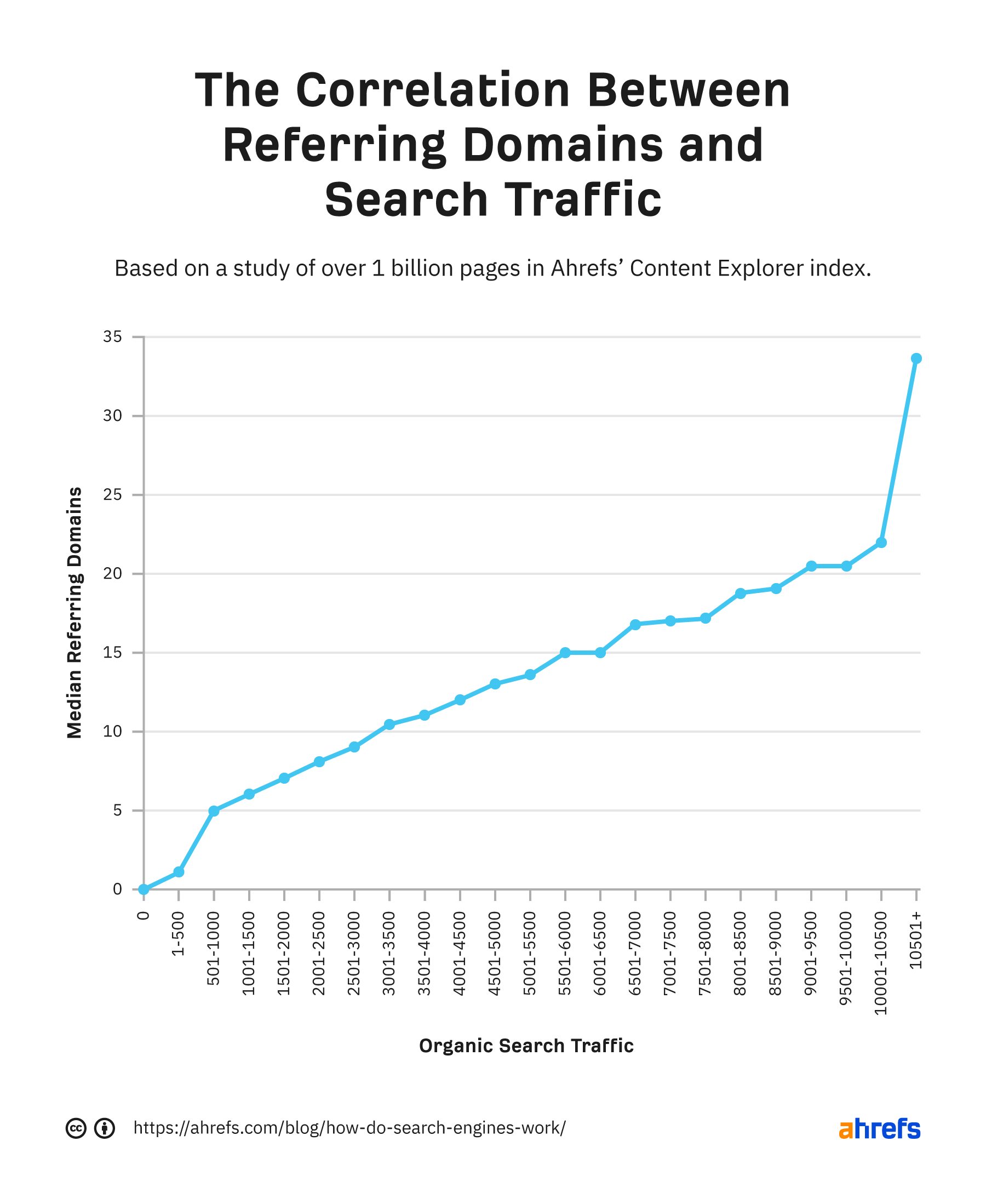
    Backlinks are links from a page on one website to another. They’re one of Google’s strongest ranking factors.This is probably why we saw a strong correlation between linking domains and organic traffic in our study of over a billion pages.

    The correlation between referring domains and search traffic

    It’s not all about quantity, though. Quality matters too. Pages with a few high-quality backlinks often outrank those with many low-quality backlinks.

    Did you know?

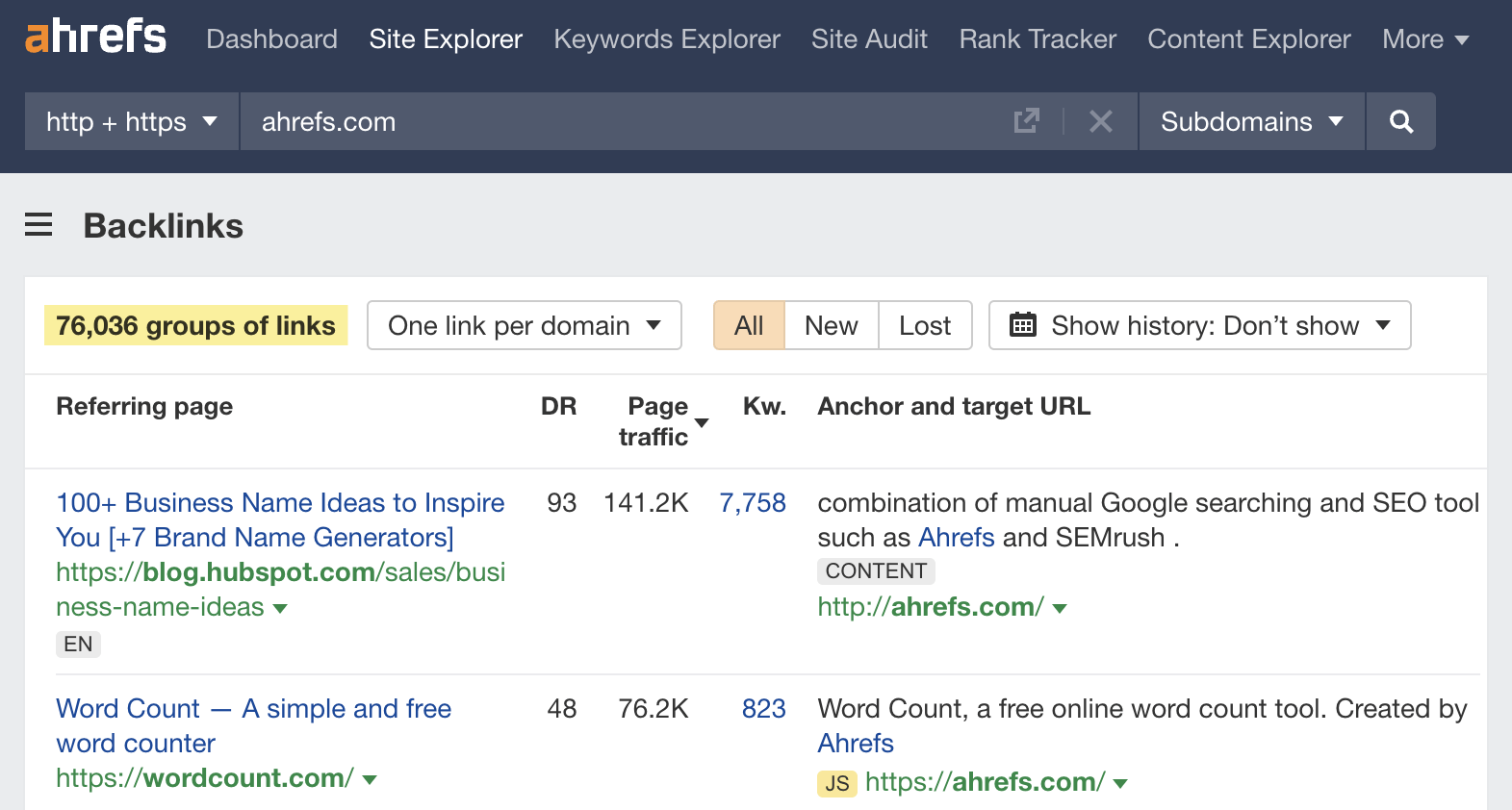
    You can check backlinks to your website for free in Ahrefs. 

    Sign up for a free Ahrefs Webmaster Tools account, enter your domain in Site Explorerand go to the Backlinks report.

    Backlinks report in Ahrefs' Site Explorer

    Our crawler is the fifth most active on the web,so you’ll see a pretty complete view of your backlinks here. 

    Relevance

    Relevance is the usefulness of a given result for the searcher. Google has many ways of determining this. At the most basic level, it looks for pages containing the same keywords as the search query. It also looks at interaction data to see if others found the result useful.

    Freshness

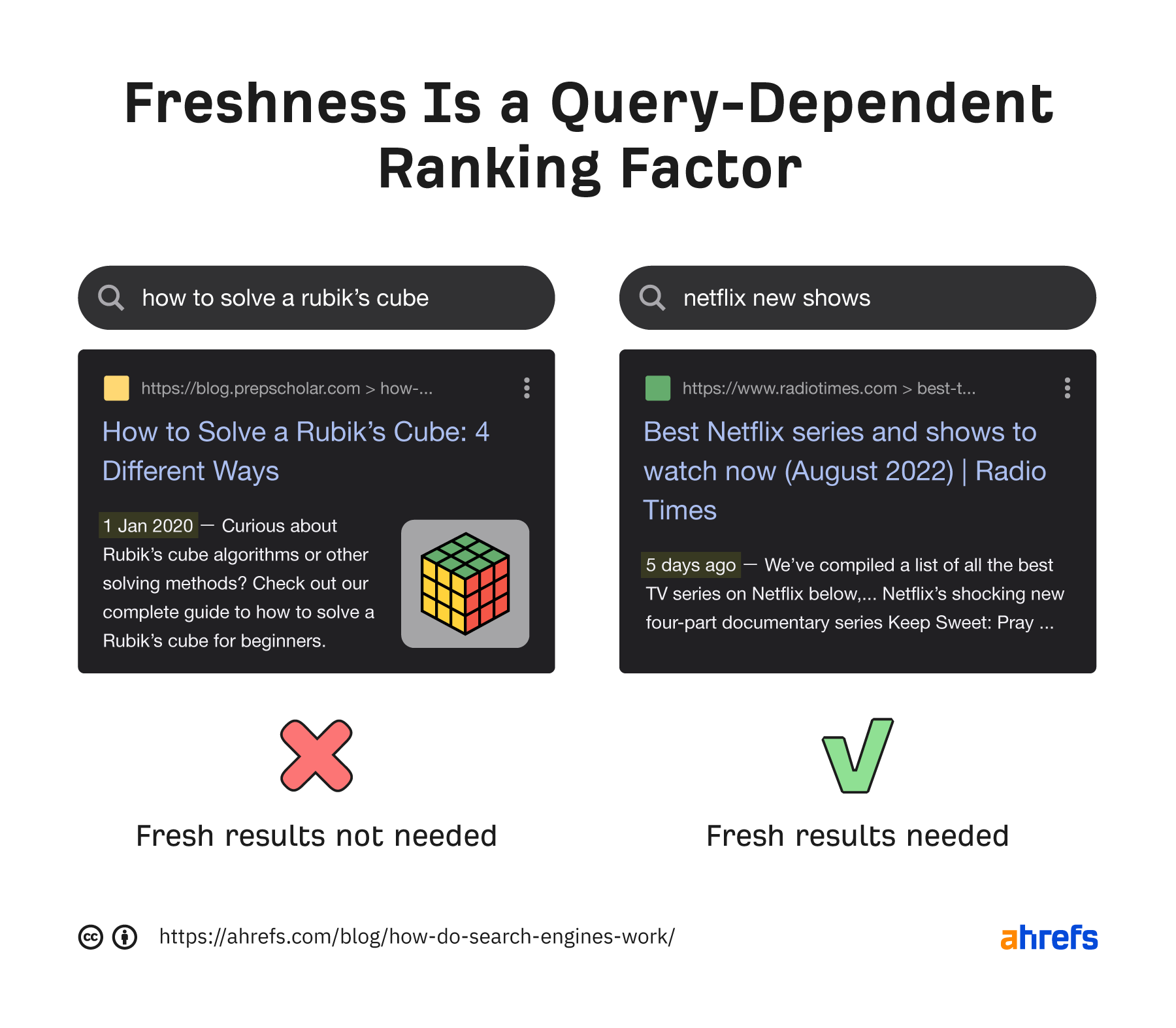
    Freshness is a query-dependent ranking factor. It’s stronger for searches that call for fresh results. That’s why you see a recently published top result for “new netflix series” but not “how to solve a rubik’s cube.” 

    Freshness is a query-dependant Google ranking factor

    Page speed

    Page speed is a ranking factor on desktop and mobile. But it’s more of a negative ranking factor than a positive one. This is because it negatively affects the slowest pages rather than positively affect lightning-fast pages.

    Did you know?

    You can check your page speed for free in Ahrefs.

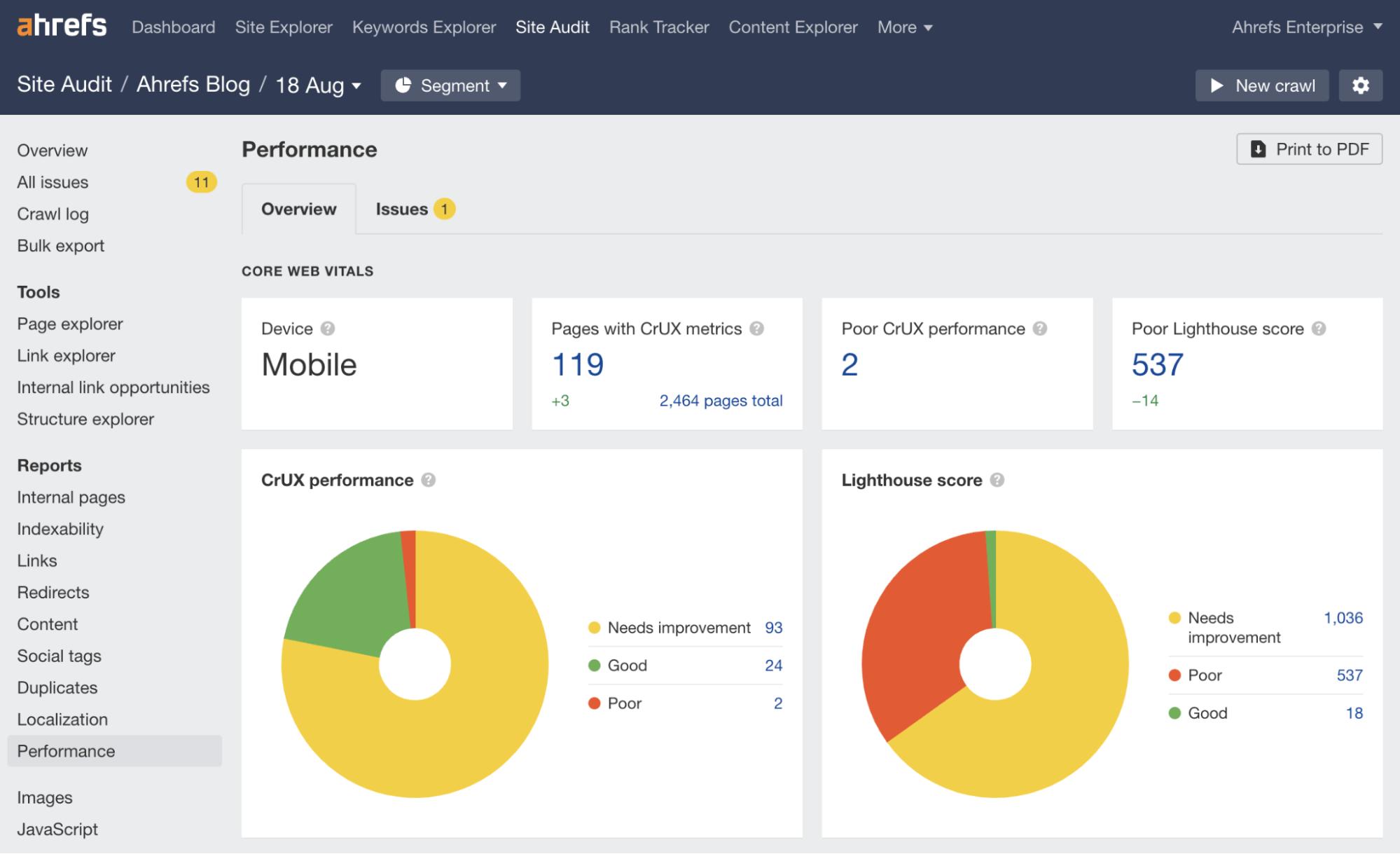
    Sign up for a free Ahrefs Webmaster Tools account, crawl your website with Ahrefs’ Site Audit, then go to the Performance report. In general, the less red you see, the better. 

    Performance report in Ahrefs' Site Audit

    Mobile-friendliness

    Mobile-friendliness has been a ranking factor on mobile and desktop since Google’s switch to mobile-first indexing in 2019.

  • How search engines build their indexes

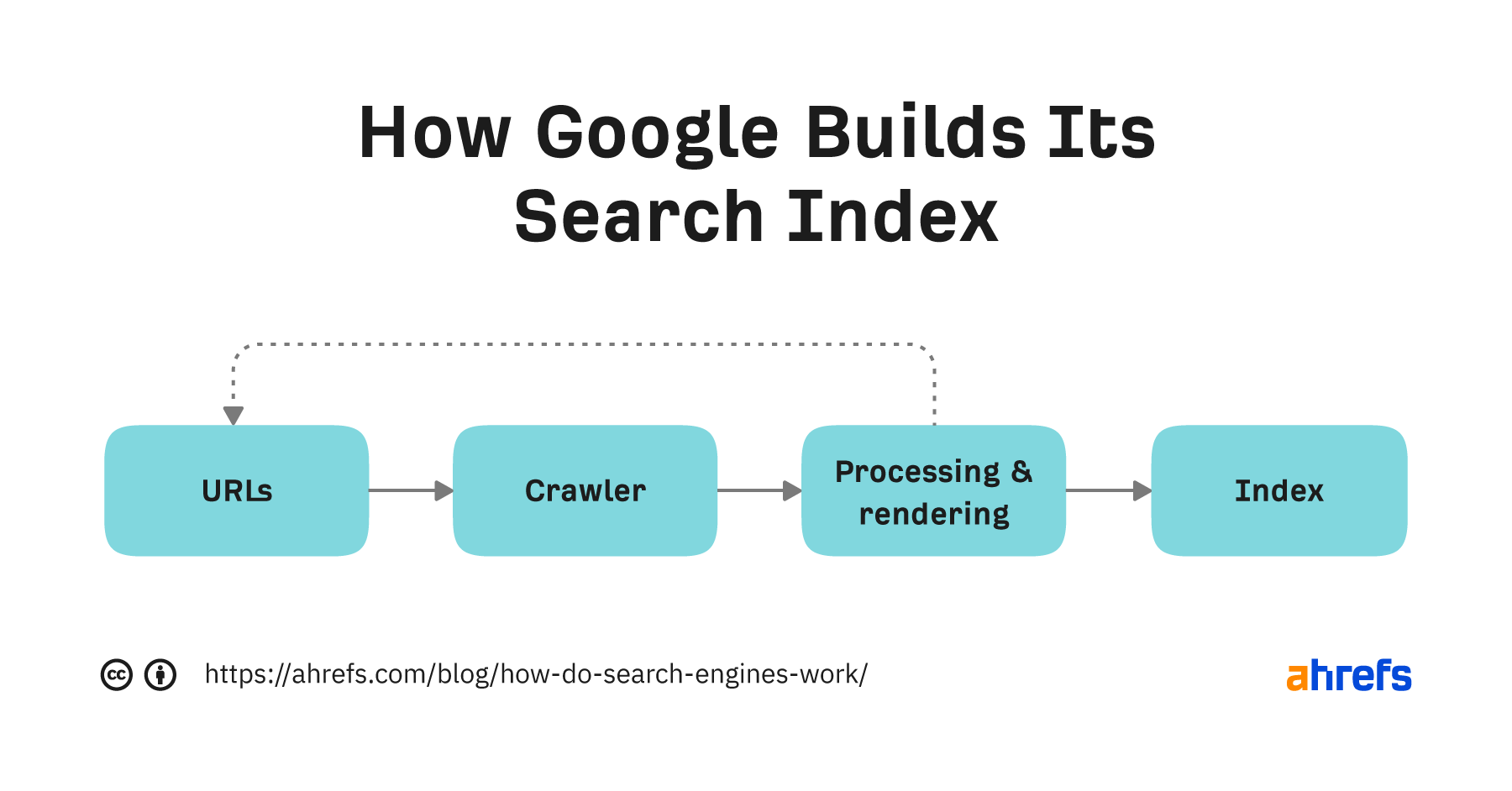
    Each search engine has its own process for building a search index. Below is a simplified version of the process Google uses.

    How Google builds its search index

    Let’s break it down.

    URLs

    Everything begins with a known list of URLs. Google discovers these in many ways, but the three most common are: 

    • From backlinks. Google has an index of hundreds of billions of webpages. If someone links to a new page from a known page, Google can find it from there.
    • From sitemaps. Sitemaps tell Google which pages and files you think are important on your site.
    • From URL submissions. Google lets site owners request crawling of individual URLs in Google Search Console.

    Crawling

    Crawling is where a computer bot called a spider visits and downloads known URLs. Google’s crawler is Googlebot.

    Processing and rendering

    Processing is where Google works to understand and extract key information from crawled pages. To do this, it has to render the page, which is where it runs the page’s code to understand how it looks for users. 

    Nobody outside of Google knows every detail about this process. But it doesn’t matter. All we really need to know is that it involves extracting links and storing content for indexing. 

    Indexing

    Indexing is where processed information from crawled pages gets added to the search index.

    The search index is what you search when you use a search engine. That’s why getting indexed in major search engines like Google and Bing is so important. Users can’t find you unless you’re in the index.