Author: saqibkhan

  • How to build links

    Conceptually, most popular link building strategies fall into one of the following four buckets:

    1. Adding links – That’s when you go to some website and manually add your link there.
    2. Asking for links – That’s when you send emails to owners of relevant websites and ask them to link to you.
    3. Buying links – Same as above, but you offer them money (or some other form of compensation).
    4. Earning links – This refers to creating and promoting something so noteworthy that people would link to it naturally.
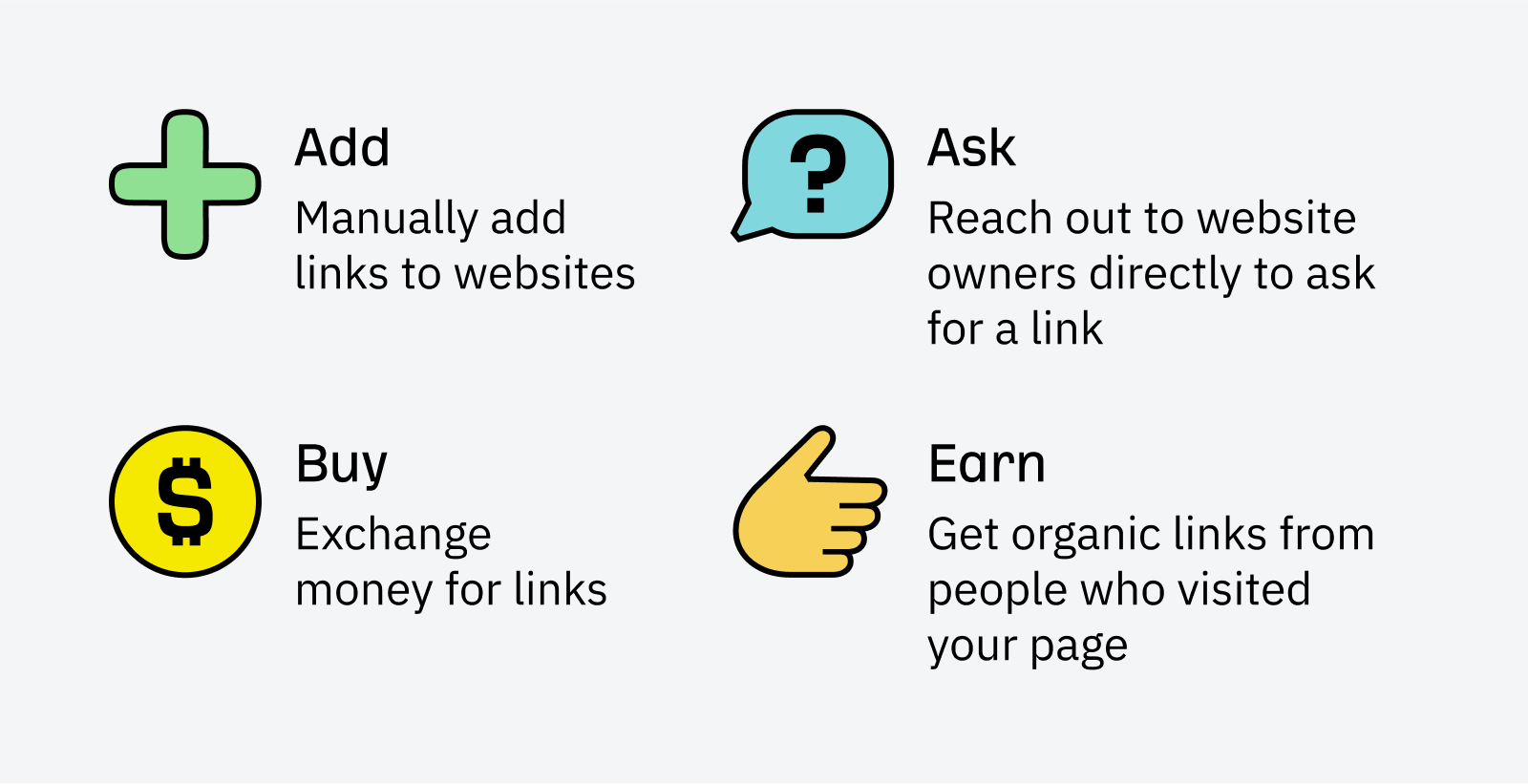
    Four ways to build backlinks
    How to get backlinks.

    You can also hire an experienced link builder (or a link building agency) to do it all for you. And that’s what a lot of digital marketers and business owners eventually end up doing because no matter which tactics you choose, building links is a lot of work.

    But even if you decide to outsource link building, it would be immensely useful to have some basic knowledge of how it’s done. This way, you would be able to see if the person you hired is doing a good job or not.

    So let’s take a closer look at each of the four buckets.

    1. Adding links

    This is when you go to a website that doesn’t belong to you and manually place your link there.

    The most common tactics that fit into this category are:

    • Social profiles creation.
    • Business directory submissions.
    • Review site listings.
    • Posting to forums, communities, and Q&A sites.

    Building links via those tactics is very easy to do. And for that exact reason, such links tend to have little to no value in the eyes of Google.

    Other than that, these kinds of links barely give you any competitive edge. If you can go to a website and manually place your link there, so can your competitors.

    And yet, this group of link building tactics should not be ignored completely. In fact, some professional link builders prefer to start with these kinds of links when they’re working with a brand-new website.

    They refer to it as building “foundational links.”

    Think about it. Most online businesses have branded accounts at the major social networks, as well as listings at major business directories and review sites (Yelp, Trustpilot, ProductHunt, Glassdoor, etc.). And all of these pages contain a link to their website.
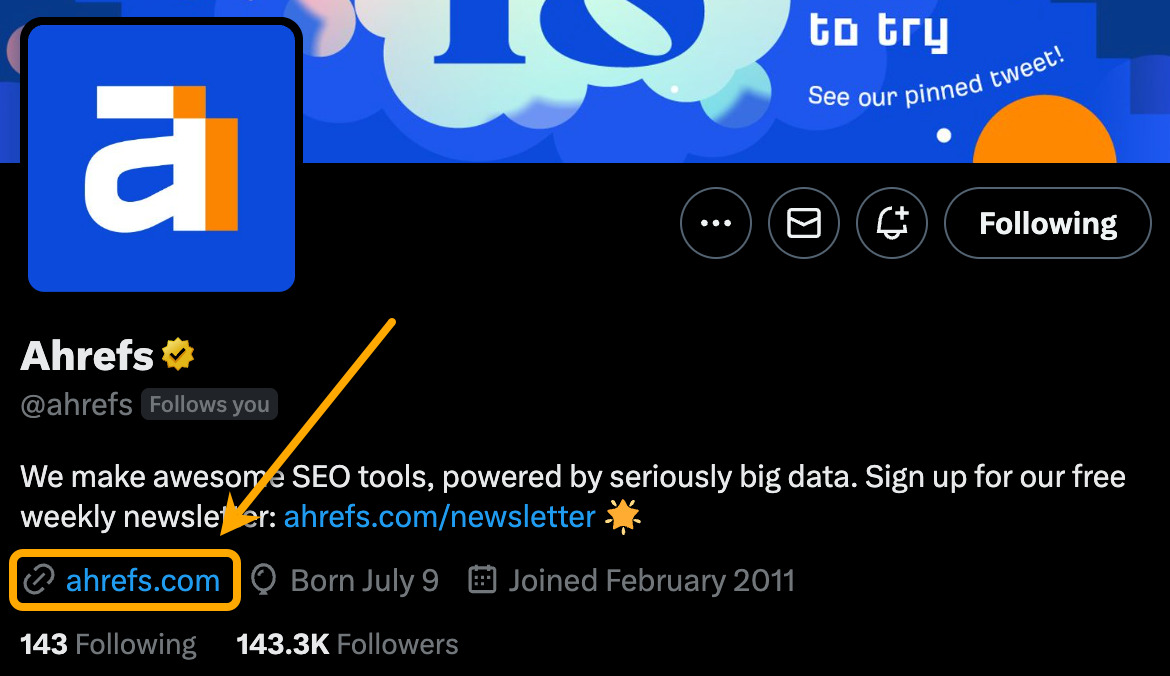
    Link from our Twitter profile

    Google clearly pays attention to these profile pages. If you look at the “Knowledge” panel for Ahrefs (see the screenshot below), you’ll notice the links to our social profiles featured there. And we weren’t the ones who added them. Google identified our social profiles on its own and linked them to the Ahrefs brand as part of its Knowledge Graph.
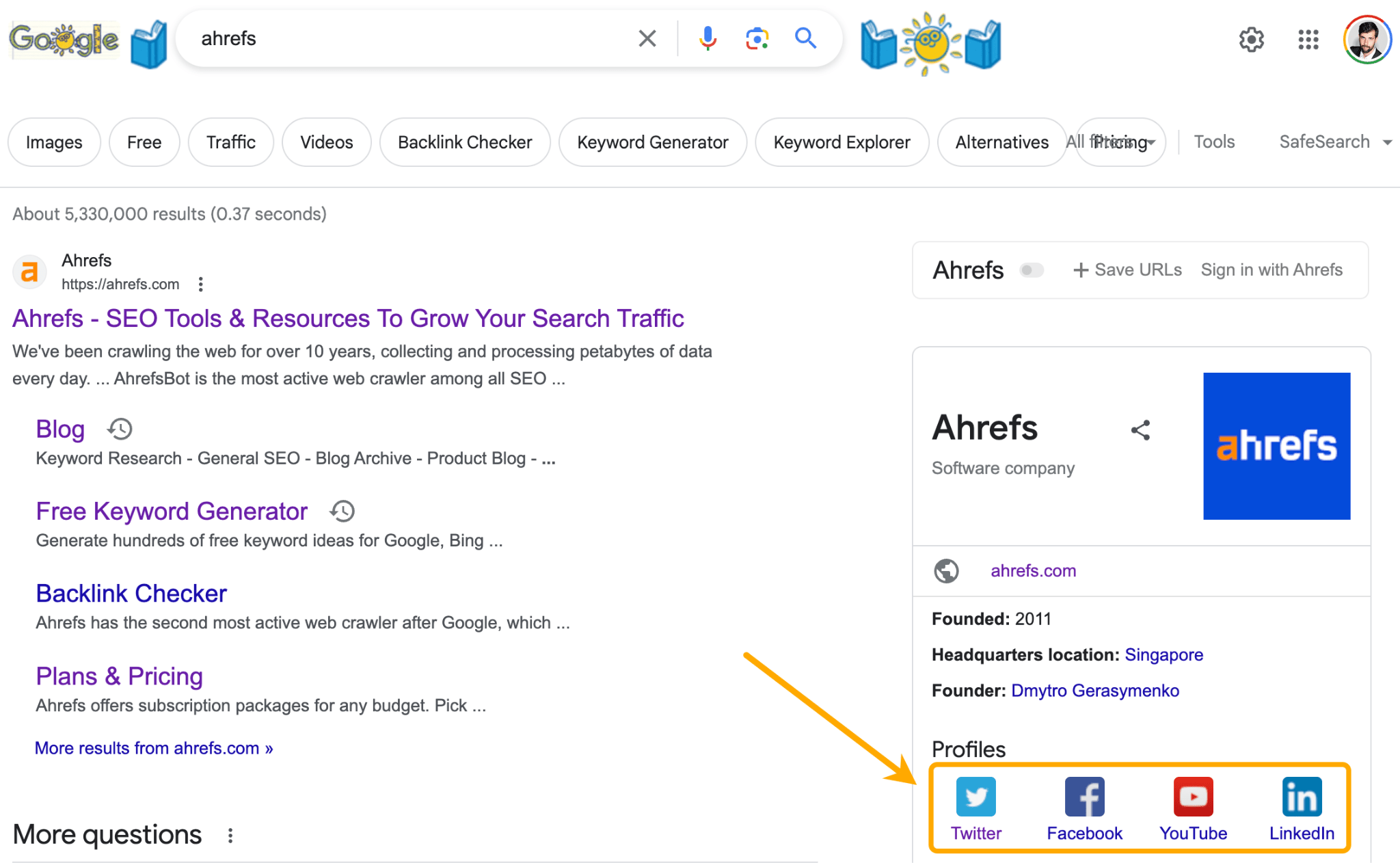
    Links in the "Knowledge" graph

    Yes, these kinds of links are either nofollow or very, very weak. Which means that they hardly move the needle when it comes to ranking in Google.

    But given that the “nofollow” attribute is now treated as a hint, there’s a chance that over time your profile pages will accrue some quality links of their own and might start bringing a bit of search engine optimization (SEO) value to your website.

    For example, Ahrefs’ profile page on Twitter boasts 11,000 backlinks, coming from over a thousand different websites. So I’m pretty sure it does have some “weight” in the eyes of Google.
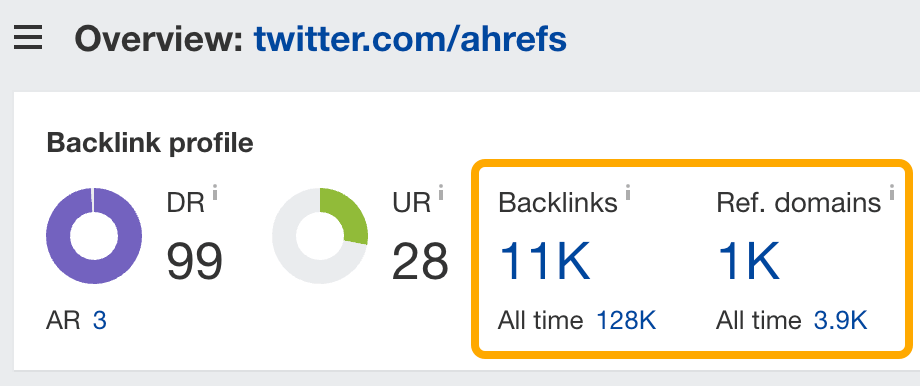
    Backlink profile of our Twitter profile, via Ahrefs' Site Explorer

    That being said, don’t go crazy listing your website in every imaginable social network and business directory there is. We’re talking about merely a few dozen of them where it is natural for your business to be listed. Anything beyond that would be a royal waste of your time.

    And the best way to find some quality websites to add your link to is to study the links of your competitors. Which we’ll discuss in more detail later in this guide.

    2. Asking for links

    This is when you reach out to other website owners and ask them for a link, which SEOs often refer to as “link outreach.”

    But you can’t possibly reach out to the folks at datasciencecentral.com and ask them to link to your page with cookie recipes, right? You need to pick websites that are somehow related to your page, since they are more likely to actually consider your request.

    The process of collating a list of relevant websites to reach out to is called “link prospecting.” And the more effort you invest into finding suitable outreach targets, the higher your success rate would be.

    But why would owners of other websites (even the relevant ones) care to link to your page anyways?

    Well, ideally, you want them to be so impressed with your resource that they would naturally want to share it with the visitors of their website (i.e., link to it).

    But not every page of your website is a one-of-a-kind masterpiece worthy of a thousand links. So SEO professionals have devised a set of tactics to persuade the owners of other websites to add links to their pages.

    Here’s a brief list of these tactics, along with the general reasoning behind them:

    • Guest posting – Write an awesome article for their website, from which you can link to yourself.
    • Skyscraper technique – Find an outdated (or somehow inferior) page that lots of websites are linking to. Create a much better one on your own website. Then show it to all the “linkers.”
    • Resource page link building – Find pages that list resources similar to yours and request to be added there.
    • Broken link building – Find a dead page that has lots of links. Create an alternative on your own website and ping all the linkers about it. That’s broken link building in a nutshell.
    • Image link building – Find sites that have used your images without proper attribution and ask them for a link.
    • HARO and journalist requests – Contribute an “expert quote” for their article.
    • Unlinked mentions – Ask to turn the mention of your brand into a link.
    • PR – Give them a killer story to cover.

    Here’s a caveat, though.

    The reasoning behind each one of these tactics might seem quite fair and logical, but you’ll be surprised how low the success rate is. I mean, if you manage to get five links out of a hundred outreach emails, you can be proud of yourself.

    But there’s one simple thing you can do to skew the odds in your favor. That is to build relationships with people in your industry way before you need something from them.

    Think about it. If today you got a cold email from a random person asking for a link, would you even bother replying? I doubt so. But what if that email comes from someone whom you’ve previously talked to on Twitter or maybe even met at some in-person event? You’ll be a lot more likely to pay attention, right?

    Thus, if you start connecting with folks from your industry in advance (and maybe even do small favors for them), you’ll have no issues reaching out with a link request at some point in future.

    Here’s a good example from my own experience. Gael Breton from Authority Hacker first reached out to me back in 2014. That was before I even joined Ahrefs:
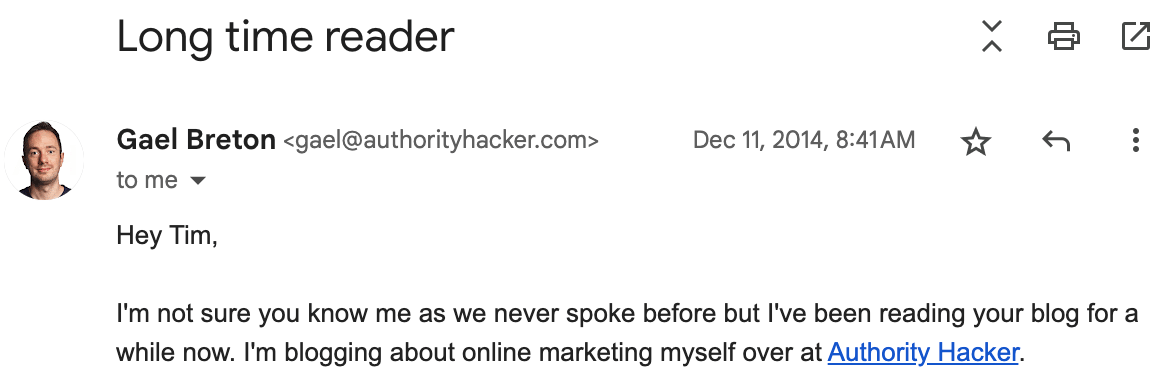
    2014 email from Gael Breton

    I enjoyed Gael’s work, and we’ve kept in touch ever since. Which is one of the reasons why his website has 122 incoming links from ahrefs.com as of today:
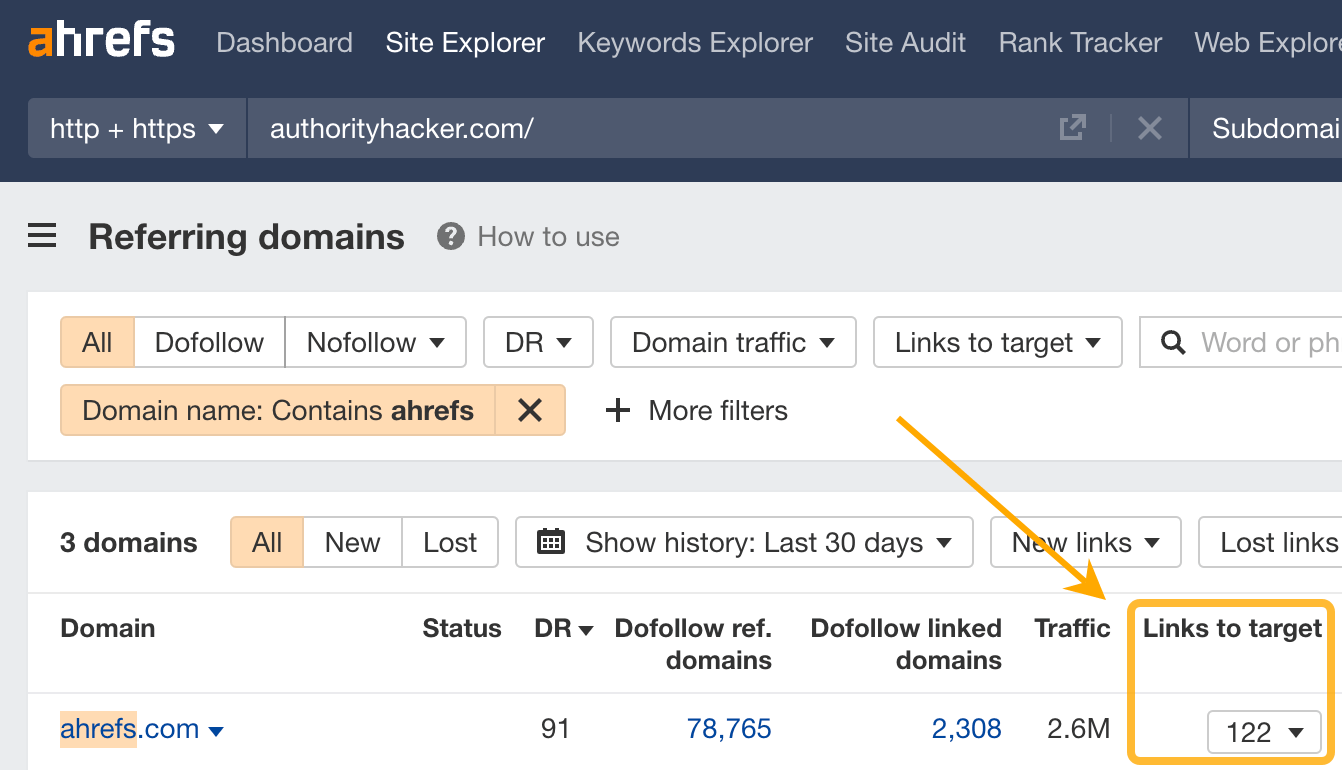
    How many times we're linking to Gael's website from our site, via Ahrefs' Site Explorer

    But don’t get me wrong. Gael didn’t ask me for links every once in a while to get these. We simply follow each other’s work. And when they publish something noteworthy on Authority Hacker, I would know about it and share it with our team. And then we might link to it at some point from our blog.

    That’s how relationships help you to acquire links naturally.

    3. Buying links

    This is the easiest way to build links. A lot of website owners would be happy to link to you if you pay them for it.

    But exchanging money (or anything else, really) for links is quite risky. Google considers it a manipulation of its algorithm. And it might punish you for it by kicking your website out of the search results.

    Another risk of buying links comes from simply wasting your money on bad links that won’t even work in the first place.

    That being said, we don’t want to teach you any tactics that might put your business (or your wallet) at risk. So there would be no tips on “how to buy links the right way” in this guide.

    And yet, you should be well aware that many people in the SEO industry do buy links to achieve their ranking goals. Once you start researching your competitors’ backlinks and reaching out to the same websites, you’ll soon find out if they paid for any of their links.

    4. Earning links

    You “earn” links when other people link to the pages on your website without you having to ask them to do so. This won’t happen unless you have something truly noteworthy that other website owners will genuinely want to mention on their websites.

    So here are a few things that can make the pages of your website worthy of a link:

    • Your company’s proprietary data
    • Results of experiments (which require significant efforts)
    • Unique ideas and strong opinions (i.e., thought leadership)
    • Industry surveys
    • Breaking news

    For example, back in 2017, we used our proprietary data to carry out a unique research study, which answered one of SEO’s most frequently asked questions: “How long does it take to rank in Google?”

    As of today, this blog post has almost 3,000 backlinks from about 1,700 different websites.
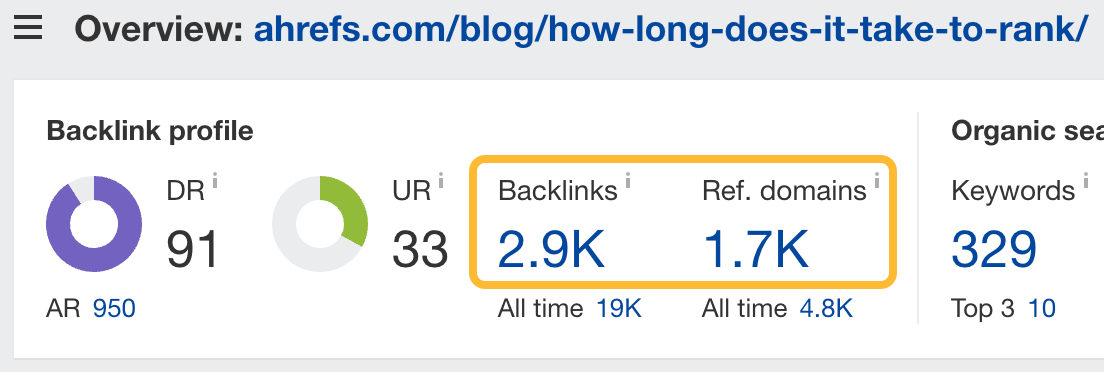
    Backlink profile for my blog post on how long it takes to rank in Google, via Ahrefs' Site Explorer

    And even six years later, this research is still picking up new links. Here are a few linked mentions from earlier this year:
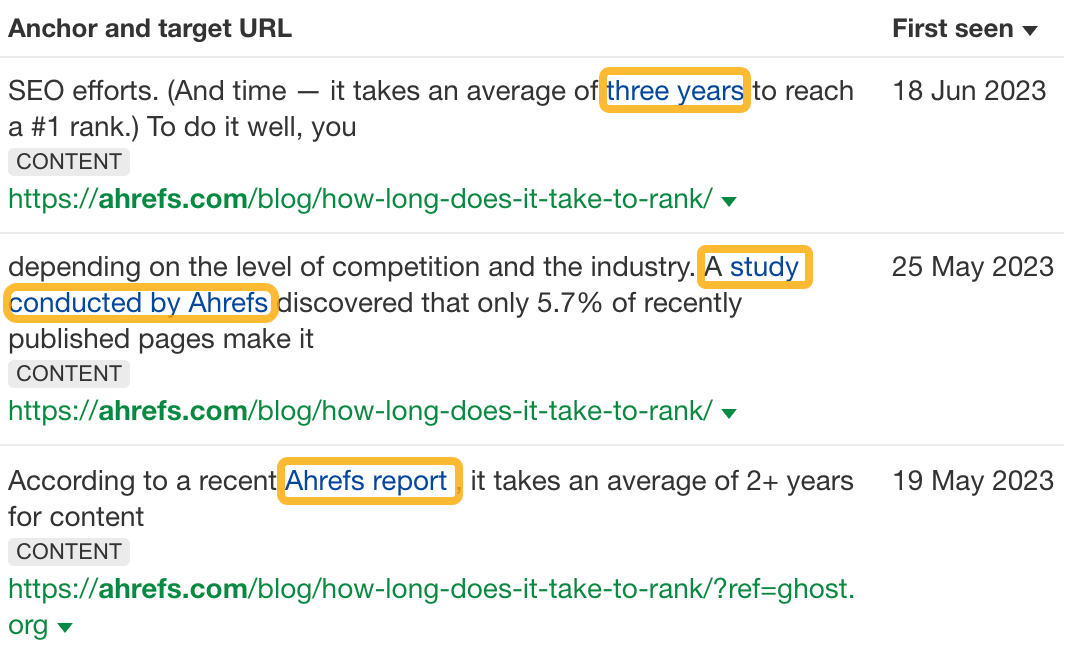
    Examples of recent links to my post

    But you don’t necessarily have to create any content at all. Your business in itself can be link-worthy. Or the products and services that you offer.

    A fair share of links to the ahrefs.com website come from people mentioning our products and company rather than the content we publish. Here are a few linked mentions we got just yesterday:
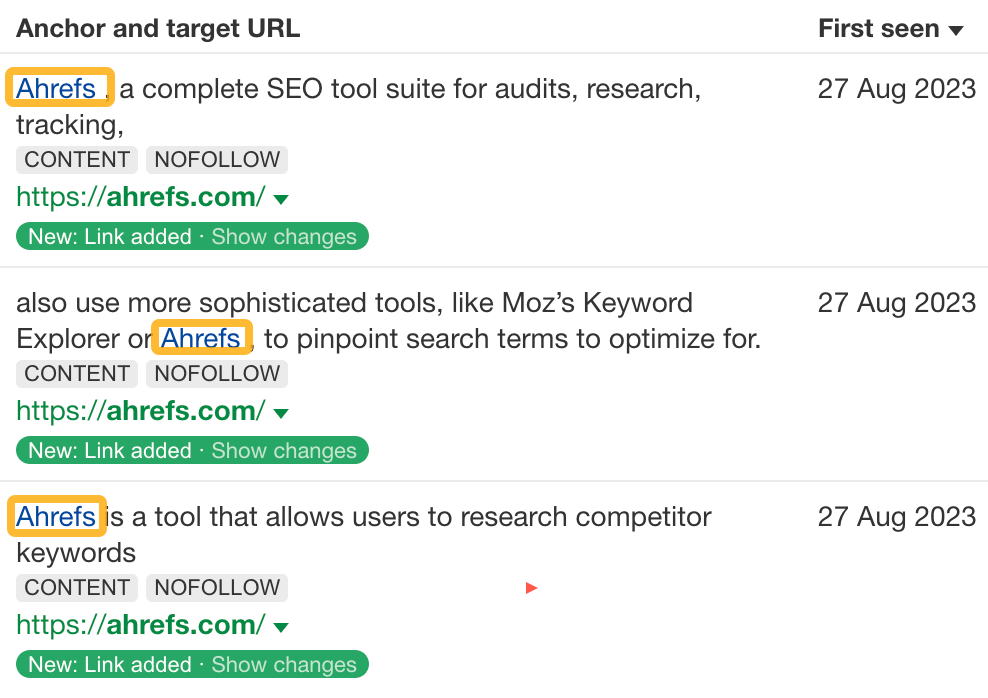
    Examples of recent links to our homepage

    But people can’t link to things that they don’t know exist. So no matter how awesome your page (or your product) is, you’ll need to promote it. And the more people see your resource, the higher the chance that some of them will end up linking to it.
  • The basics of link building

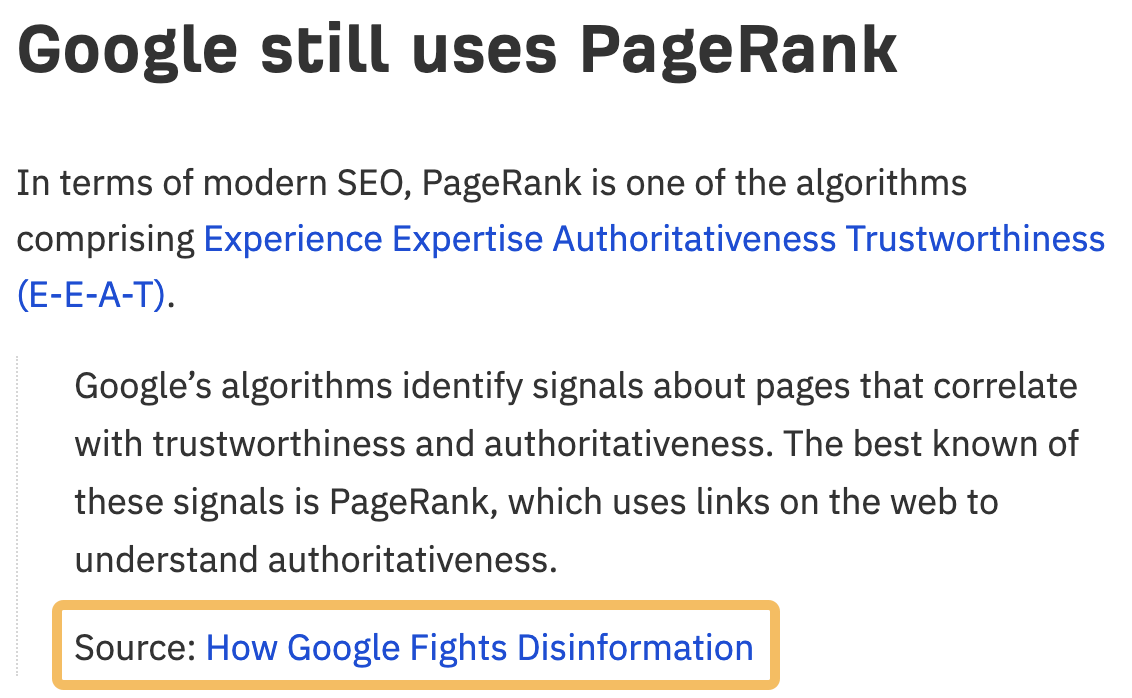
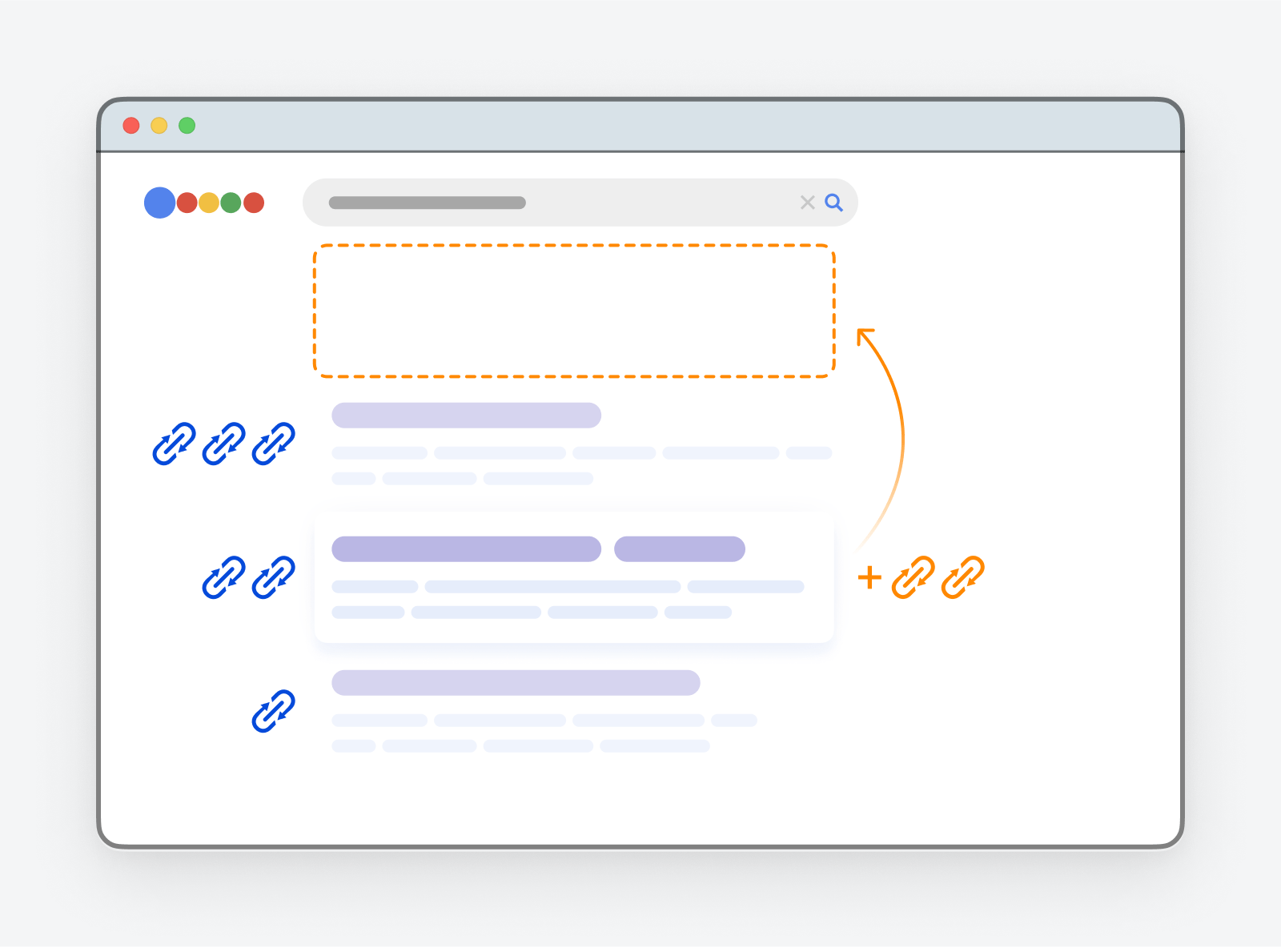
    You can think of links as votes. When other websites are linking to your page, it tells Google that your page is somehow important. Which is essentially Google’s PageRank algorithm in a nutshell.

    So the more high-quality backlinks a page has, the higher it tends to rank in Google. And if you want to outrank it with your own page, you’ll likely need to get more links than it has.

    Backlinks help you to rank higher in Google
    Backlinks help pages rank higher in Google’s search results.

    I obviously oversimplified things quite a bit. Ranking #1 in Google is a lot more nuanced than just getting more links, because links aren’t the only ranking signal that Google uses. But it’s a very strong signal nevertheless, and it has a very direct influence on your search rankings.

    So what is link building, and how do you do it?

    Link building is the process of getting other websites to link to pages on your website. Its purpose is to boost the “authority” of your pages in the eyes of Google so that these pages rank higher and bring more search traffic.

    Let’s get a bit deeper into that.

  • Make the page fast and mobile-friendly

    To rank your pages, Google will also take into account a set of “page experience signals.” These include (but are not limited to):

    • Core Web Vitals (CWV) (in other words, whether the page is fast enough and stable).
    • Security (whether the page connects via HTTPS).
    • Mobile-friendliness (Google uses the mobile version of your pages for indexing and ranking).
    • Avoiding intrusive interstitials and dialogs.

    These are problems that can be spotted on individual pages but usually need to be solved at the site level. Check out our guides to learn more:

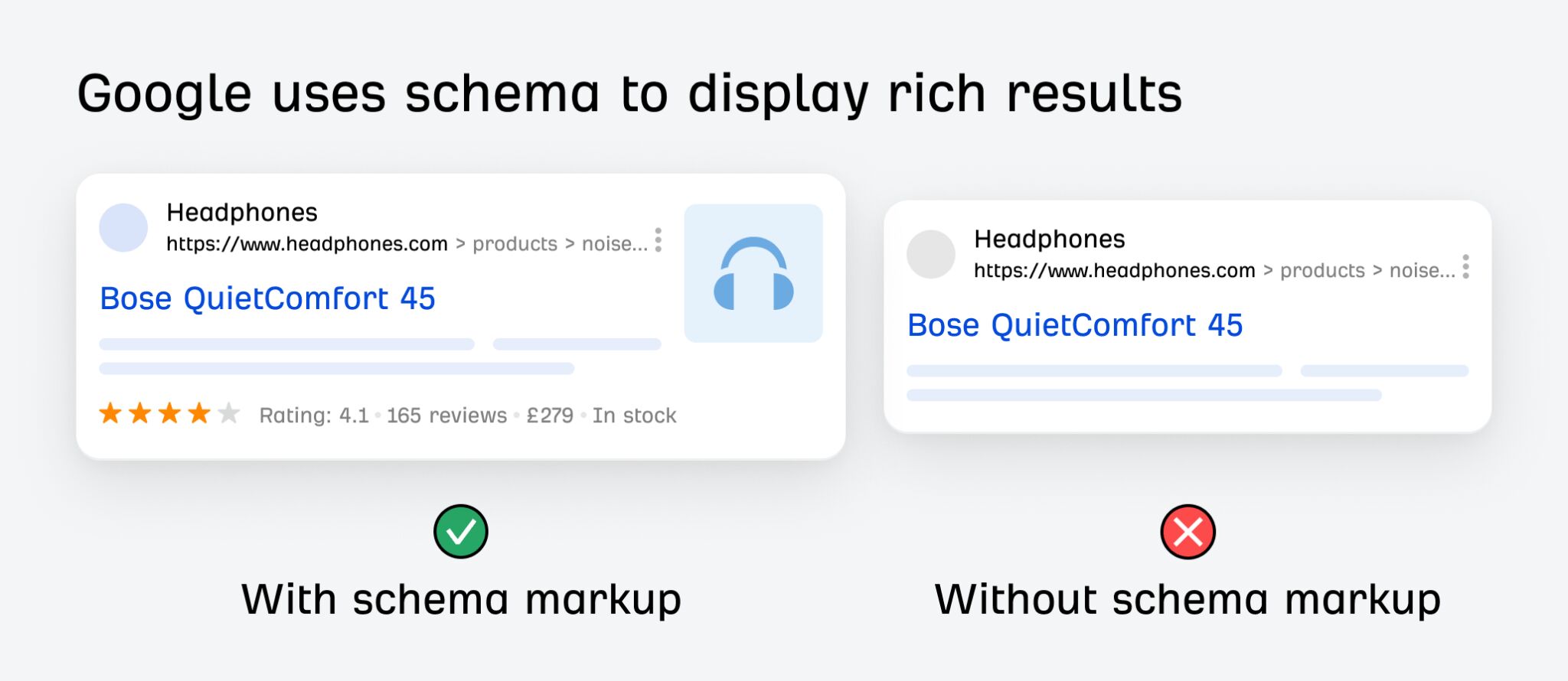
  • Get rich results with schema markup

    Rich results are search results that give searchers extra information about a page, like product ratings or recipe details. Not every type of search is eligible to show rich results, but for those that are, rich results help drive extra clicks to your page.

    To be eligible for rich snippets, you need to apply a simple code called schema markup. Learn how in our guide, Schema Markup: What It Is & How to Implement It.

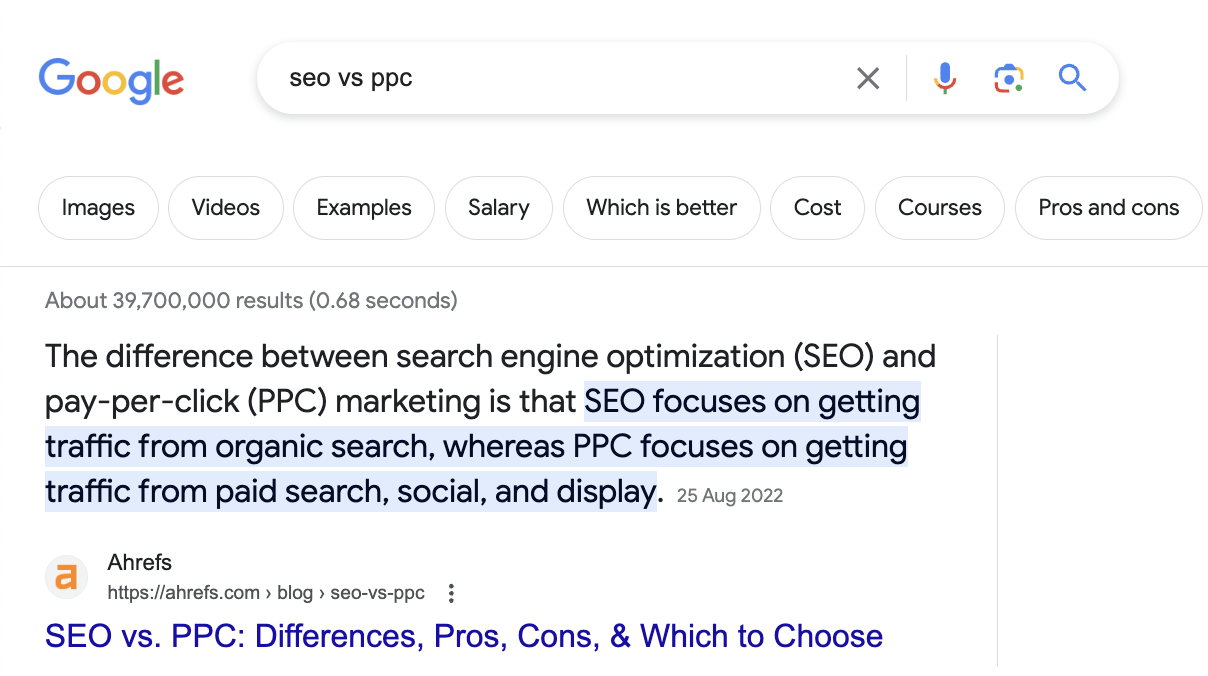
  • Optimize for featured snippets

    Featured snippets are special search results that sit above the main organic results in a place known as “position zero”:

    In searches where Google thinks visitors will benefit from a short, direct answer, they’ll often choose an excerpt from a high-ranking page to show. Plenty of queries have a featured snippet, so it’s worth trying to win them.

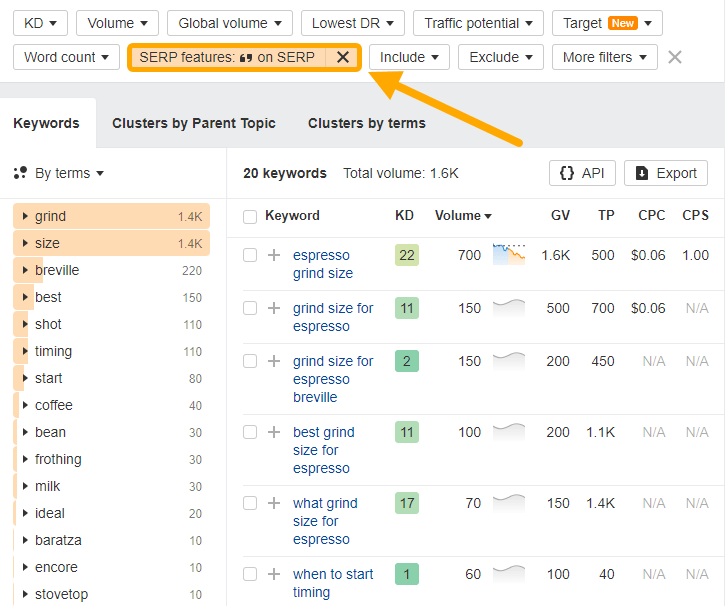
    To see which keywords have a featured snippet, head to Keywords Explorer, paste your list of keywords, and hit the SERP features toggle to show only those keywords that have a featured snippet in the search results:

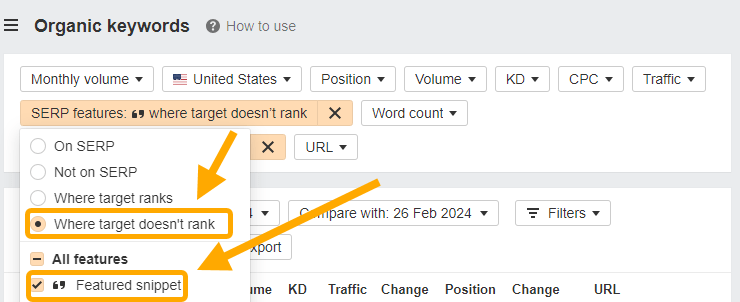
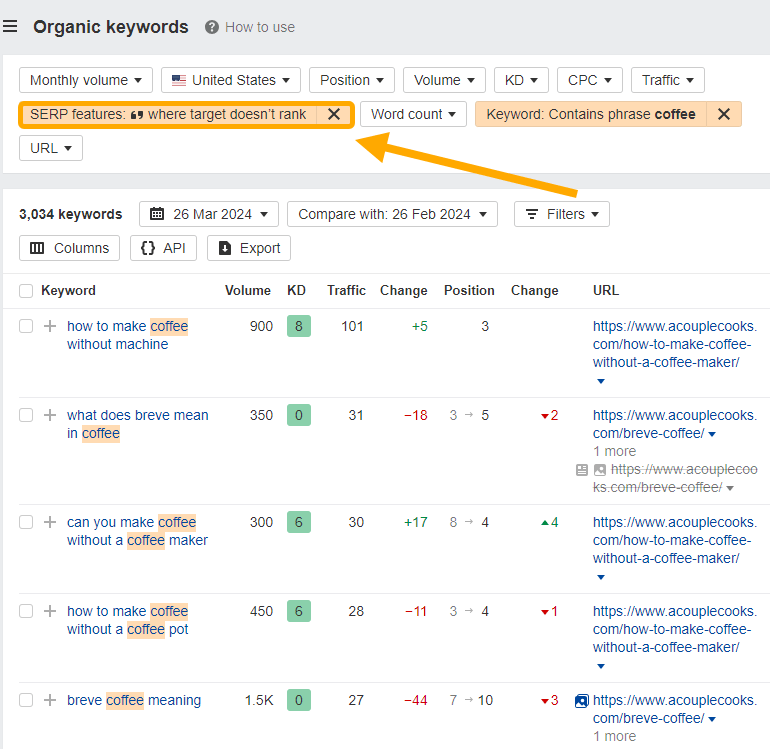
    You can also use Site Explorer to find opportunities to optimize your existing pages for featured snippets. Paste in your website URL, use the SERP features selector to show only keywords that have a featured snippet in the SERP that your website doesn’t currently rank for:

    For this website, we can see 3,034 coffee-related keywords with a featured snippet. Time to get optimizing!

    There’s no guaranteed way to win the featured snippet, but it helps to:

    • Match the existing snippet format (commonly paragraph, list, table, or video)
    • Define your topic succinctly in two to three sentences
    • Keep your content objective and fact-based, and avoid first-person language
  • Show off your experience and expertise

    Google’s quality rater guidelines encourage authors to demonstrate “EEAT” in their content: expertise, experience, authoritativeness, and trustworthiness.

    These guidelines are used by Google’s quality raters, and although they’re not a direct ranking factor, they give a clear indication of the type of content Google aims to reward in its search results. You can emphasize your EEAT in a few different ways:

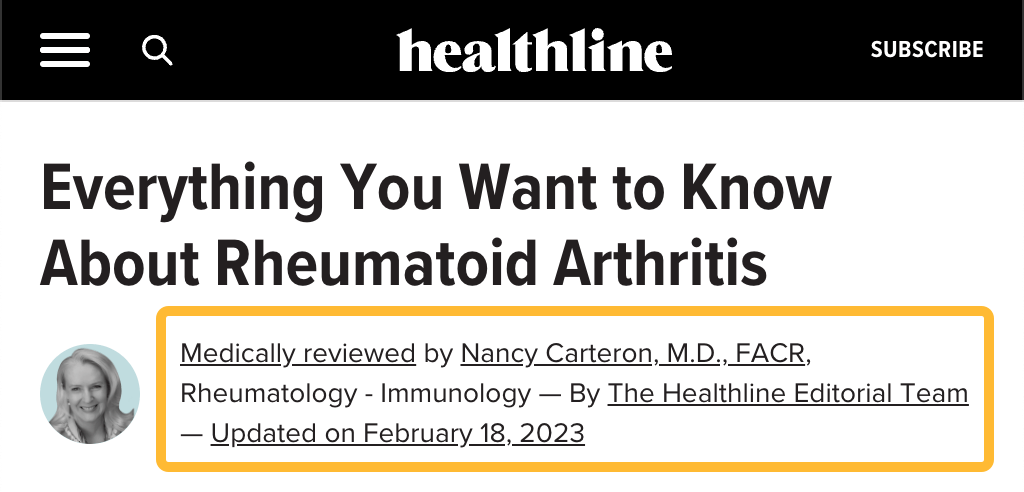
    • Show relevant expertise in your author bio. This is especially important for so-called YMYL (Your Money or Your Life) topics: medical content should be reviewed by medical professionals, investment advice by accredited investors, and so on.
    • Include expert quotes. When your expertise isn’t enough to be authoritative on the subject, seek out quotes and feedback from people who are experts (especially in fields that require specific certifications and qualifications, like healthcare or accountancy).
    • Get hands-on with your topic. If you’re writing about brewing espresso, actually go and brew a few hundred shots. Reviewing free CRM software? Download, install, and spend a few hours with each option. If you aren’t willing to go to these lengths, there’s a good chance you’ll be beaten by someone who will.
    • Show evidence. Prove to readers (and Google) that you did the thing you’re talking about: add experience to your author bio, and include original photographs and videos of your experience.
    Here’s an example of an author bio demonstrating relevant expertise for the article topic.
  • Fill your content gaps

    You can often improve your ranking by filling any “content gaps” in your article: important information that other articles cover, but you don’t.

    Adding new sections to include this missing information can help you rank for extra long-tail keyword variations and improve your ranking for your primary keyword.

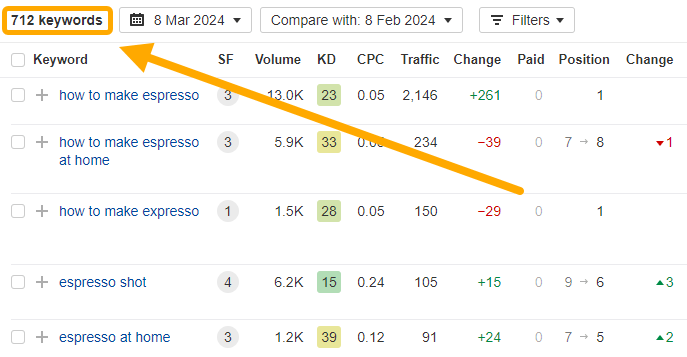
    In the image below, we can see an article called How to brew espresso ranking for 712 keywords, including terms like how to make espresso at home and espresso shot:

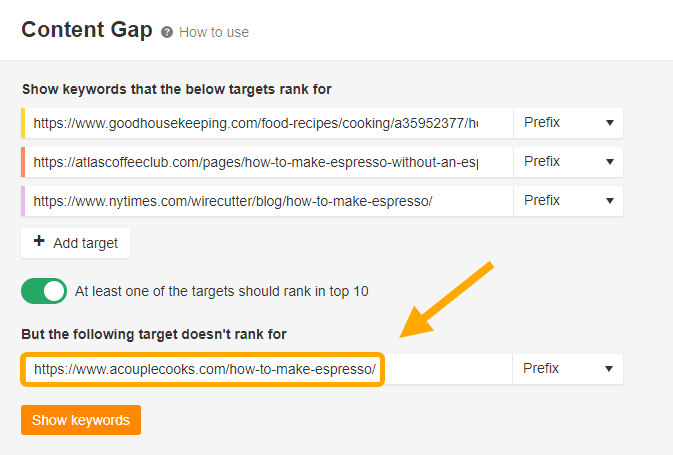
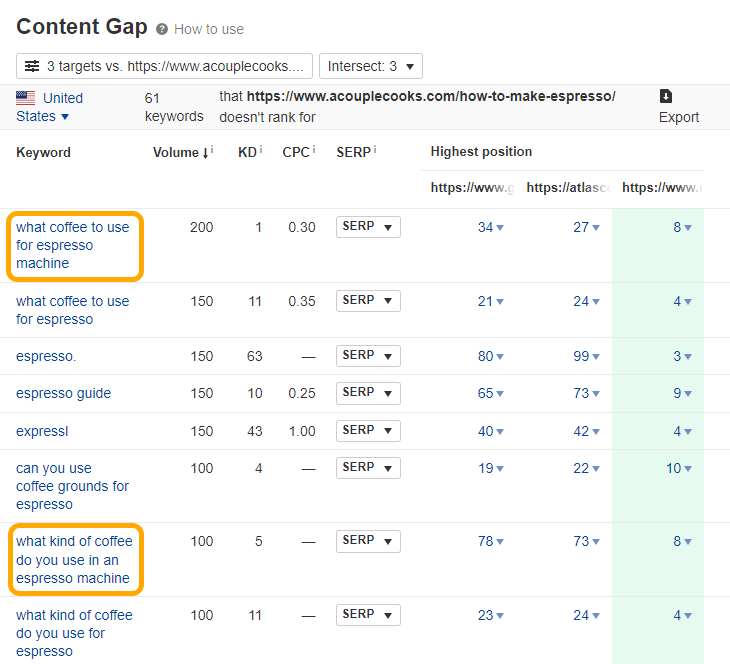
    The Content Gap report In Ahrefs is designed to quickly show these opportunities. In the screenshot below, I’m comparing an article about how to make espresso (highlighted) with three competing articles:

    Hit “Show keywords” and you can immediately see keywords that you don’t rank for, but your competitors do. In this example, we should probably add a section talking about the type of coffee that works best in espresso machines:

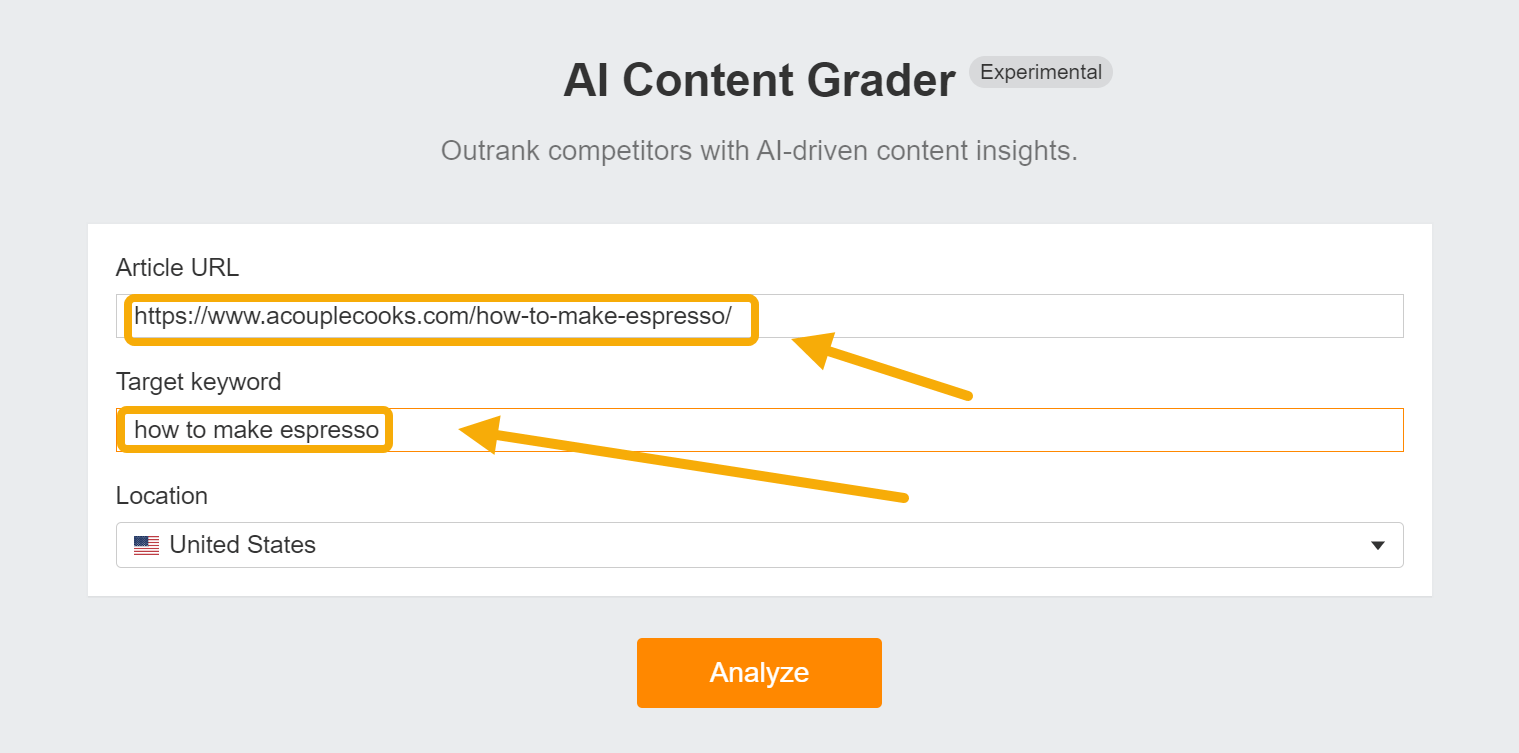
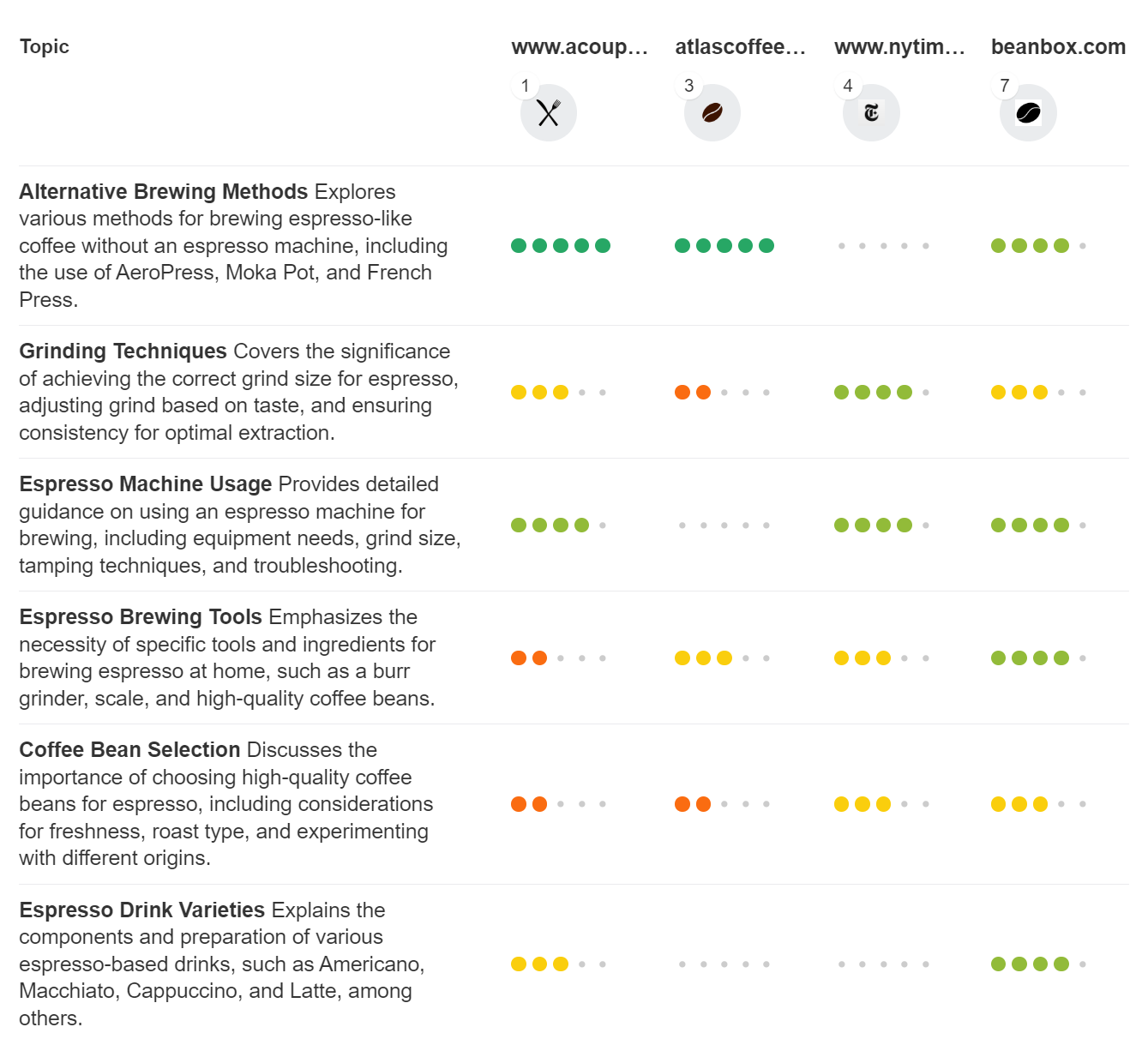
    Our new Content Grader takes a different approach, using semantic analysis (analyzing the words on the page) to find topics covered by your competitor but lacking from your article.

    Here, we just add our published article URL and the target keyword:

    Content Grader identifies common topics, and scores each article based on how well it covers the topic:

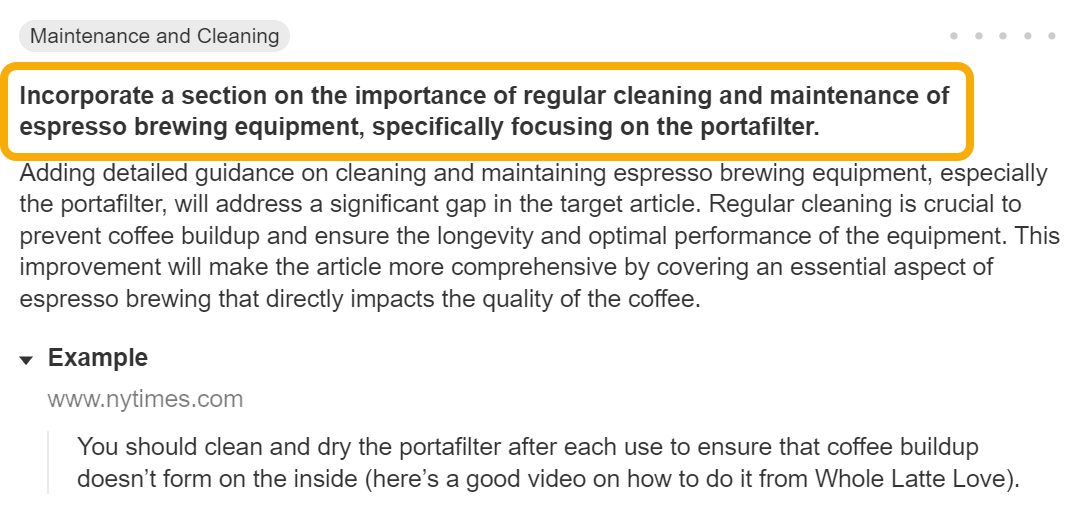
    Before making specific recommendations for topics to consider adding to our own article:

  • Optimize your images

    Images from your pages can rank in Google image search and send more traffic your way. You need to do three things to optimize them:

    • Compress your images. Compressing images makes file sizes smaller, leading to faster load times. Plenty of tools exist for doing this. ShortPixel is a good option.
    • Use descriptive filenames. Google says that filenames give them clues about the image’s subject matter.[9] So dog.jpg is better than IMG_859045.jpg. As a rule of thumb, be descriptive, be succinct, and don’t stuff keywords.
    • Use descriptive alt text. The main purpose of alt text is to improve accessibility for visitors who use screen readers, but Google also uses alt text (alternative text) to understand the subject matter of an image.[9] This is an HTML attribute that looks something like this: <img src=“https://yourdomain.com/puppy.jpg” alt=“puppy”>

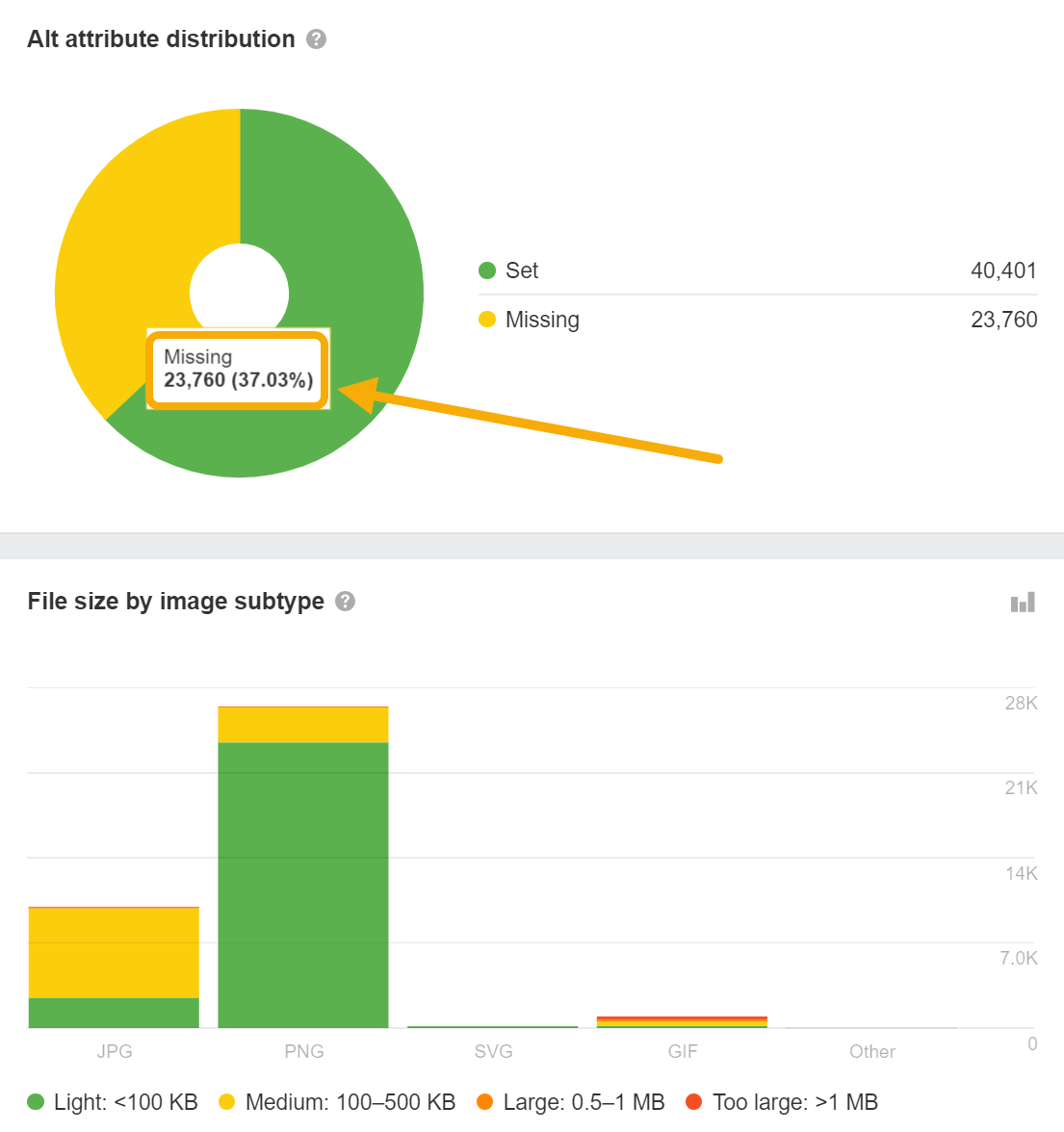
    You can use the Images report in Ahrefs’ Site Audit to check your site for images with missing alt text (and flag a host of other possible optimization opportunities, like oversized images):

  • Add external links

    Google says linking to other websites is a great way to provide value to your users

    External linking is also a good idea whenever you want to cite information from elsewhere on the web, or send the reader to an authoritative third-party source of information.

    We do this all the time on the Ahrefs blog:

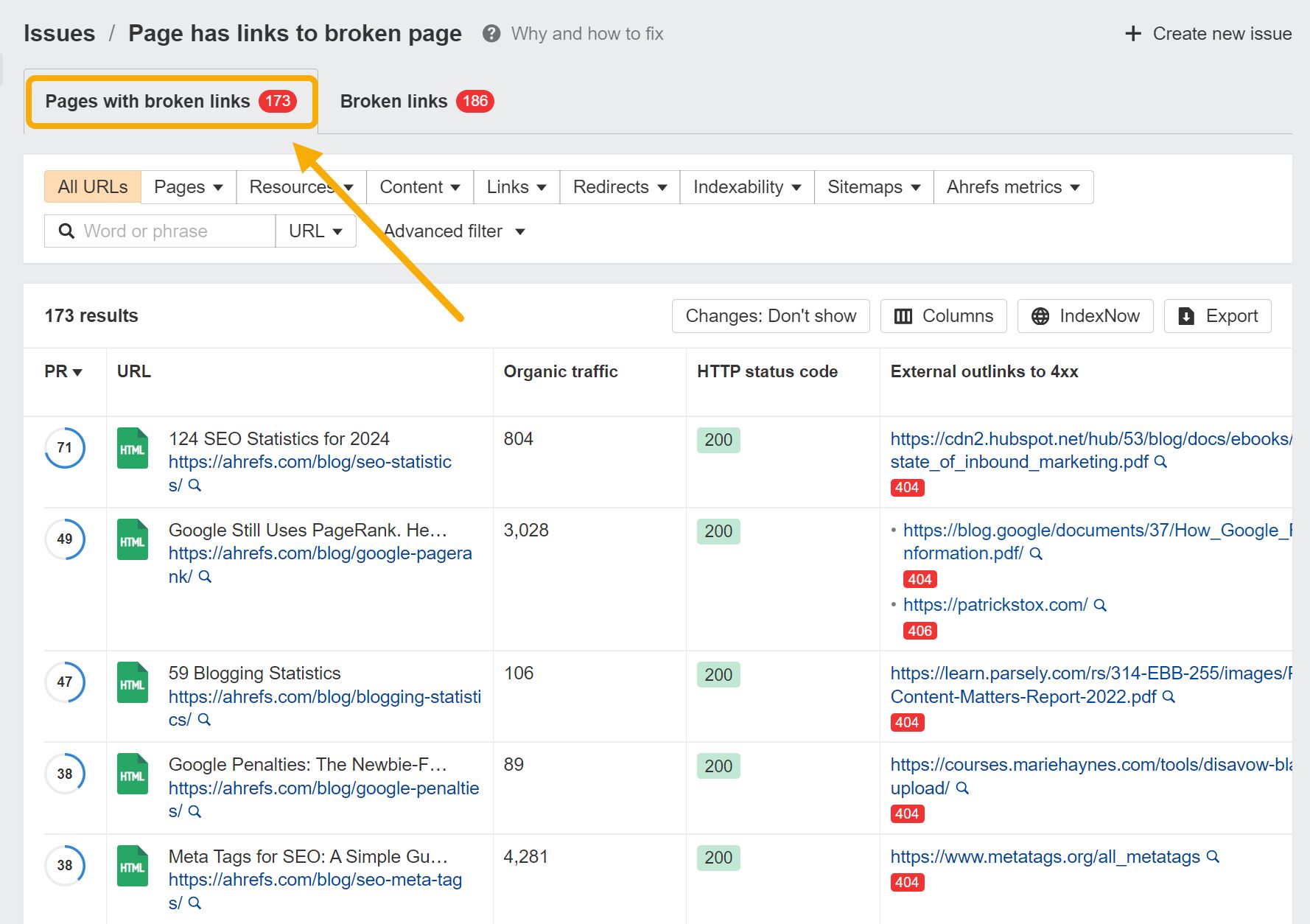
    Over time, some of your external links will break as the linked page is redirected or deleted, creating a bad user experience. You can find and fix these broken links using Site Audit: just set up a regular crawl of your website, and monitor the Pages with broken links issue in your crawls.

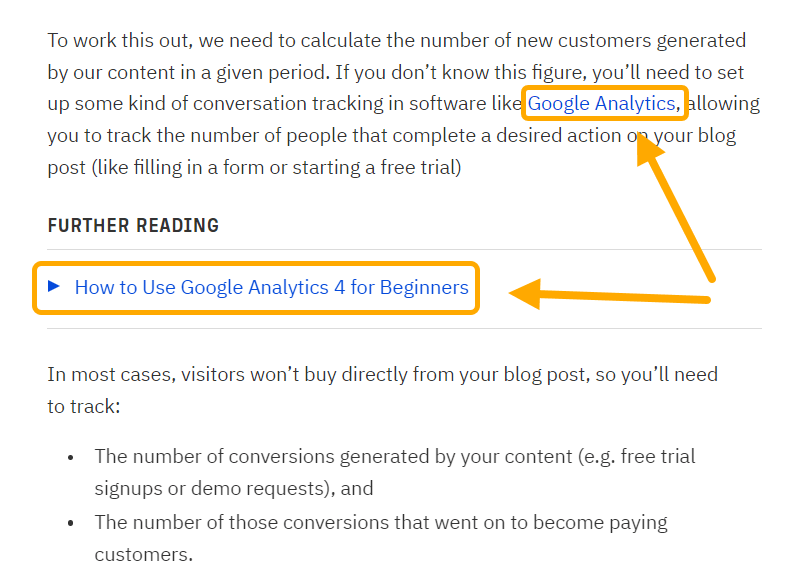
  • Add internal links in useful places

    If you have them, link to relevant pages on your website. Internal links help visitors navigate your website and increase the odds that they’ll find the information they need—but there are benefits for SEO too.

    Internal linking helps search engines find all the pages on your website, understand what each page is about (and how they relate to one another), and highlight the pages you believe to be the most important. These links also help pass link authority between your pages.

    When adding internal links:

    • Use relevant anchor text—but keep it natural and don’t keyword stuff your anchors.
    • Link to your most important pages, like your product and service pages, or your best blog posts.
    • Use the hub-and-spoke model to ensure that your most important “hub” pages receive the link authority they deserve.

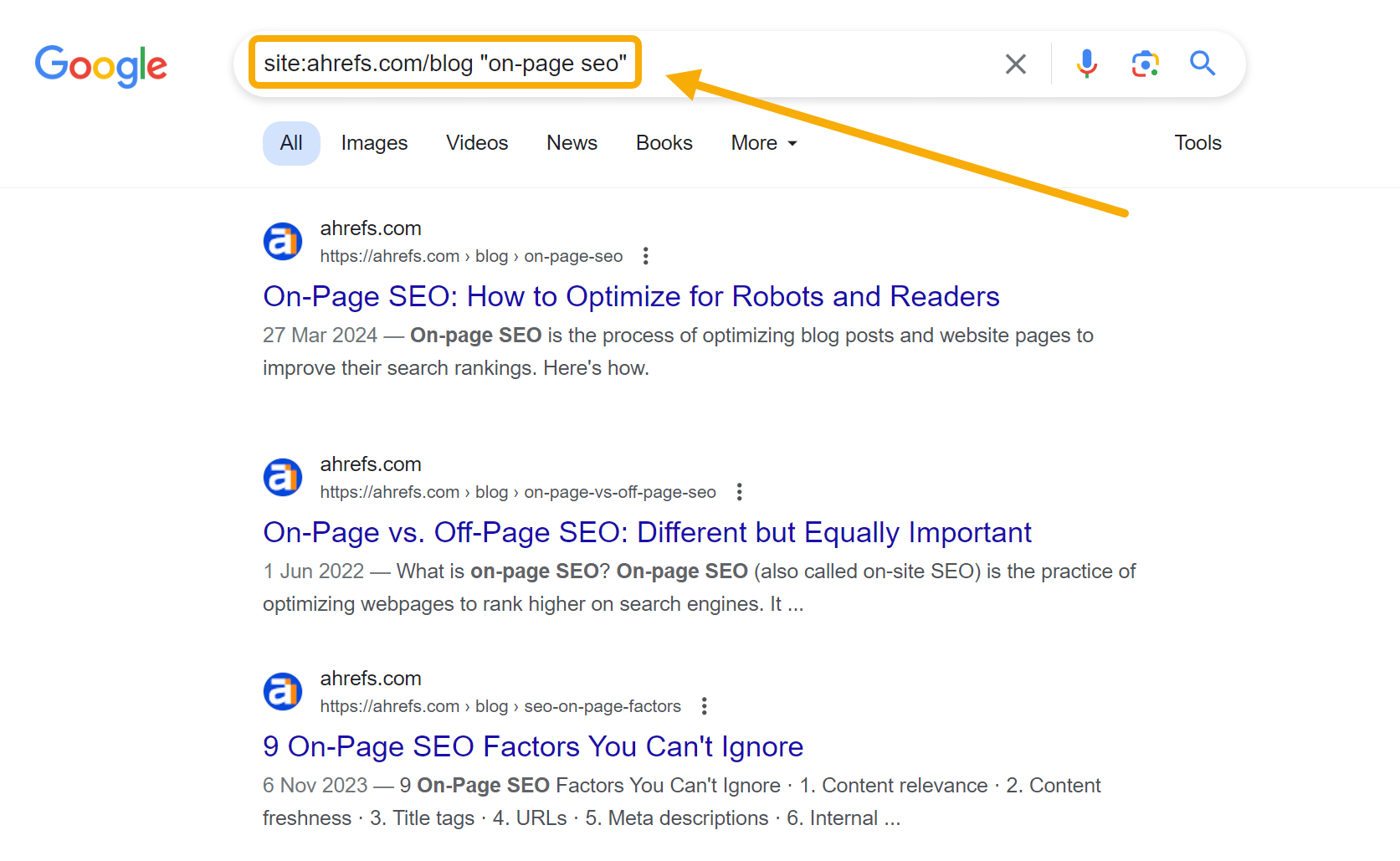
    You can use Google’s site: search operator to quickly find relevant pages to link to. Search your website for your target keyword (in brackets to find exact matches), and Google will show every indexed page that features the keyword:

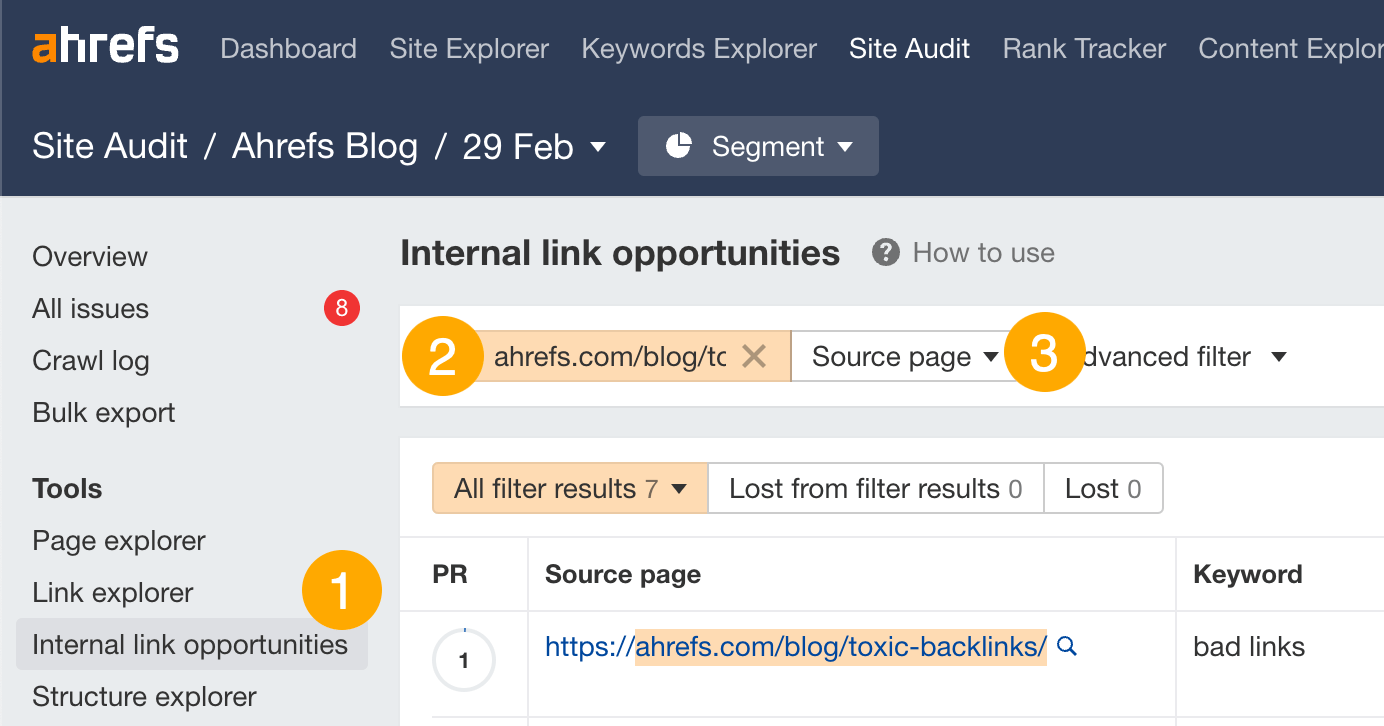
    Or you can automate the process using Ahrefs’ Site Audit:

    1. Go to the Internal link opportunities report
    2. Enter the URL of your newly-published page in the search box
    3. Choose “Source page” from the dropdown

    Hit enter, and you’ll see a list of recommended internal linking opportunities.

    For example, here the report is suggesting that I link from our post on toxic backlinks to our guide on bad links: