Top ranking on search results pages will make consumers believe you’re the best choice. In search engine results lists, up to 40% of users click on the first results if they need a fast answer. Consumers won’t be aware of the SEO practices that elevated you to the top of the list, so they’ll rely on your reputation as an industry leader. Even if you lose your ranking position, this title will have a lasting impact. A few tips using which a website can rank on top are –
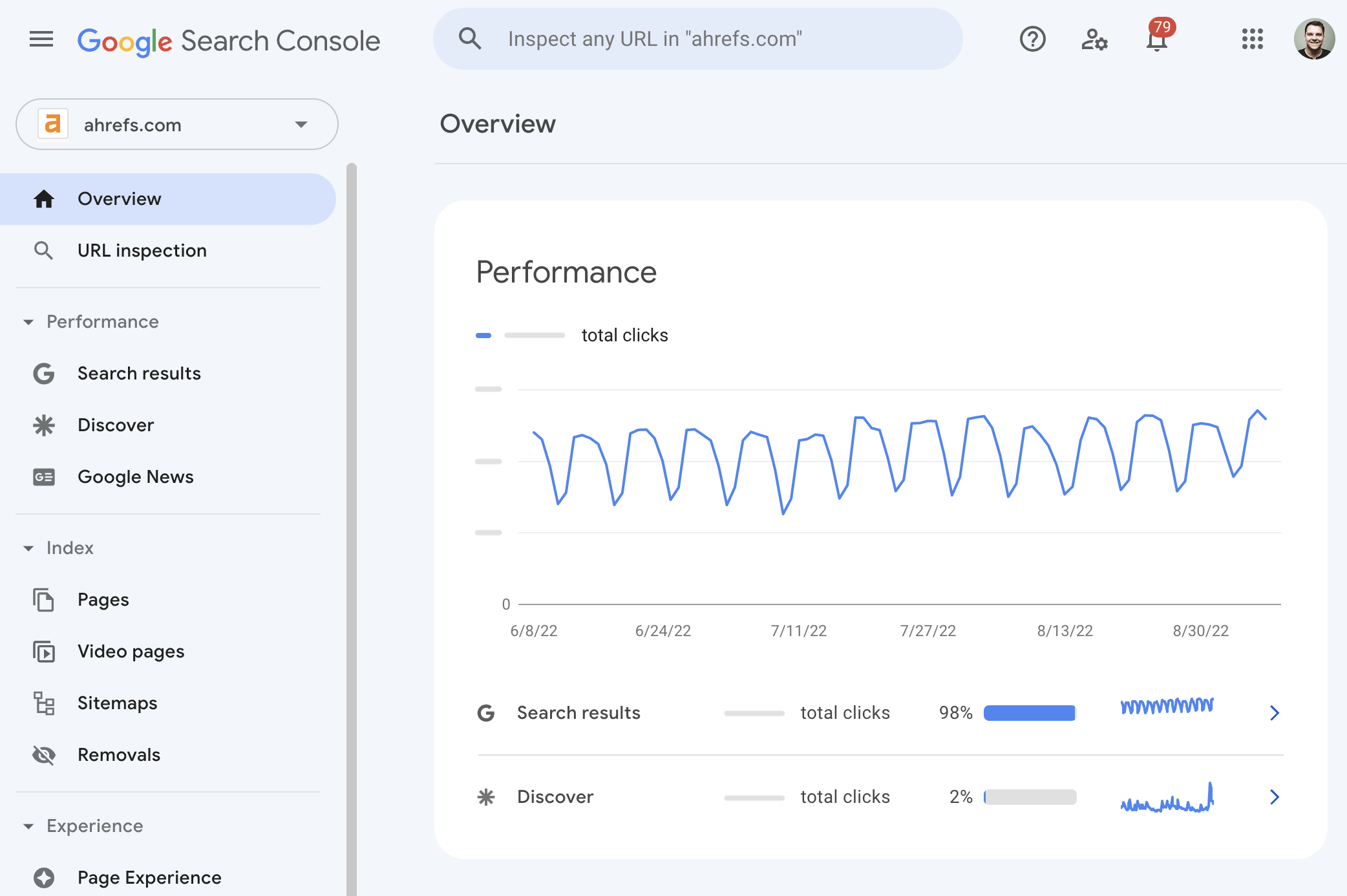
Google Search Console (previously Google Webmaster Tools) is a free service from Google that helps you monitor and troubleshoot your website’s appearance in its search results.
Use it to find and fix technical errors, submit sitemaps, see structured data issues, and more.
Bing and Yandex have their own versions, and so does Ahrefs. Ahrefs Webmaster Tools is a free tool that’ll help you improve your website’s SEO performance. It allows you to:
Monitor your website’s SEO health.
Check for 100+ SEO issues.
View all your backlinks.
See all the keywords you rank for.
Find out how much traffic your pages are receiving.
Find internal linking opportunities.
It’s our answer to the limitations of Google Search Console.
Google’s Mobile-Friendly Test
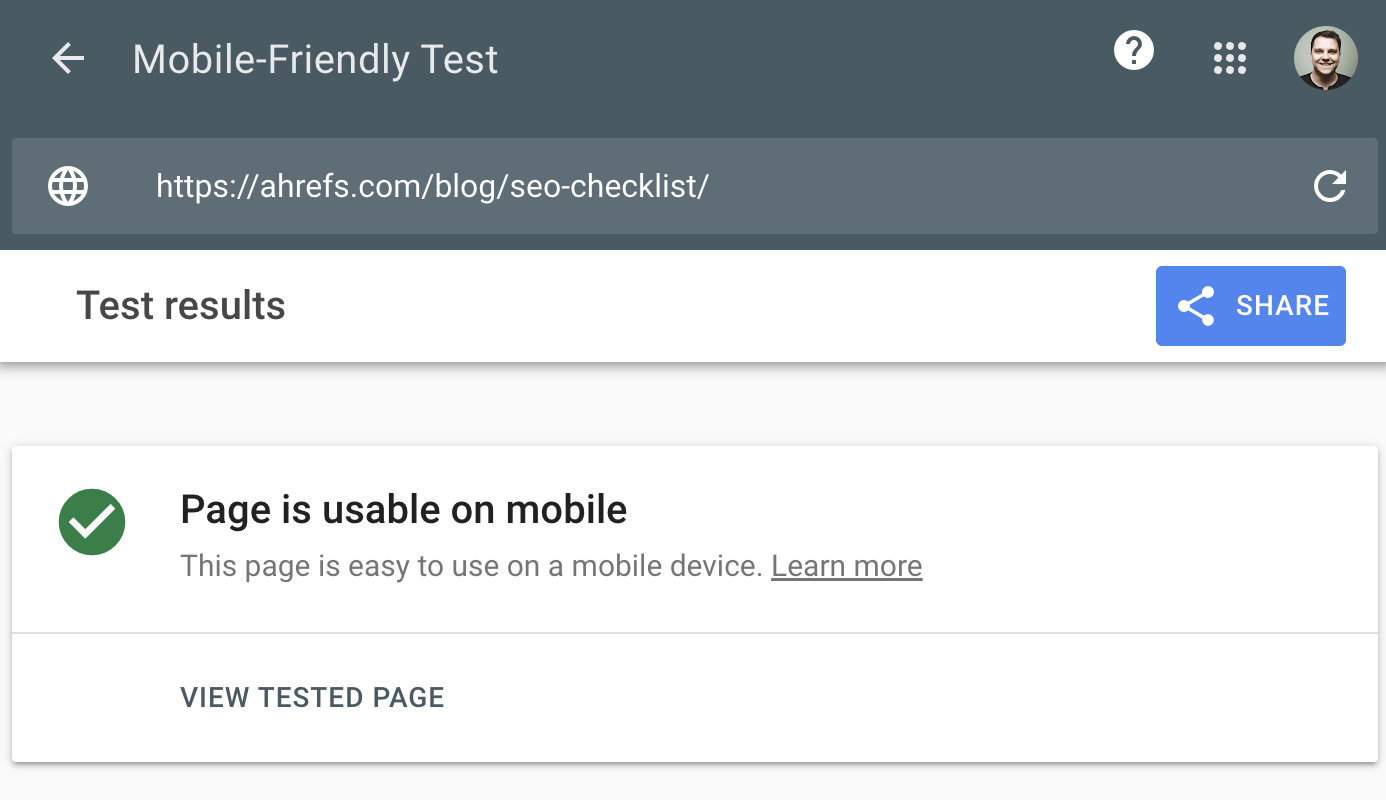
Google’s Mobile-Friendly Test checks how easily a visitor can use your page on a mobile device. It also identifies specific mobile-usability issues like text that’s too small to read, the use of incompatible plugins, and so on.
The Mobile-Friendly Test shows what Google sees when it crawls the page. You can also use the Rich Results Test to see the content Google sees for desktop or mobile devices.
Chrome DevTools
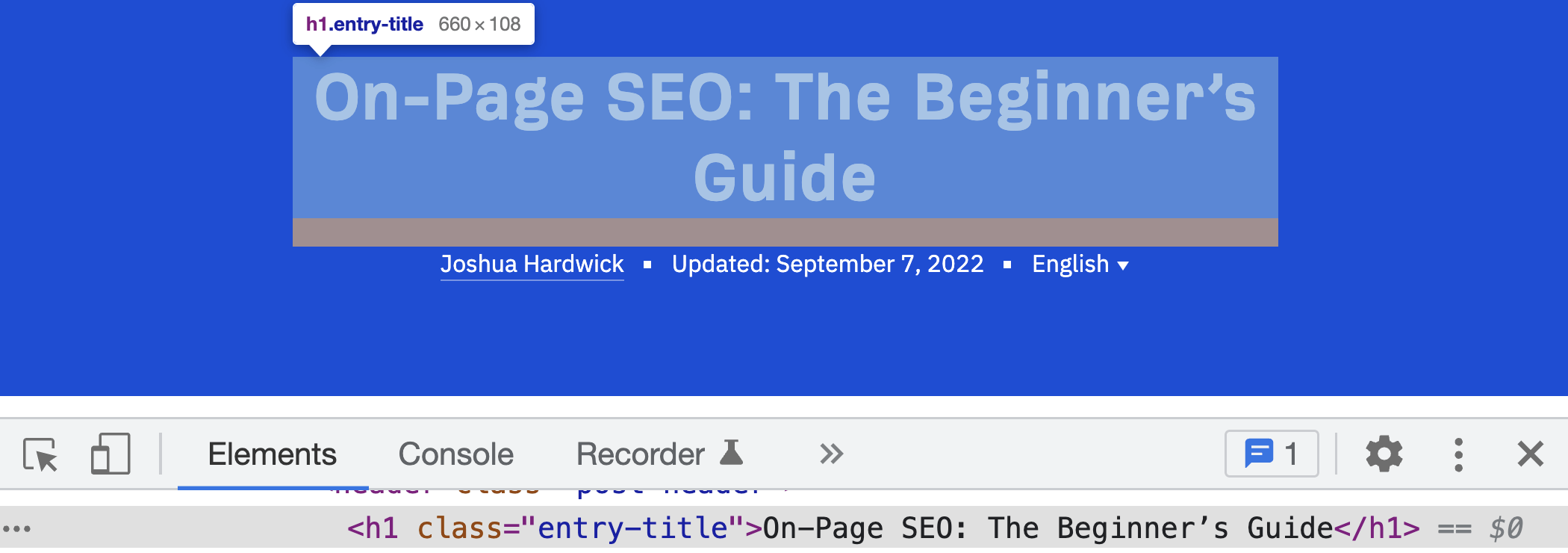
Chrome DevTools is Chrome’s built-in webpage debugging tool. Use it to debug page speed issues, improve webpage rendering performance, and more.
From a technical SEO standpoint, it has endless uses.
Ahrefs’ SEO Toolbar
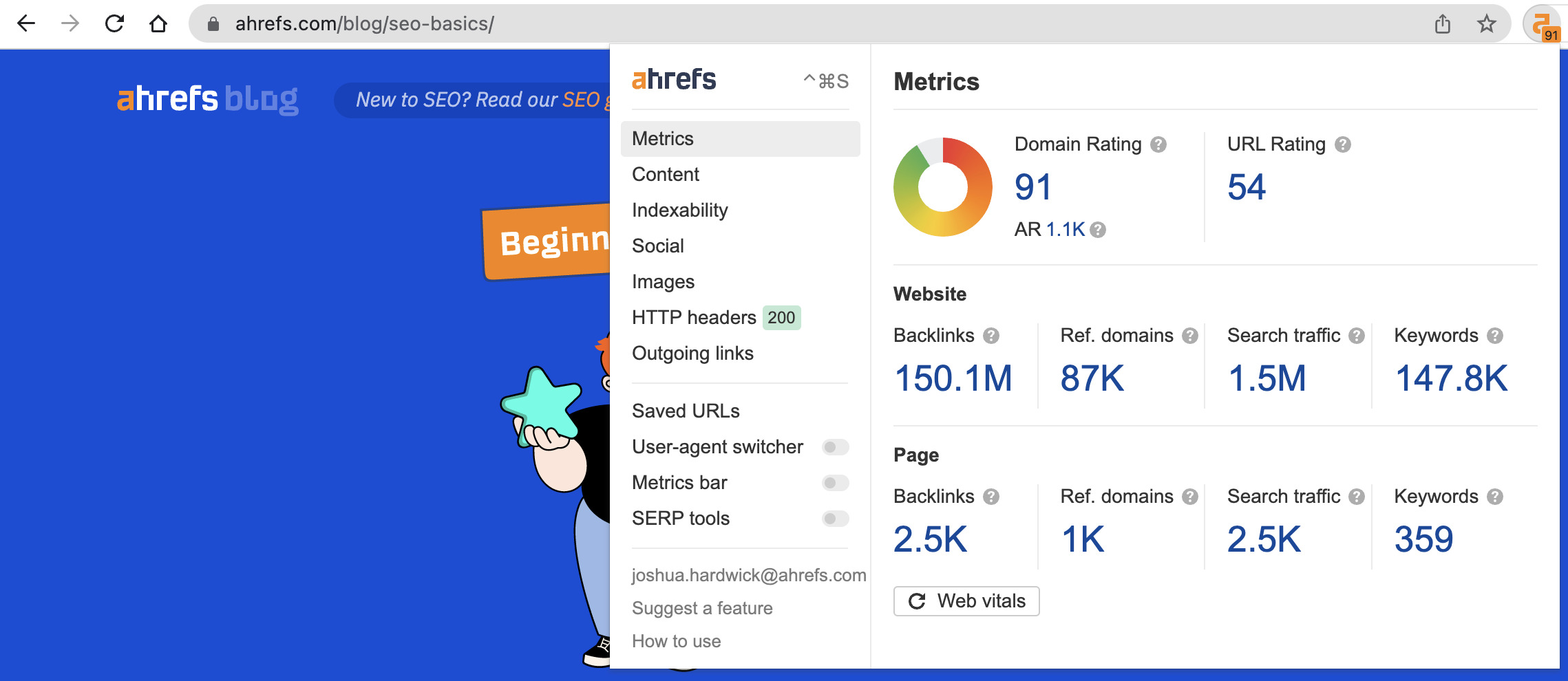
Ahrefs’ SEO Toolbar is a free extension for Chrome and Firefox that provides useful SEO data about the pages and websites you visit.
Its free features are:
On-page SEO report
Redirect tracer with HTTP headers
Broken link checker
Link highlighter
SERP positions
In addition, as an Ahrefs user, you get:
SEO metrics for every site and page you visit and for Google search results
Keyword metrics, such as search volume and Keyword Difficulty, directly in the SERP
SERP results export
PageSpeed Insights
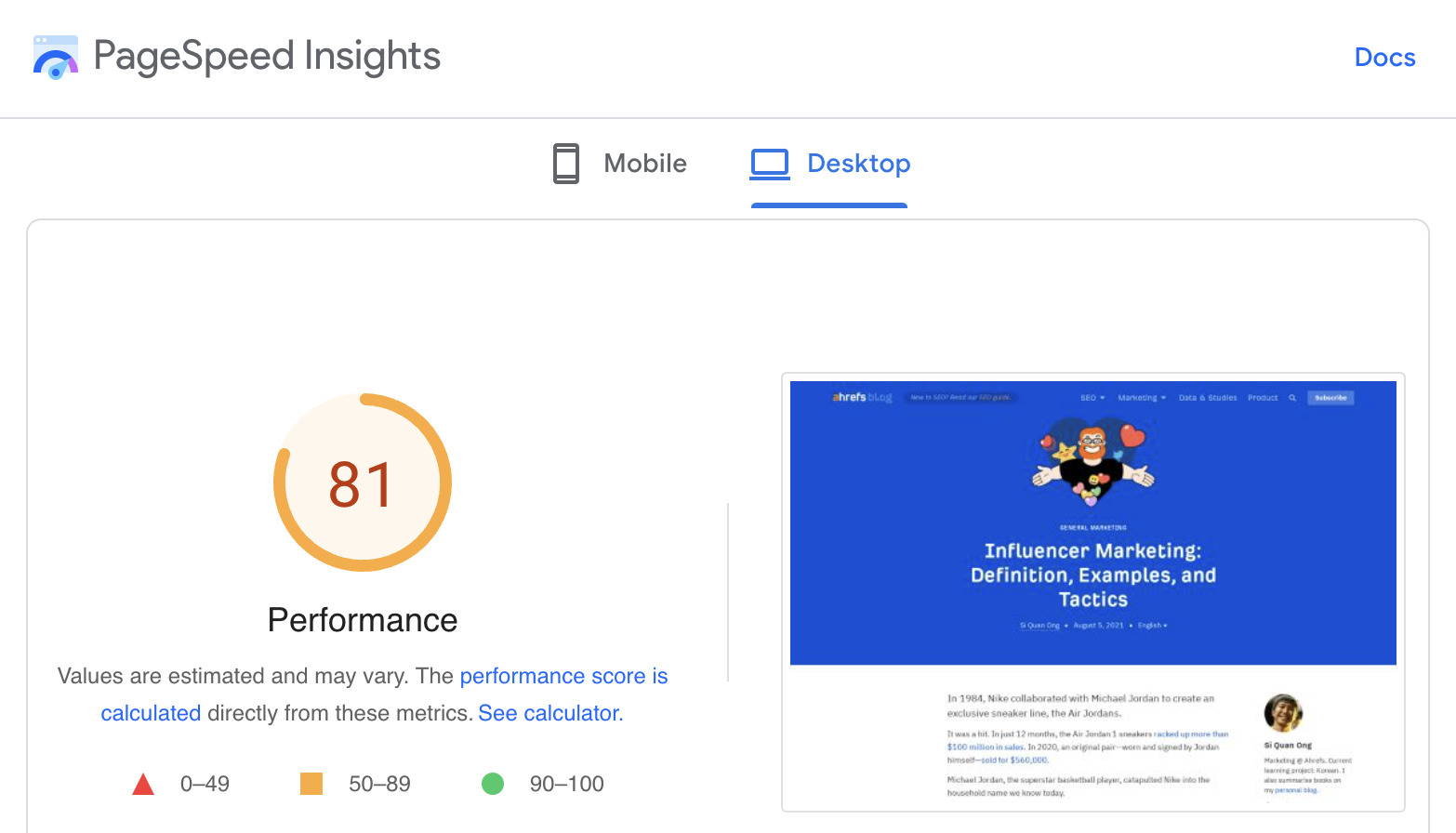
PageSpeed Insights analyzes the loading speed of your webpages. Alongside the performance score, it also shows actionable recommendations to make pages load faster.
The projects we’ll talk about in this chapter are all good things to focus on, but they may require more work and have less benefit than the “quick win” projects from the previous part. That doesn’t mean you shouldn’t do them. This is just to help you get an idea of how to prioritize various projects.
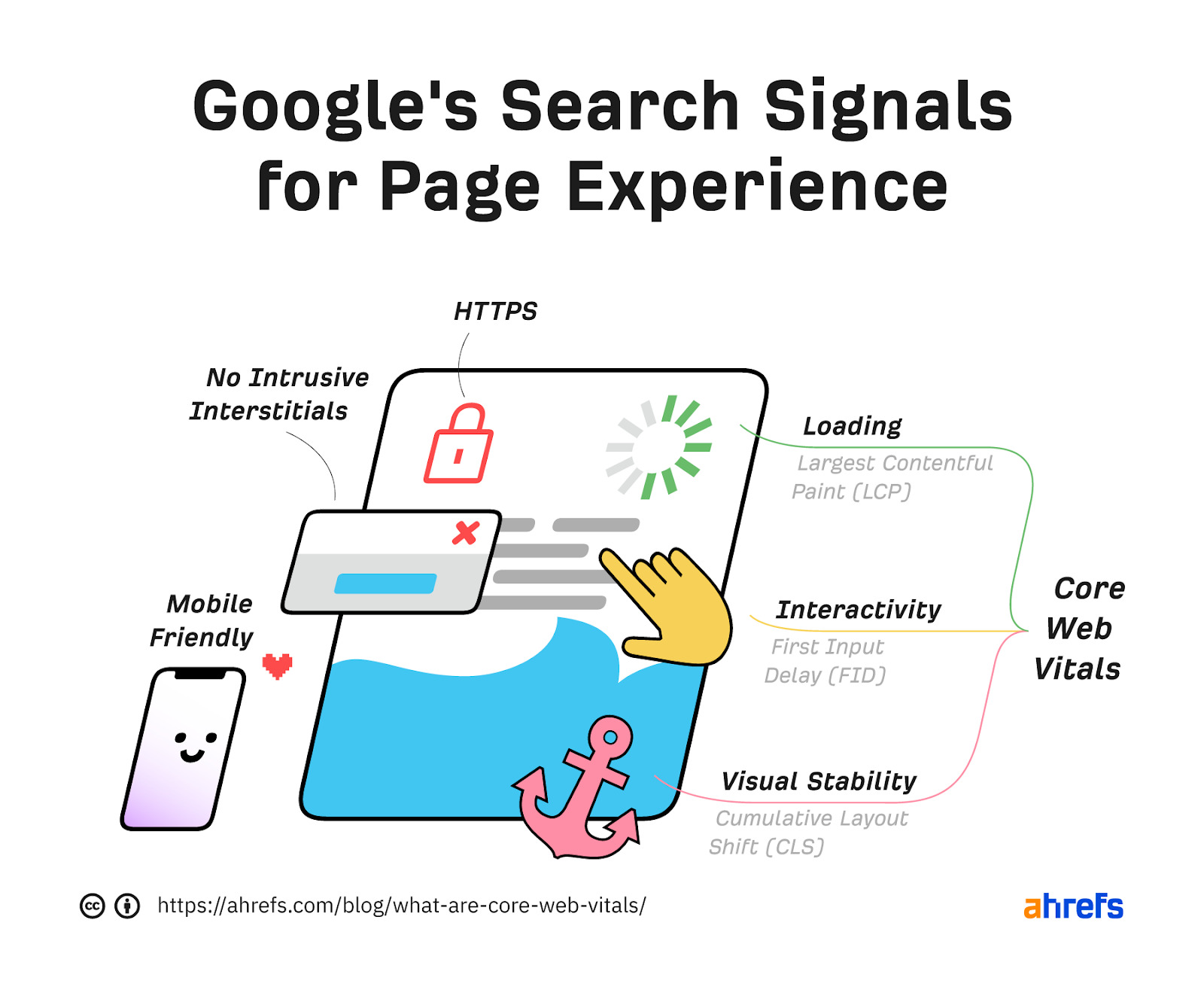
Page experience signals
These are lesser ranking factors, but still things you want to look at for the sake of your users. They cover aspects of the website that impact user experience (UX).
Core Web Vitals
Core Web Vitals are the speed metrics that are part of Google’s Page Experience signals used to measure user experience. The metrics measure visual load with Largest Contentful Paint (LCP), visual stability with Cumulative Layout Shift (CLS), and interactivity with First Input Delay (FID).
HTTPS
HTTPS protects the communication between your browser and server from being intercepted and tampered with by attackers. This provides confidentiality, integrity, and authentication to the vast majority of today’s WWW traffic. You want your pages loaded over HTTPS and not HTTP.
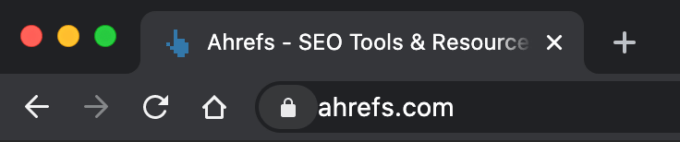
Any website that shows a “lock” icon in the address bar is using HTTPS.
Mobile-friendliness
Simply put, this checks if webpages display properly and are easily used by people on mobile devices.
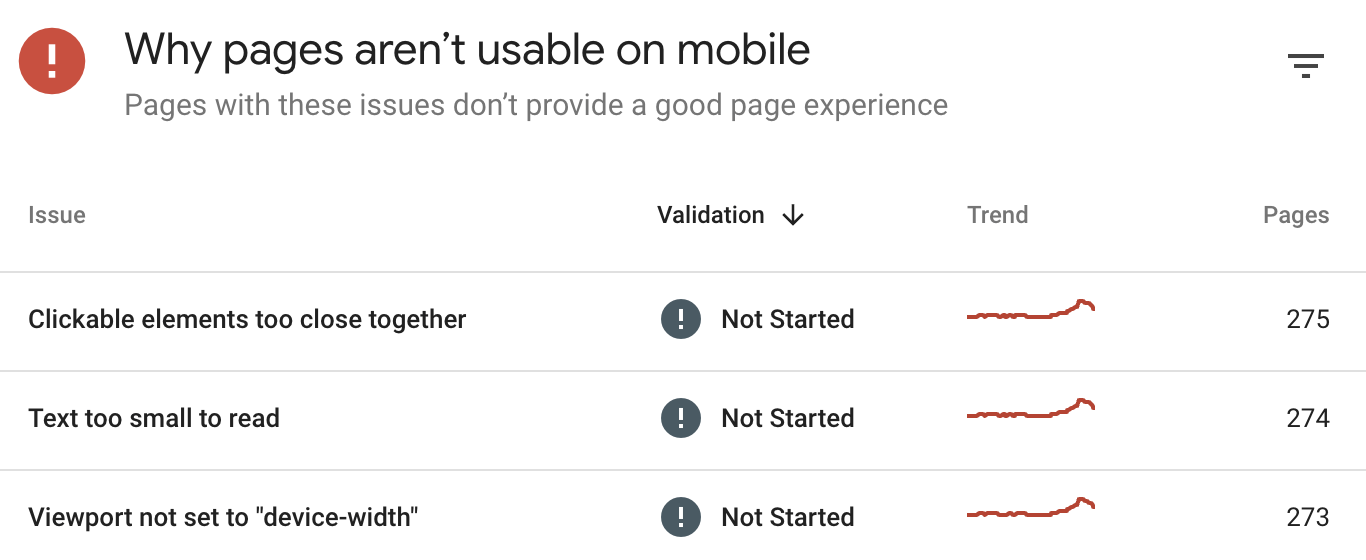
How do you know how mobile-friendly your site is? Check the “Mobile Usability” report in Google Search Console.
This report tells you if any of your pages have mobile-friendliness issues.
Interstitials
Interstitials block content from being seen. These are popups that cover the main content and that users may have to interact with before they go away.
Hreflang — For multiple languages
Hreflang is an HTML attribute used to specify the language and geographical targeting of a webpage. If you have multiple versions of the same page in different languages, you can use the hreflang tag to tell search engines like Google about these variations. This helps them to serve the correct version to their users.
General maintenance/website health
These tasks aren’t likely to have much impact on your rankings but are generally good things to fix for user experience.
Broken links
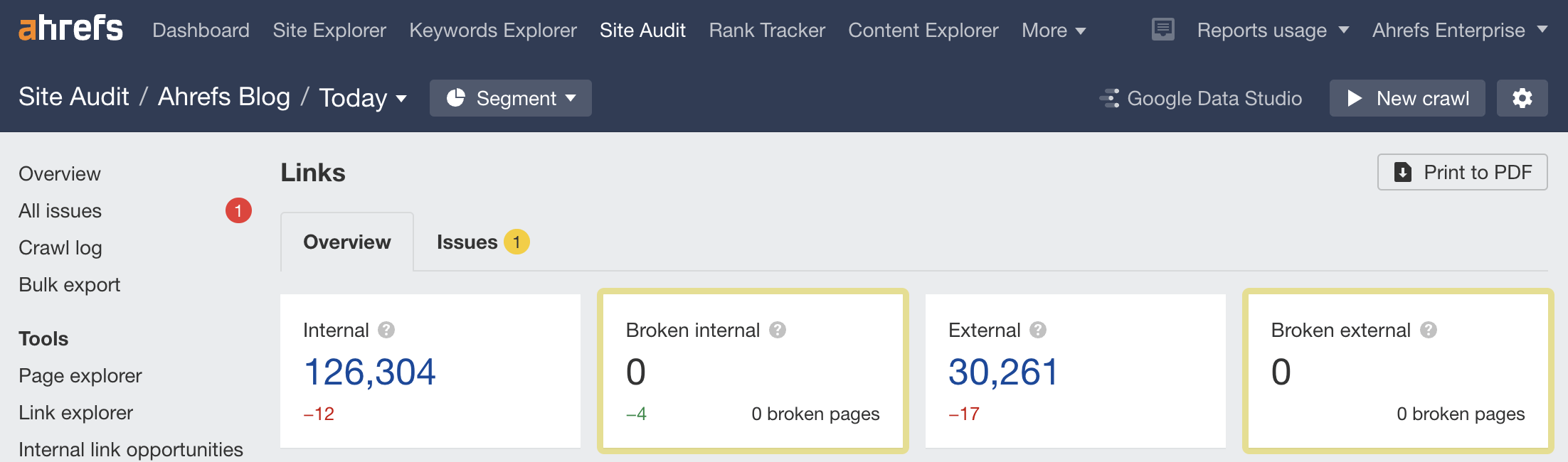
Broken links are links on your site that point to non-existent resources. These can be either internal (i.e., to other pages on your domain) or external (i.e., to pages on other domains).
You can find broken links on your website quickly with Site Audit in the Links report. It’s free in Ahrefs Webmaster Tools.
Redirect chains
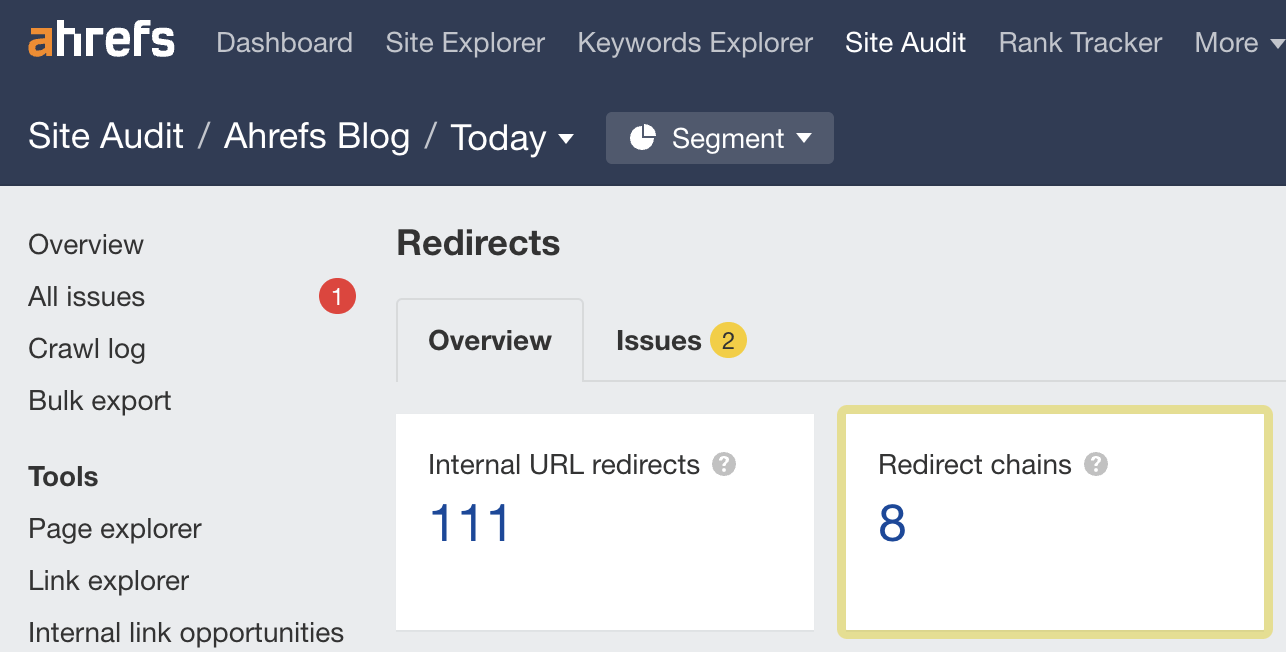
Redirect chains are a series of redirects that happen between the initial URL and the destination URL.
You can find redirect chains on your website quickly with Site Audit in the Redirects report. It’s free in Ahrefs Webmaster Tools.
One of the hardest things for SEOs is prioritization. There are a lot of best practices, but some changes will have more of an impact on your rankings and traffic than others. Here are some of the projects I’d recommend prioritizing.
Check indexing
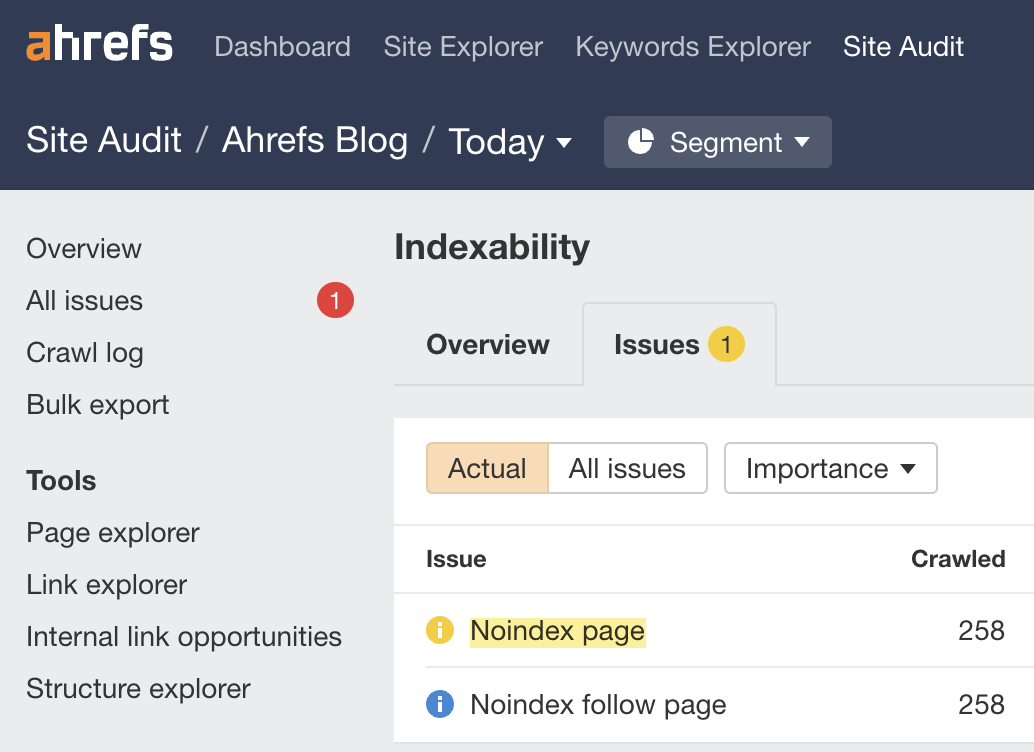
Make sure pages you want people to find can be indexed in Google. The two previous chapters were all about crawling and indexing, and that was no accident.
You can check the Indexability report in Site Audit to find pages that can’t be indexed and the reasons why. It’s free in Ahrefs Webmaster Tools.
Reclaim lost links
Websites tend to change their URLs over the years. In many cases, these old URLs have links from other websites. If they’re not redirected to the current pages, then those links are lost and no longer count for your pages. It’s not too late to do these redirects, and you can quickly reclaim any lost value. Think of this as the fastest link building you will ever do.
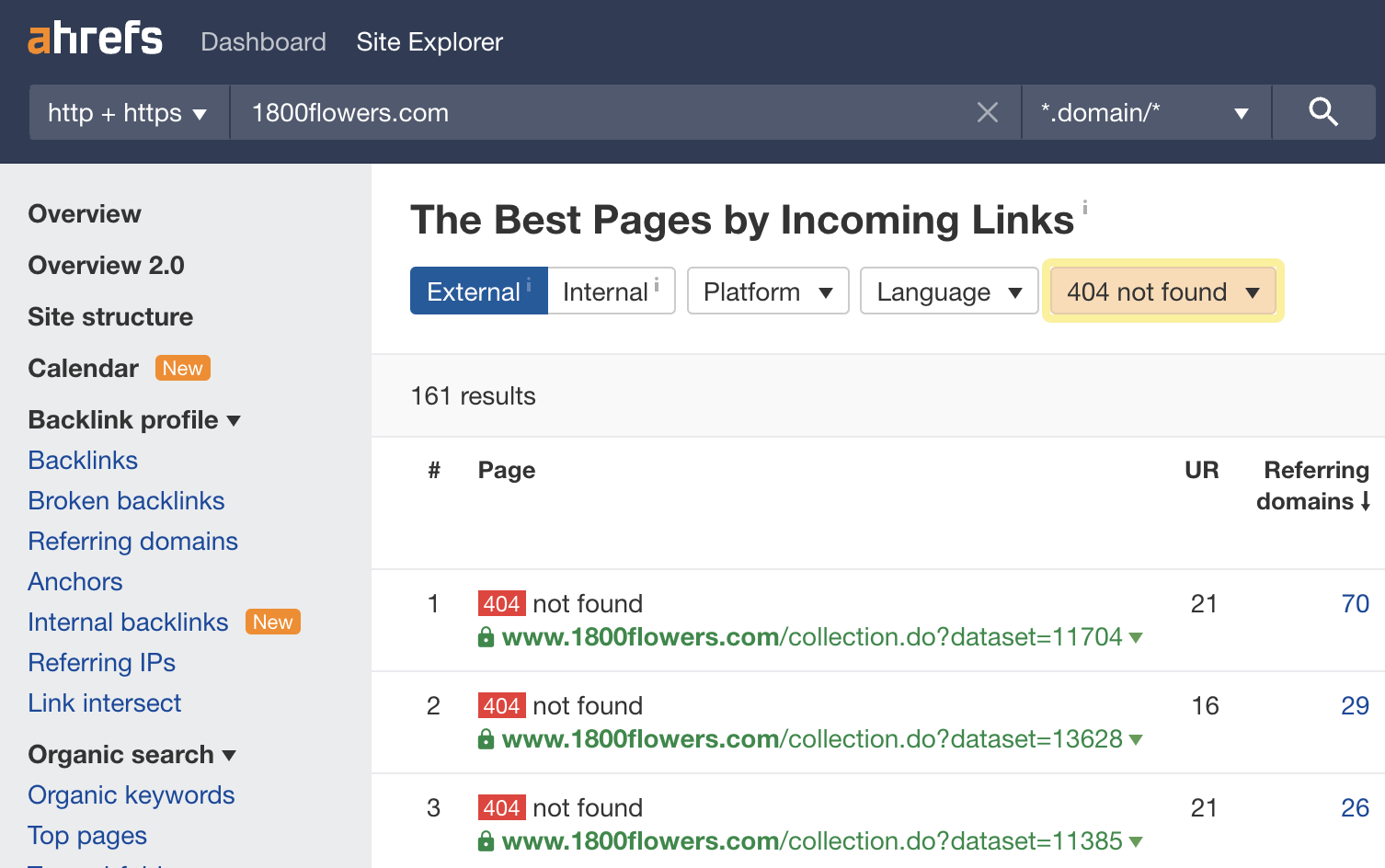
You can find opportunities to reclaim lost links using Ahrefs’ Site Explorer. Enter your domain, go to the Best by Links report, and add a “404 not found” HTTP response filter. I usually sort this by “Referring Domains”.
This is what it looks like for 1800flowers.com:
Looking at the first URL in archive.org, I see that this was previously the Mother’s Day page. By redirecting that one page to the current version, you’ll reclaim 225 links from 59 different websites—and there are plenty more opportunities.
You’ll want to 301 redirect any old URLs to their current locations to reclaim this lost value.
DID YOU KNOW?
A 301 redirect is a permanent redirect. Any links pointing to the redirected URL will count toward the new URL in Google’s eyes.[3]
Add internal links
Internal links are links from one page on your site to another page on your site. They help your pages be found and also help the pages rank better. We have a tool within Site Audit called Internal Link Opportunities that helps you quickly locate these opportunities.
This tool works by looking for mentions of keywords that you already rank for on your site. Then it suggests them as contextual internal link opportunities.
For example, the tool shows a mention of “faceted navigation” in our guide to duplicate content. As Site Audit knows we have a page about faceted navigation, it suggests we add an internal link to that page.
Add schema markup
Schema markup is code that helps search engines understand your content better and powers many features that can help your website stand out from the rest in search results. Google has a search gallery that shows the various search features and the schema needed for your site to be eligible.
In this chapter, we’ll talk about how to make sure your pages are indexed and check how they’re indexed.
Robots directives
A robots meta tag is an HTML snippet that tells search engines how to crawl or index a certain page. It’s placed into the <head> section of a webpage and looks like this:
<meta name="robots" content="noindex" />
Canonicalization
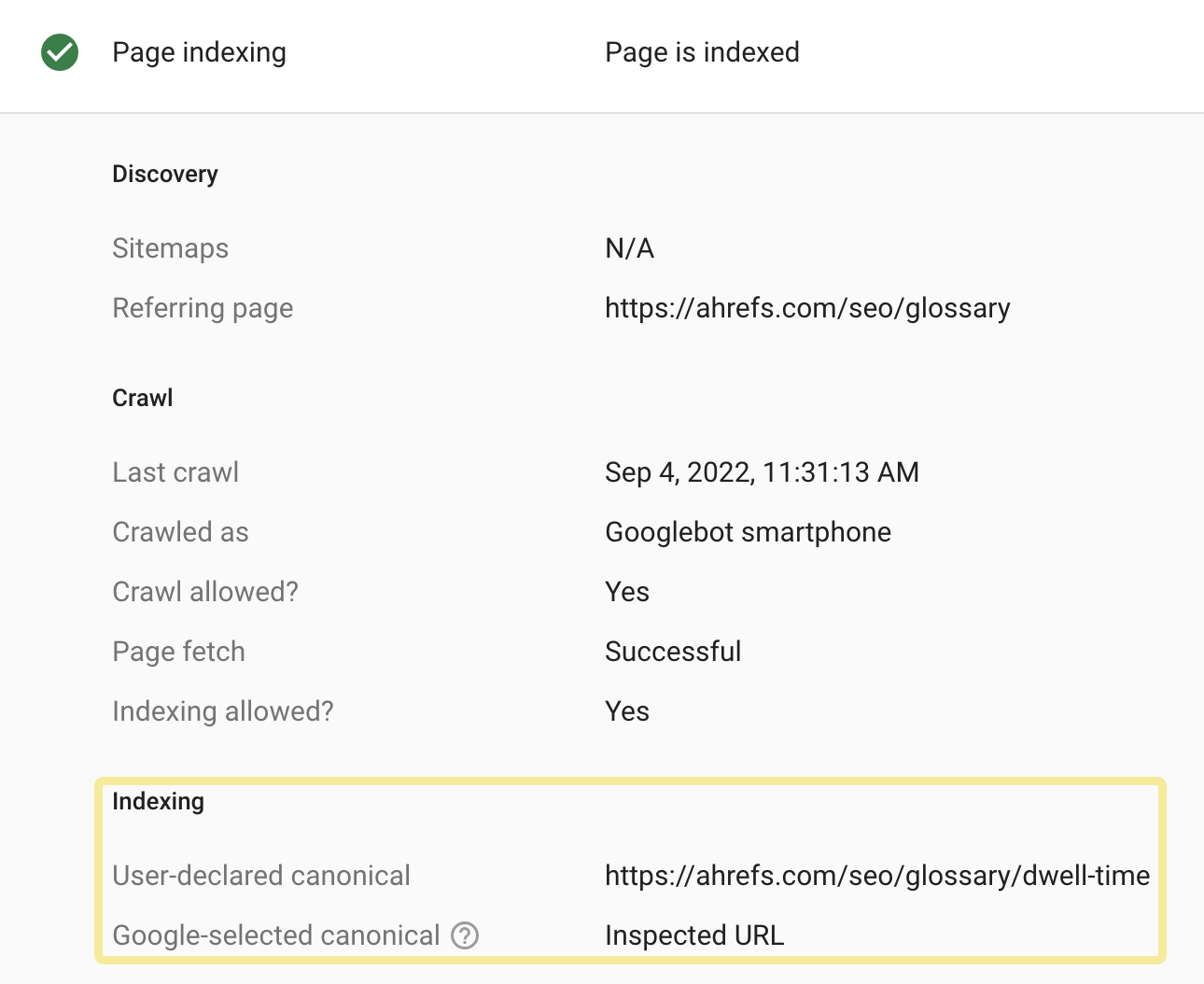
When there are multiple versions of the same page, Google will select one to store in its index. This process is called canonicalization and the URL selected as the canonical will be the one Google shows in search results. There are many different signals it uses to select the canonical URL including:
Canonical tags
Duplicate pages
Internal links
Redirects
Sitemap URLs
The easiest way to see how Google has indexed a page is to use the URL Inspection tool in Google Search Console. It will show you the Google-selected canonical URL.
In this chapter we’ll cover how to make sure search engines can efficiently crawl your content.
How crawling works
Crawling is where search engines grab content from pages and use the links on them to find even more pages. There are a few ways you can control what gets crawled on your website. Here are a few options.
Robots.txt
A robots.txt file tells search engines where they can and can’t go on your site.
DID YOU KNOW?
Google may index pages that it can’t crawl if links are pointing to those pages. This can be confusing, but if you want to keep pages from being indexed, check out this guide and flowchart which can guide you through the process.
Crawl rate
There’s a crawl-delay directive you can use in robots.txt that many crawlers support. It lets you set how often they can crawl pages. Unfortunately, Google doesn’t respect this. For Google, you’ll need to change the crawl rate in Google Search Console.
Access restrictions
If you want the page to be accessible to some users but not search engines, then what you probably want is one of these three options:
Some kind of login system
HTTP authentication (where a password is required for access)
IP whitelisting (which only allows specific IP addresses to access the pages)
This type of setup is best for things like internal networks, member-only content, or for staging, test, or development sites. It allows for a group of users to access the page, but search engines will not be able to access the page and will not index it.
How to see crawl activity
For Google specifically, the easiest way to see what it’s crawling is with the “Crawl stats” report in Google Search Console, which gives you more information about how it’s crawling your website.
If you want to see all crawl activity on your website, then you will need to access your server logs and possibly use a tool to better analyze the data. This can get fairly advanced. But if your hosting has a control panel like cPanel, you should have access to raw logs and some aggregators like AWstats and Webalizer.
Crawl adjustments
Each website is going to have a different crawl budget, which is a combination of how often Google wants to crawl a site and how much crawling your site allows. More popular pages and pages that change often will be crawled more often, and pages that don’t seem to be popular or well linked will be crawled less often.
If crawlers see signs of stress while crawling your website, they’ll typically slow down or even stop crawling until conditions improve.
After pages are crawled, they’re rendered and sent to the index. The index is the master list of pages that can be returned for search queries. Let’s talk about the index.
Technical SEO is the practice of optimizing your website to help search engines find, crawl, understand, and index your pages. It helps increase visibility and rankings in search engines.
How complicated is technical SEO?
It depends. The fundamentals aren’t really difficult to master, but technical SEO can be complex and hard to understand. I’ll keep things as simple as I can with this guide.
While it is technically possible to build links with just a bit of brain power and a Gmail account, there are a number of link building tools that will help make the process of acquiring links much faster and easier.
Here are some free ones:
Ahrefs’ Free Backlink Checker – Shows top 100 links pointing at any website or URL.
Google Alerts – Notifies you whenever a specific word or phrase was mentioned on a newly published page. Which is a great way to source relevant link prospects.
And here are some premium ones:
Ahrefs’ Site Explorer – Shows you all links of any website or URL with an option to sort and filter them by many important SEO metrics.
Ahrefs’ Content Explorer – A unique link prospecting tool, which helps you find thousands of relevant websites for link requests and guest posting. Also helps to discover linkable assets on any topic from all around the web.
Ahrefs Alerts – Similar to Google Alerts but has more flexibility with SEO-related filters.
Pitchbox/BuzzStream/GMass – Email outreach tools. There are many other tools that let you send personalized emails at scale, but these ones seem to be the most popular among SEOs.
Hunter.io/Voila Norbert – The so-called “email lookup services,” which help you find contact details of websites at scale.
There are many different link building tactics and strategies out there. Some of them can be very effective, while others no longer work these days and will most likely just waste your time.
Here’s what works really well today, according to our observations:
1. Replicating your competitor’s backlinks
If someone is linking to your competitor, there’s a good chance that they might be open to linking to you too.
A good way to kick off this strategy is to study who links to the actual homepages of your competitor’s websites. These people are mentioning the business as a whole and not some specific webpage, which you might not have on your own website.
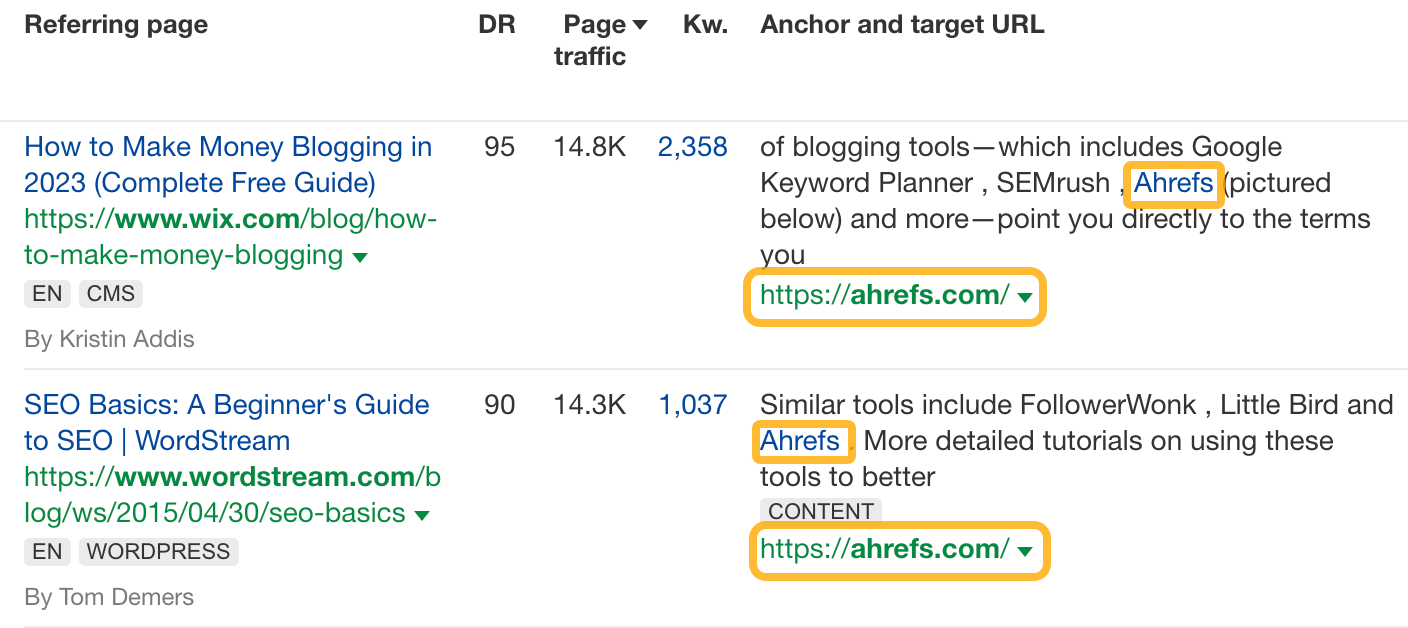
For example, here are a couple of pages (with decent search traffic) that link to our homepage:
A screenshot from Site Explorer.
As you can see, in both cases, Ahrefs is mentioned right next to some other marketing tools, which only proves the point that asking to be mentioned alongside your competitors is a fair request.
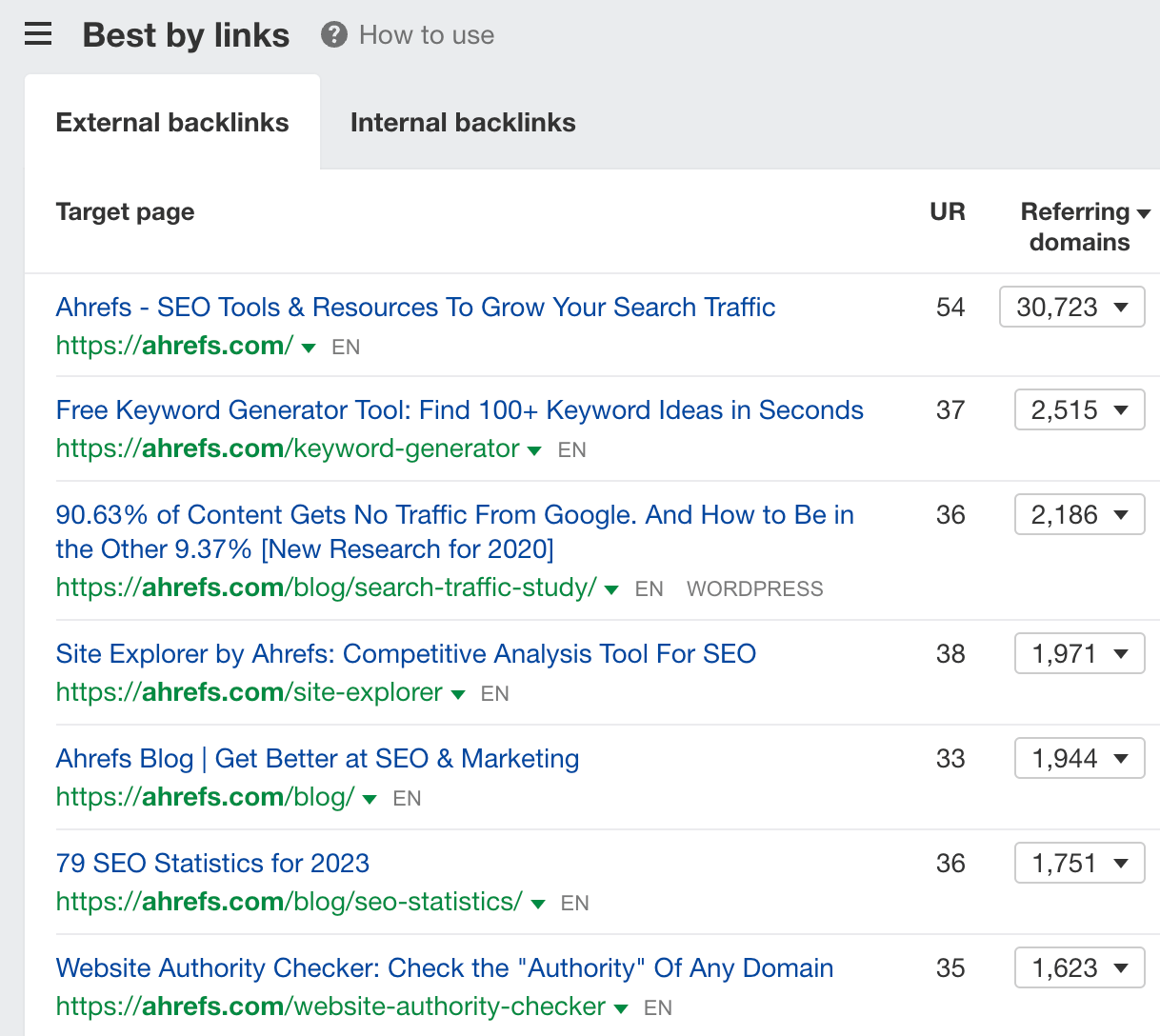
Once you’re done with the homepage links, the next step is to study which pages on your competitor’s websites have the most links. We have a report in Site Explorer just for that, which is called “Best by links.”
By looking at the Best by links report for ahrefs.com (above), it’s easy to spot what kinds of pages have brought us the most links:
Our homepage – Because lots of people mention Ahrefs as a software or as a company.
Our free tools – Keyword Generator and Website Authority Checker are two of the many free tools we developed. And each of these tools is attracting a ton of backlinks organically.
Our blog – Thanks to a consistent output of useful content, lots of people are now recommending our blog and linking to it.
Our research studies – People love insightful data. So the research studies that we publish tend to get lots of links.
Try browsing the Best by links report for your own competitors and see what kinds of pages bring them links. Once you identify what worked for them, you can create similar (or better) resources on your own website.
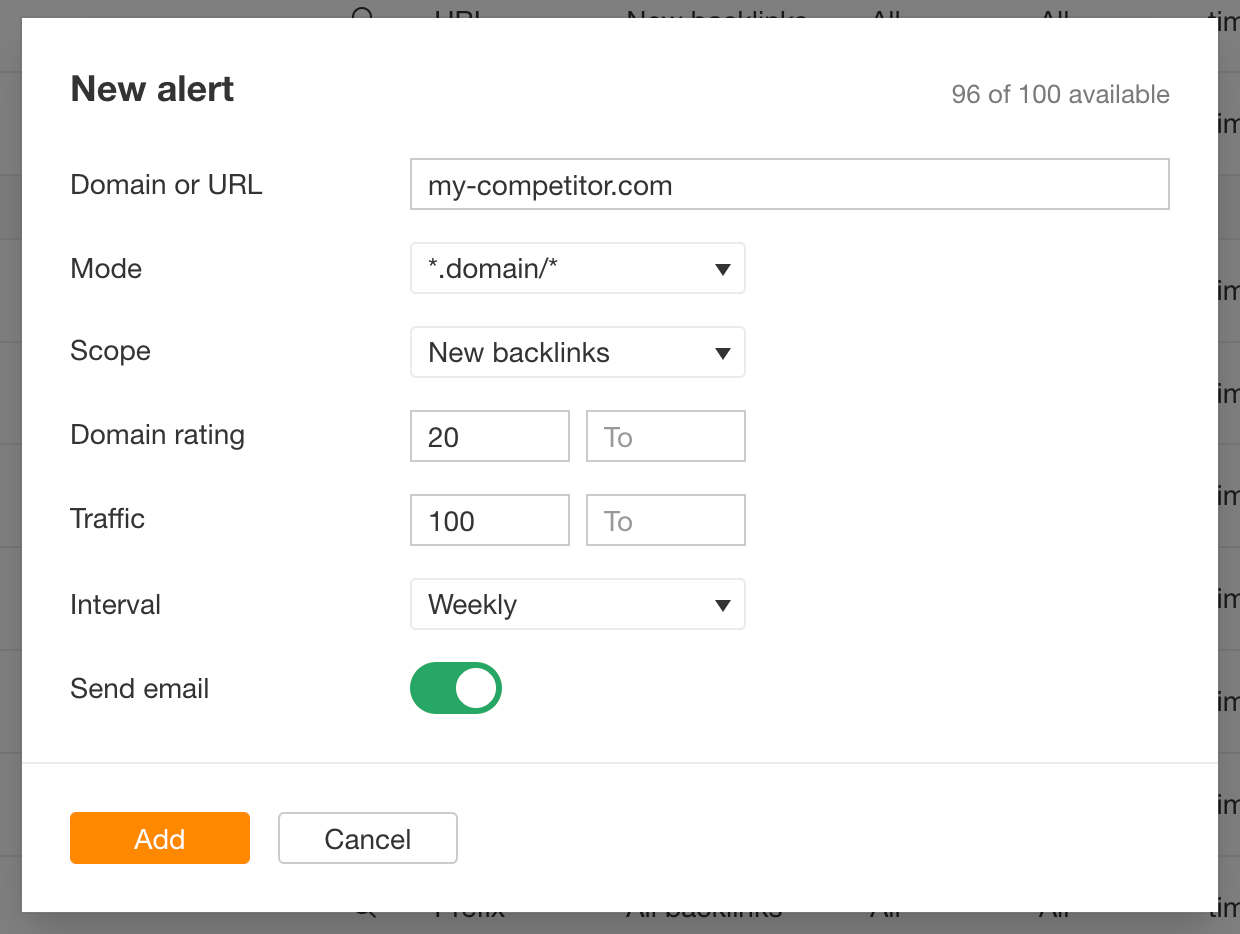
After you’re done with the above tactics, I suggest that you set up a backlink alert and get notified whenever your competitors get new links. This way, you’ll be able to immediately reach out to whoever linked to them and try to get yourself added on the same page.
All in all, your competitors are a goldmine of great link opportunities. And as you dig deep into their backlinks, you’ll soon see some link building patterns, which you can leverage on your own website. We wrote a pretty detailed article on that topic, actually. Make sure to check it out.
2. Targeted link outreach
So let’s say you’ve done your keyword research and a very specific page that you need to rank well in Google for a certain keyword. And you need to build links to that very specific page.
Well, the best place to start is to pull up the top-ranking pages for your desired keyword and research where they got their links from.
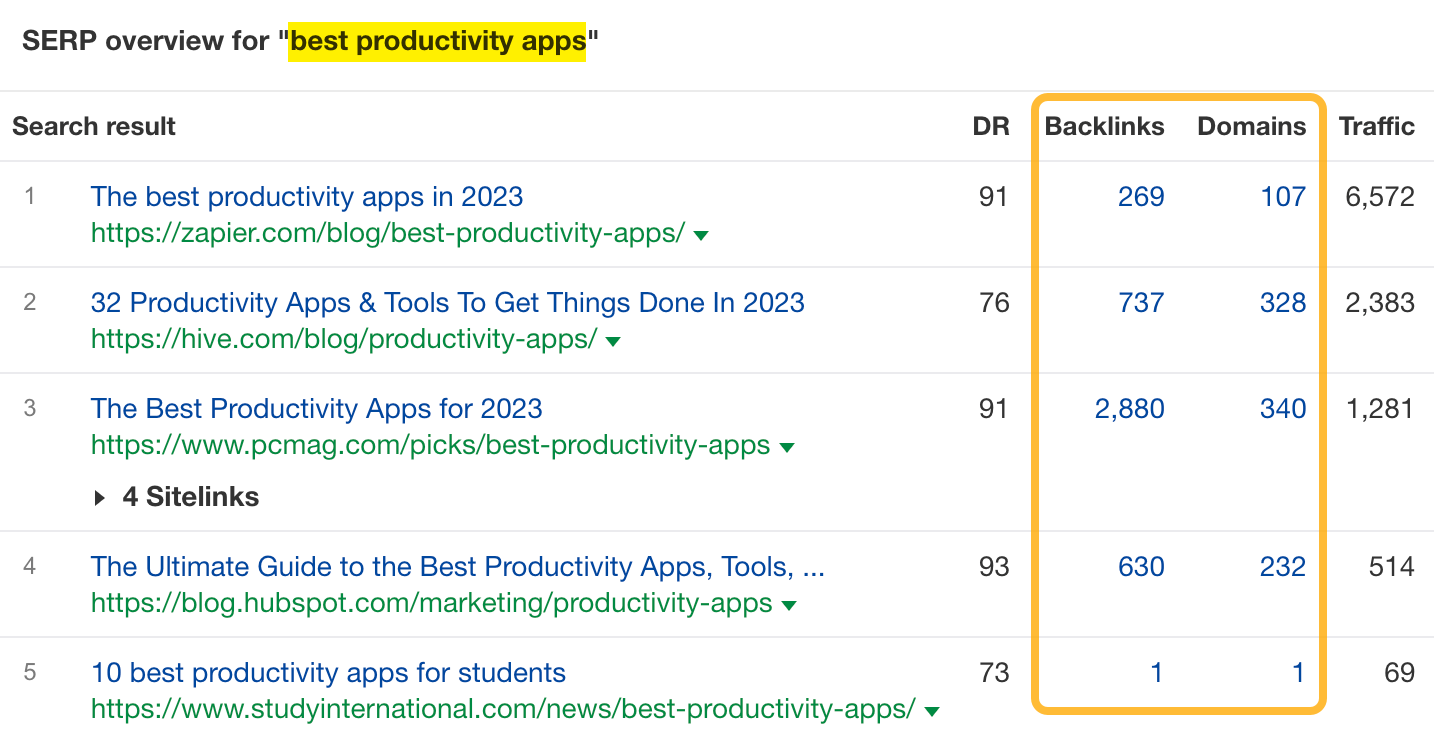
Just put your keyword into Ahrefs’ Keywords Explorer and scroll down to the “SERP Overview” widget. You’ll see the top-ranking pages along with how many backlinks (and linking domains) they have.
So let’s say you want to rank for “best productivity apps.” Here’s how the SERP for this keyword looks:
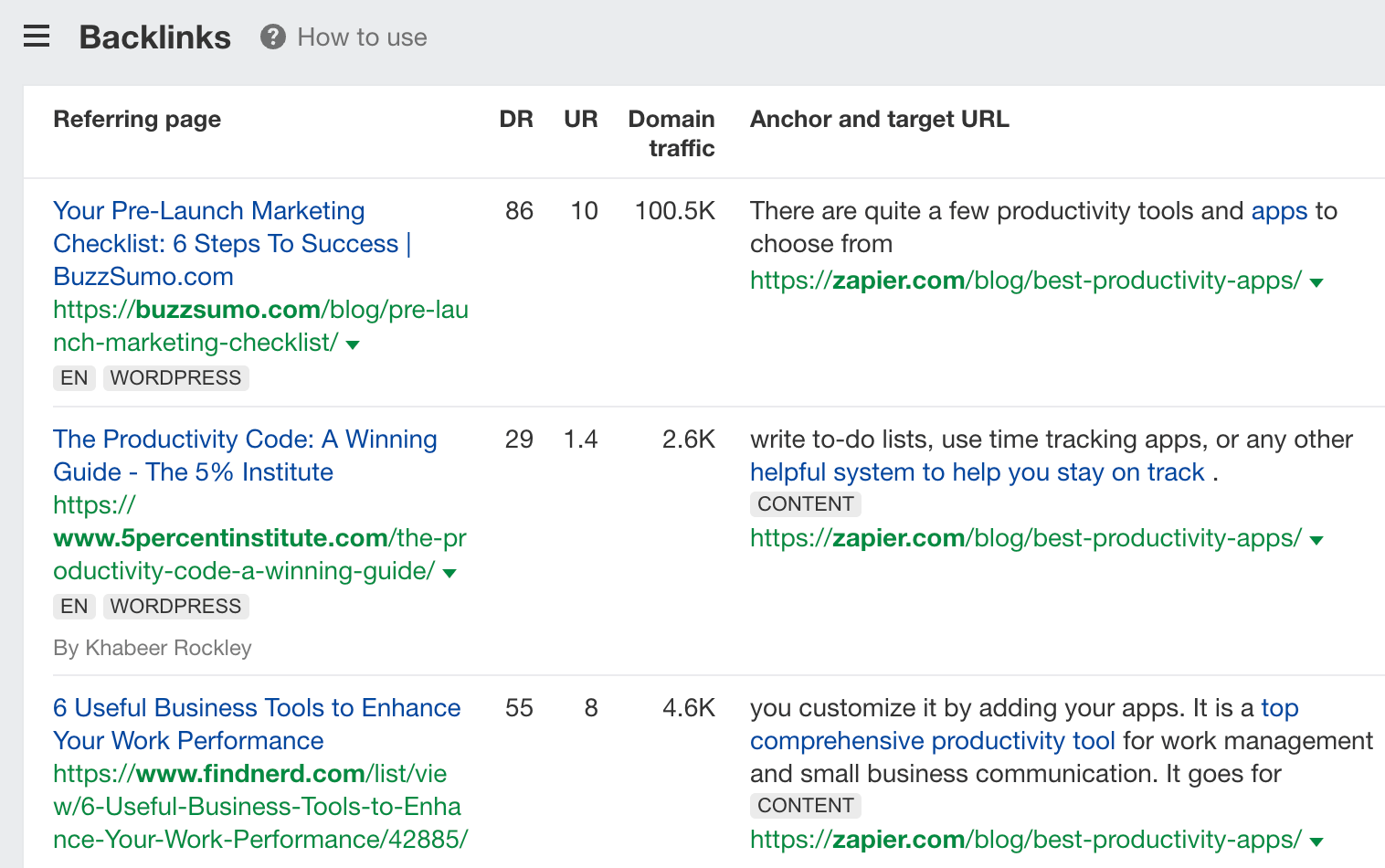
Once you click on any of the backlink numbers, you’ll be redirected to a list of backlinks of a given page in Ahrefs’ Site Explorer.
Here’s what you need to do next:
Apply some filters to focus on “meaningful backlinks” only
Manually go through the list of remaining pages, open them one by one, and see if the context of it allows for a link to your page to be added
Reach out to the owners of these websites and try to make a case for adding a link to your resource on their page
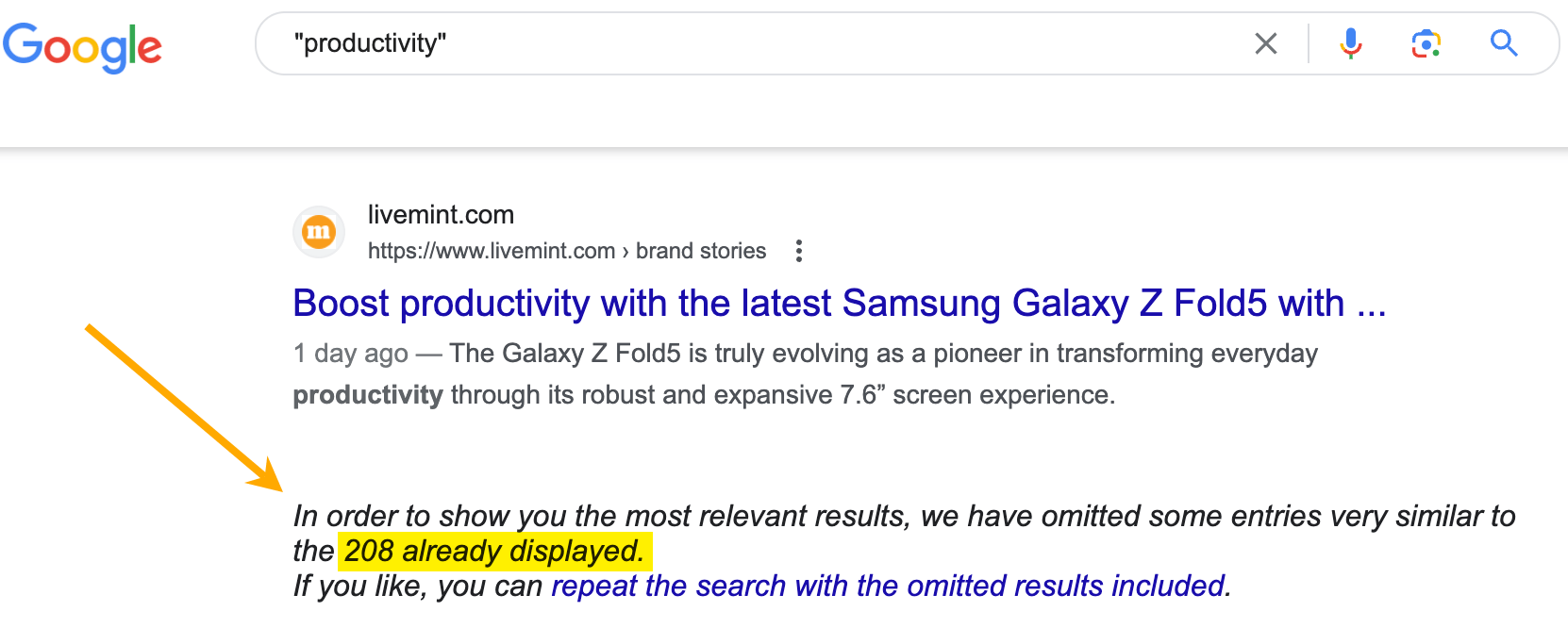
The next place you turn to for finding potential linkers is among people who mentioned your topic on their websites. For example, if you need to build links to a productivity app, you want to get in touch with all websites that have mentioned the word “productivity” somewhere on their pages.
You can try to search for them in Google, but it only gives you a limited number of search engine results. Just a couple of hundred on average.
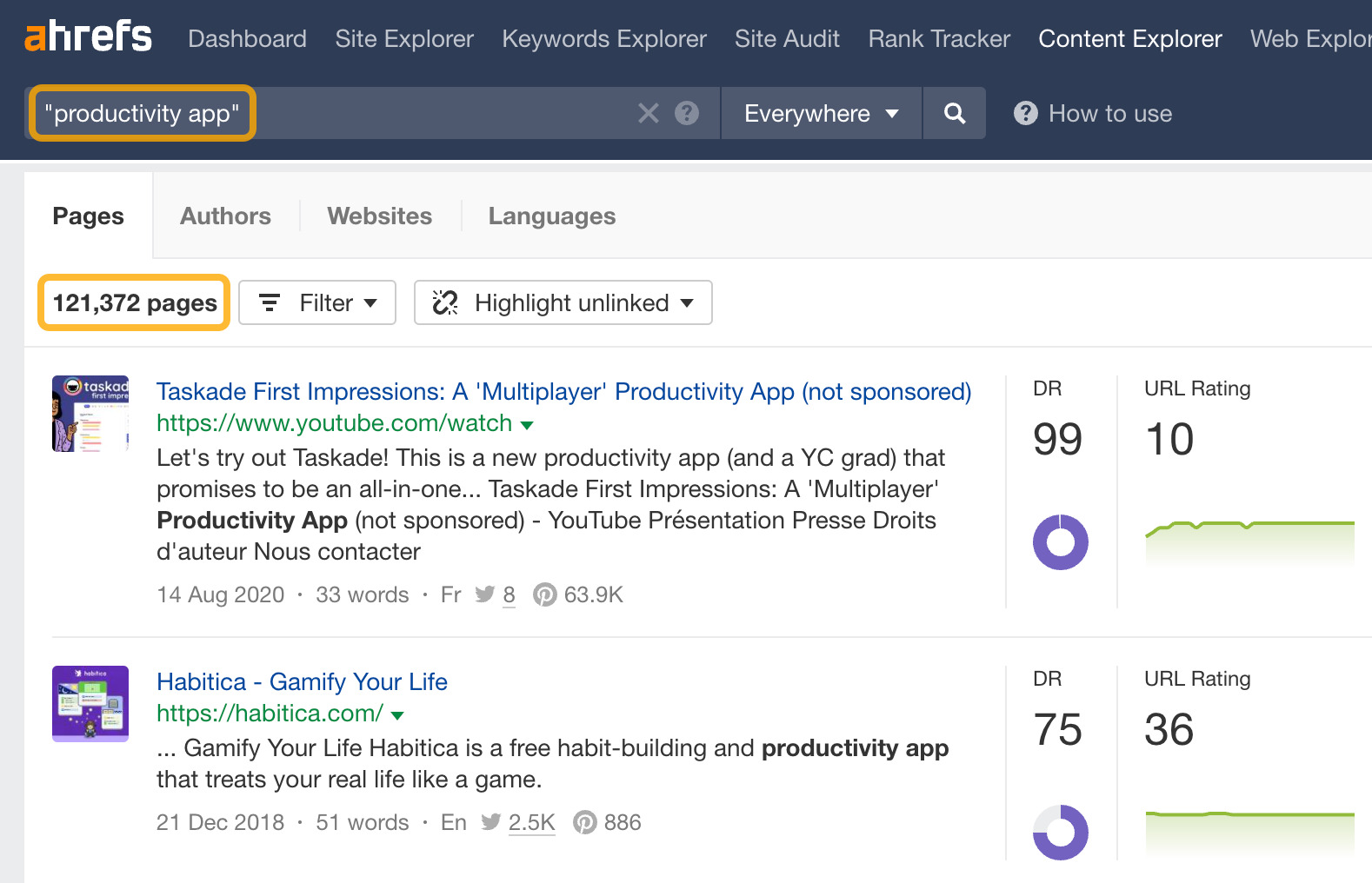
A much faster way to find thousands of pages that mention your topic is Ahrefs’ Content Explorer.
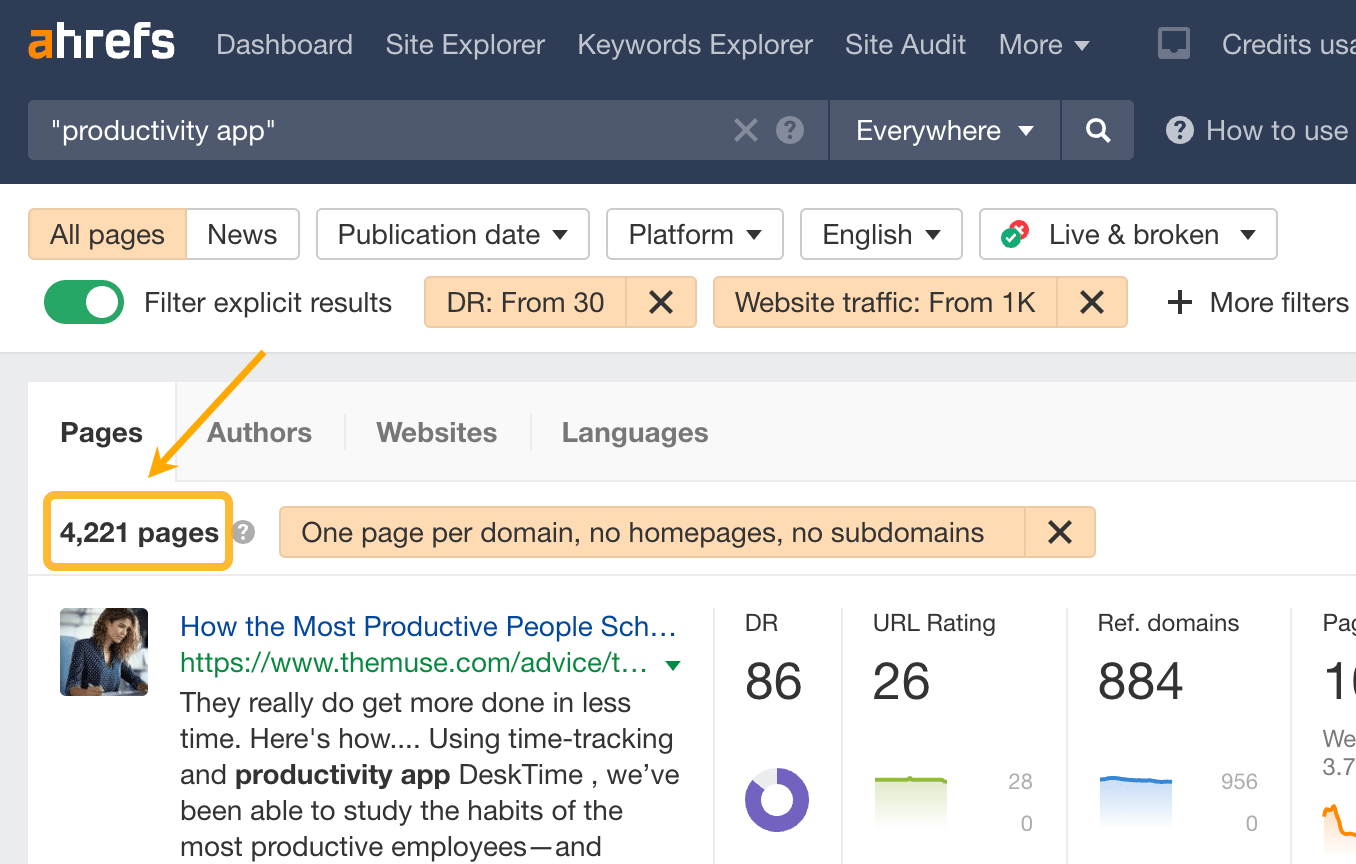
For example, if you search for the keyword “productivity app,” you’ll get over 120,000 pages that mention this keyword.
From there, you might want to apply the following filters to narrow down the list of results to the most meaningful ones:
Language: English (or whatever language you’re interested in)
Website traffic: from 1,000
Domain Rating: from 30
Filter explicit results
Filters: one page per domain, exclude homepages, exclude subdomains
This way, you’ll end up with slightly over 4,000 pages. Which is a way more manageable number of link prospects to work with.
And your plan of action here would be very similar to the previous one. Review these pages one by one and reach out to the respective site owners if you think there’s a chance that they might agree to link to your page from theirs.
In all fairness, your success rate with both these groups of link prospects will likely be quite low. I know it because I did this kind of link building outreach not that long ago. And from my conversations with professional link builders, that’s pretty much the norm.
Most people won’t bother replying to your emails.
Many will reply just to politely decline your request.
Some will ask for money or a link exchange.
And only a few will actually link to you.
That’s why I mentioned earlier that you should start building relationships with all these website owners before you actually ask them for a favor.
A good way to do this is to reach out to them while you’re still in progress of creating your page. You can ask for their opinion, a quote, or even suggest to feature some of their relevant work.
And it is always of great help if something that you’re working on is of actual interest to them.
For example, back when I was running my personal blog, I reached out to 500+ fellow bloggers asking them to share some of their Google Analytics data for my small research study. That request piqued their interest, and many of them helped me out with it.
After my research was done and published, I made sure to give a heads-up over email to all these 500+ bloggers whom I originally reached out to. And that is how this article became the most linked-to page on my blog:
But, most importantly, all the hard work I poured into this research has gained me respect from many of these bloggers. And whenever I later reached out to them with some other request, I was no longer a “nobody” and they were more open to talk to me.
In other words, your email outreach will be massively more effective if what you’re working on actually deserves people’s attention.
3. Creating linkable assets
In SEO, we use the terms “linkable asset” or “link bait” to refer to content that is strategically crafted to attract links. Such linkable assets can take on many different forms:
Industry surveys
Studies and research
Online tools and calculators
Awards and rankings
How-to guides and tutorials
Definitions and coined terms
Infographics, GIFographics, and “Map-o-graphics”
Earlier, I already mentioned two examples of linkable assets: a blogger survey I did for my personal blog and a research study we did here at Ahrefs. So let me show you a cool example from someone else.
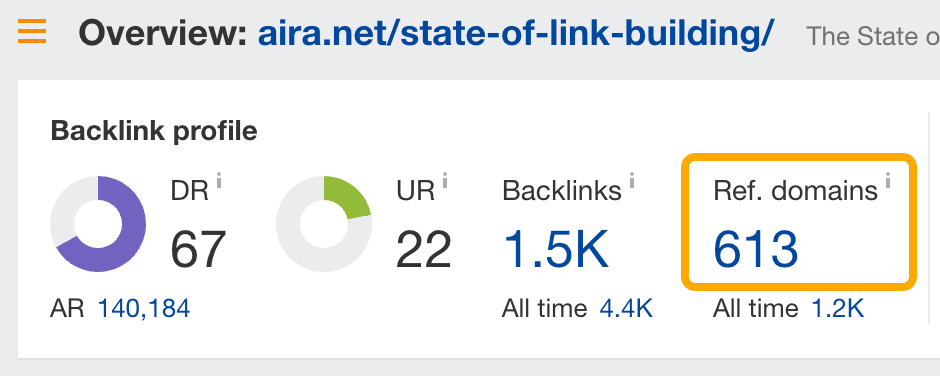
The folks at Aira, a digital marketing agency, run an annual “The State of Link Building Report” by surveying hundreds of leading industry professionals. This report has brought them backlinks from over 600 different websites:
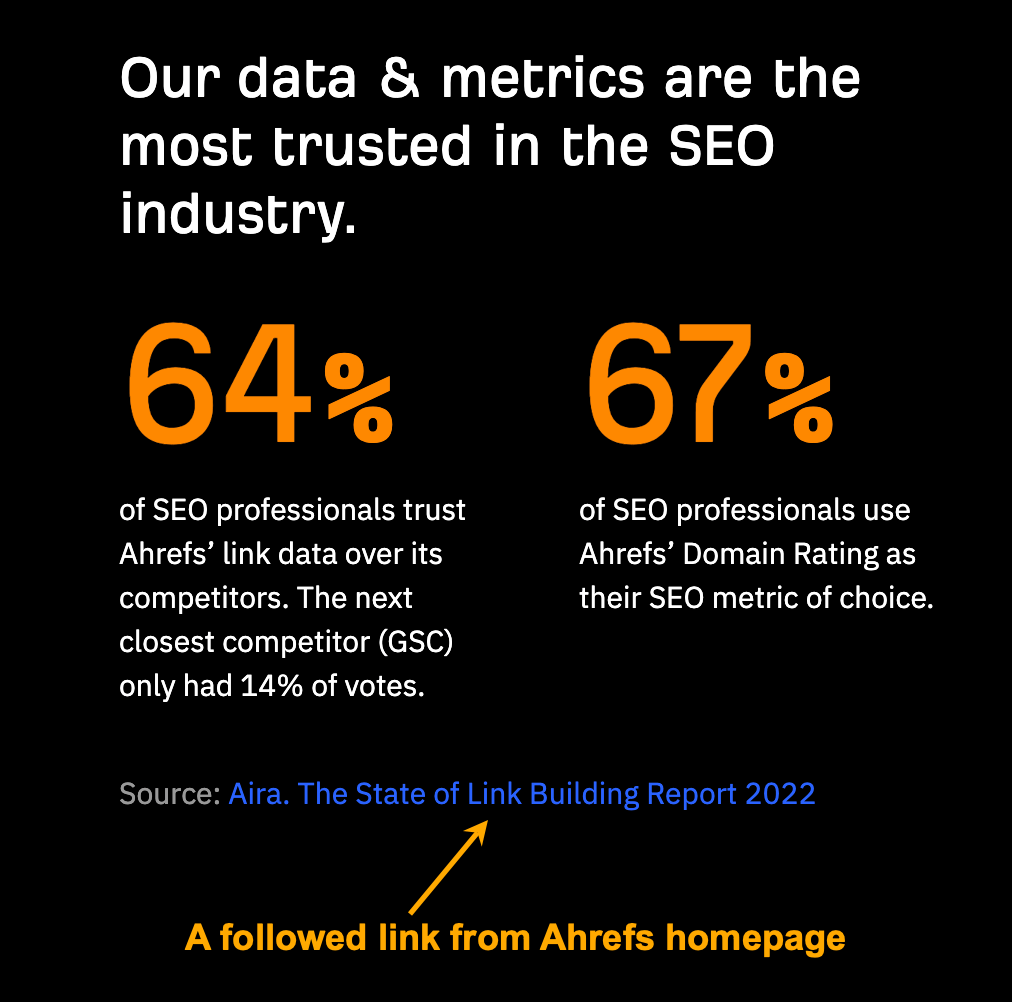
And one of these backlinks is coming from the very homepage of ahrefs.com (which has a URL Rating of 54):
Their report contains some data that is very favorable for our company, so we couldn’t resist featuring it on our very homepage. Many marketers refer to this kind of link bait as part “ego bait.” But in Aira’s case, I don’t think it was deliberate, because they can’t know in advance what the results of their industry survey would be.
So how do you put this link building strategy into action?
Well, first of all, you need to come up with an actual idea of a link-worthy page.
You can start from a simple brainstorm based on the abovementioned list of linkable asset types:
Can you survey your industry about something?
Can you calculate some meaningful statistics from the data that your business has access to?
Is there any interesting experiment, which you could carry out?
Does your industry need some kind of free online tool?
Etc.
The folks from Authority Hacker have recently published a pretty detailed video on YouTube, explaining how they use surveys to create linkable content for their websites. Check it out; it’s very actionable:
And if you fail to brainstorm any exciting ideas, you can always go back to studying the websites of your competitors and figuring out what types of linkable assets worked for them.
Just don’t forget that even the best linkable assets have to be promoted in order to attract links. Because people can’t link to things they don’t know exist.
So let’s talk about content promotion real quick.
4. Content promotion
We actually have a separate article listing 21 content promotion tactics. But for now, I want to focus your attention on just the following three:
Advertising – A very easy way to promote your resource to thousands of relevant people but might require a significant budget.
Influencer outreach – You can look up all the active thought leaders in your space and reach out to them whenever you publish something worthy of their attention. If you’re lucky, they might share it with their followers.
Building a following – You should definitely start building an email list (if you haven’t already), as well as be active on platforms like Twitter and LinkedIn. And if you consistently publish quality content, more people will start following you and many of them might end up linking to your content.
And don’t forget to promote your older content by mentioning it in your newly published content.
As Ryan Holiday said in his book “Perennial Seller”: “Creating more work is one of the most effective marketing techniques of all.”
5. Guest posting
This link building tactic is actually frowned upon by some SEO professionals. Mainly because some people tend to overdo it to the point of being spammy.
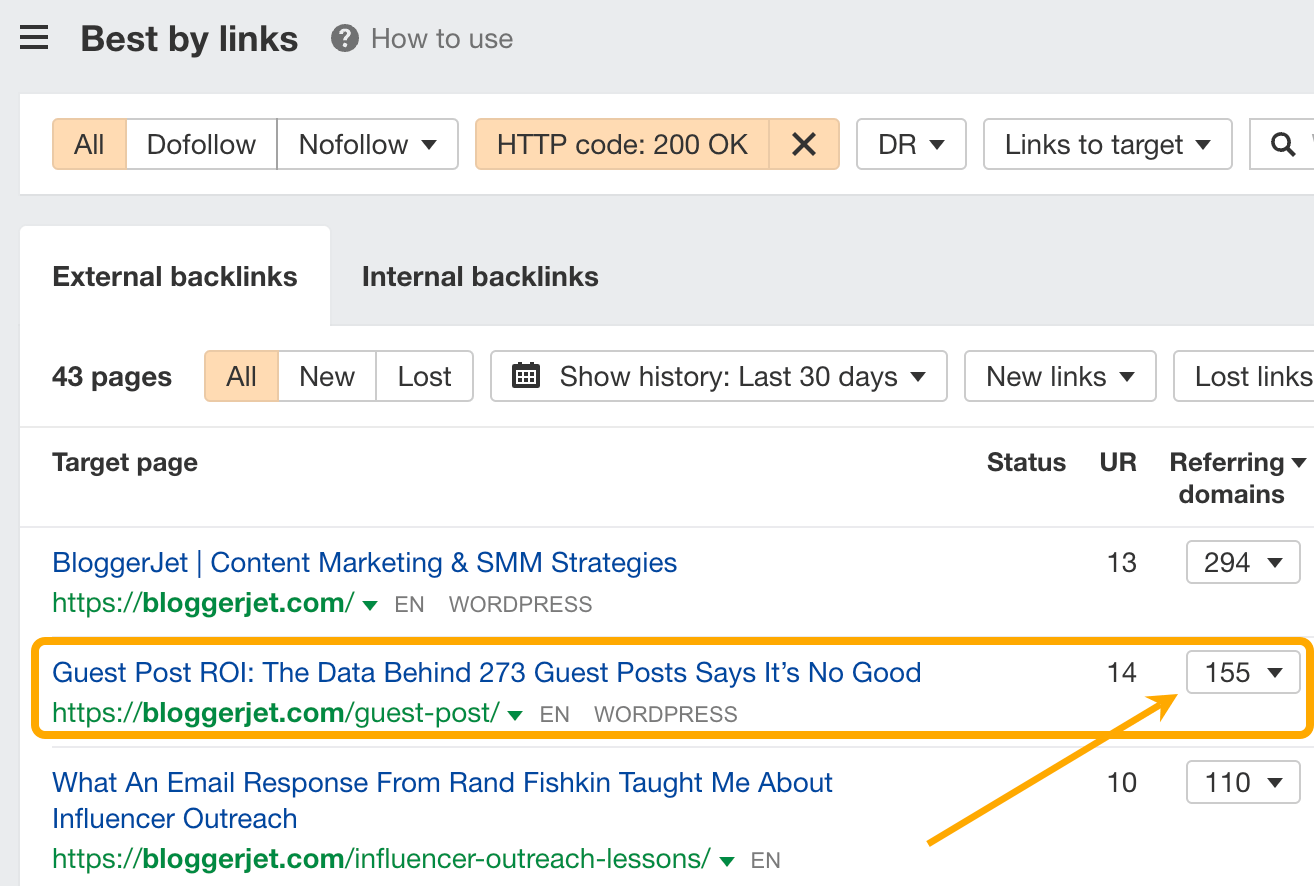
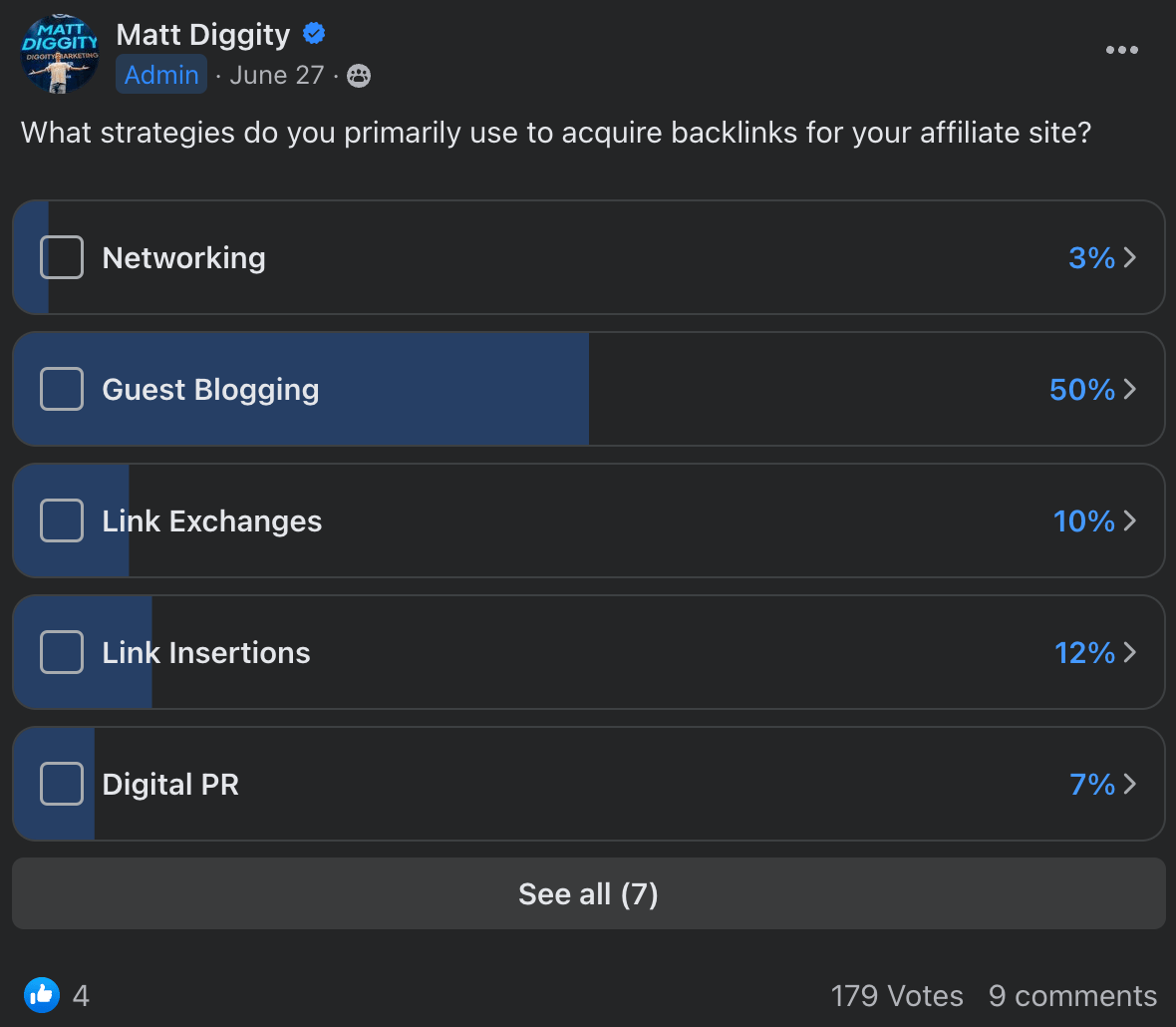
And yet guest blogging is one of the most popular ways how SEOs build links these days:
Even here at the Ahrefs Blog, we do allow guest contributions once in a while. And our guest authors might link to some of their own resources, as long as they’re relevant to the topic of their post. Which means you can build links with guest articles in a perfectly legit way.
But how do you get your content published on the top blogs in your industry? Well, you just need to pitch them a really compelling article idea.
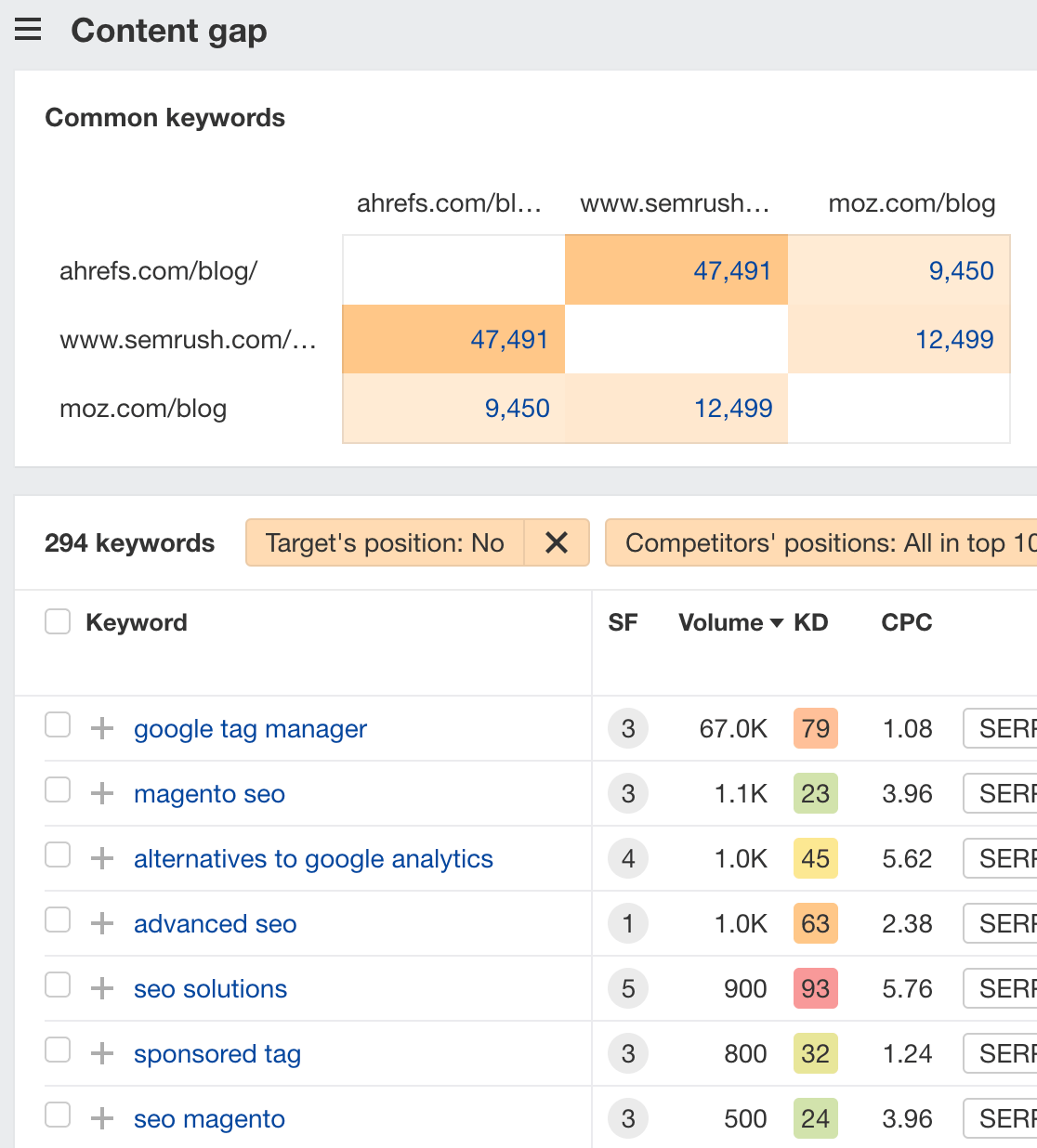
And here’s a simple tip on how to come up with content ideas that are hard to say no to. Just find a few competitors of the blog you want to write for and use the Content Gap tool to find which topics bring them lots of traffic but weren’t covered on the blog that you’re pitching.
For example, a quick Content Gap analysis of our own blog against the blogs of our competitors reveals a bunch of great topics that they get search traffic from, while we don’t.
If someone made a compelling pitch that they could write a decent post on any of these topics, it would be very hard for us to turn it down.
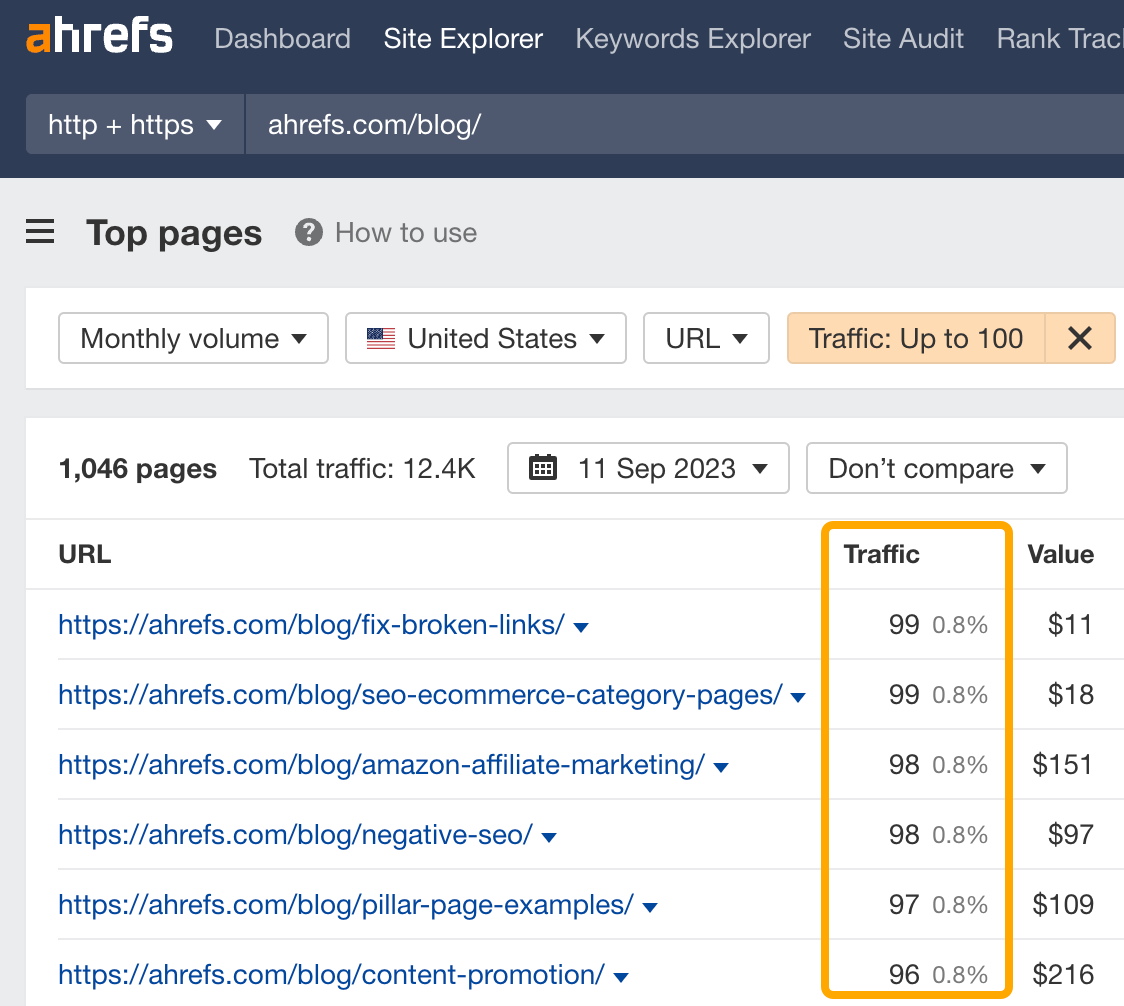
A somewhat lesser-known guest posting tactic is to find an underperforming article on the blog you want to write for and offer them to rewrite it from scratch. If you can persuade them that you can greatly improve that article and it will end up ranking higher in Google and bringing them more search traffic, I’m sure they’ll have a hard time resisting your pitch.
How do you find these underperforming pages? Just open the Top pages report in Site Explorer and use the “Traffic” filter:
Different kinds of links have different impacts on your page’s ranking in Google. And no one knows for sure how exactly Google measures the value of each individual link.
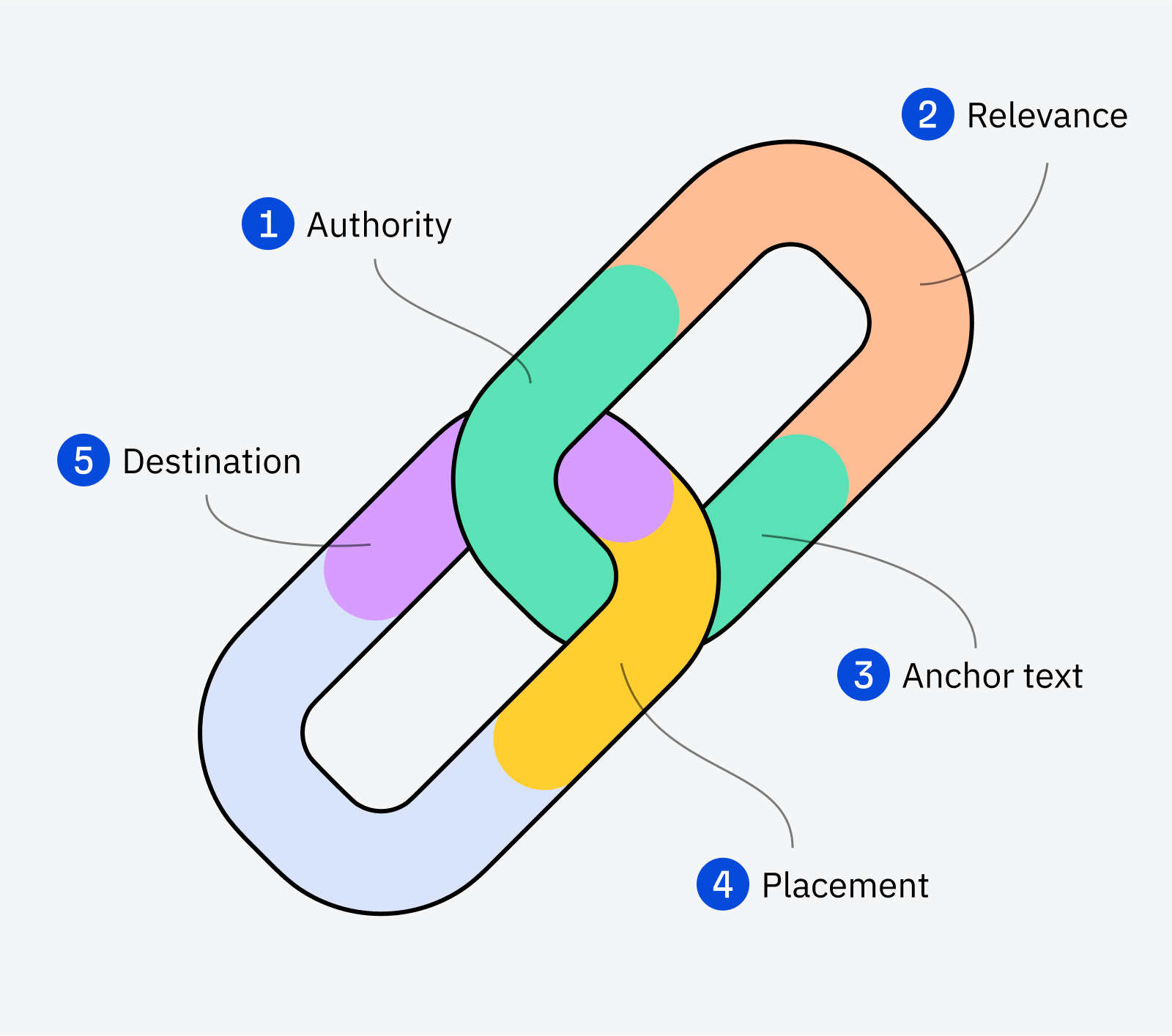
But there are five general concepts of evaluating links that the SEO community believes to be true.
What makes a good link.
1. Authority
It seems intuitive that a link from The New York Times and a link from your friend’s small travel blog couldn’t possibly be treated by Google as equals. NYT is a world-famous authority, and your friend’s blog is hardly known even among their friends.
Over many years of building links, SEOs have gathered a lot of empirical evidence that links from more well-known and authoritative websites have a bigger influence on your page’s rankings in Google.
But how do you measure the “authority” of the website?
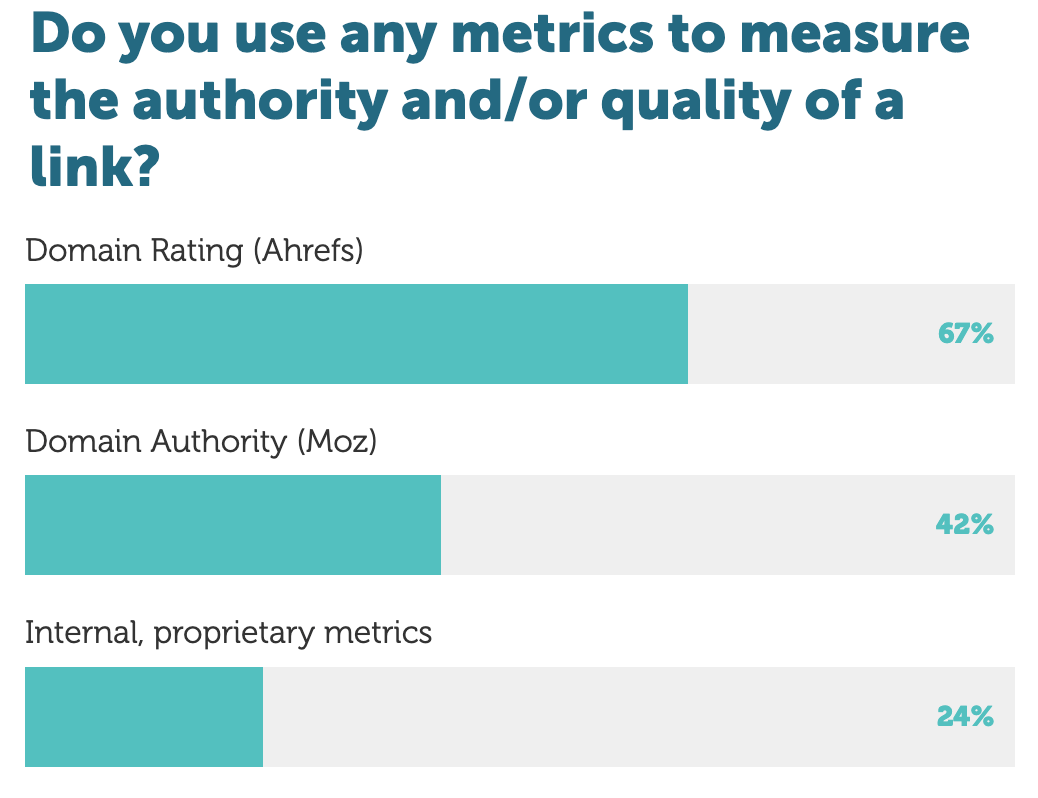
Well, according to an industry survey done by Aira, the most popular website authority metrics are Ahrefs’ Domain Rating (DR) and Moz’s Domain Authority (DA). With internally developed metrics (which often have DR or DA blended in them) holding the third spot.
The State of Link Building Report 2022.
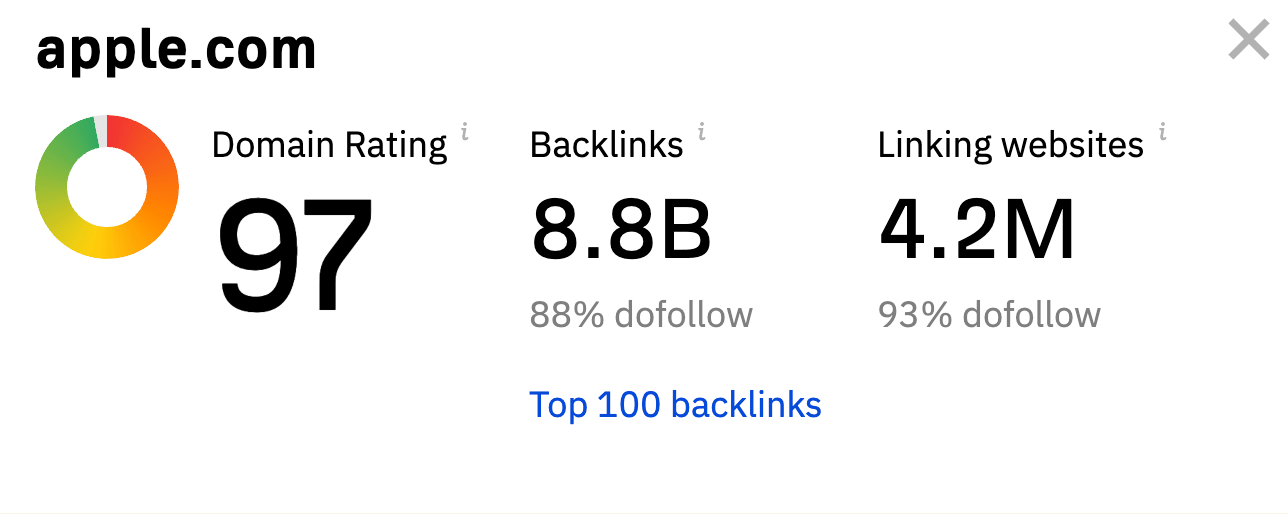
We actually have a free Website Authority Checker tool, which you can use to check the Domain Rating metric of any website:
But other than the authority of an entire website, there’s also the authority of the actual page that is linking to you. Which is known to be calculated by Google with the help of the famous PageRank algorithm.
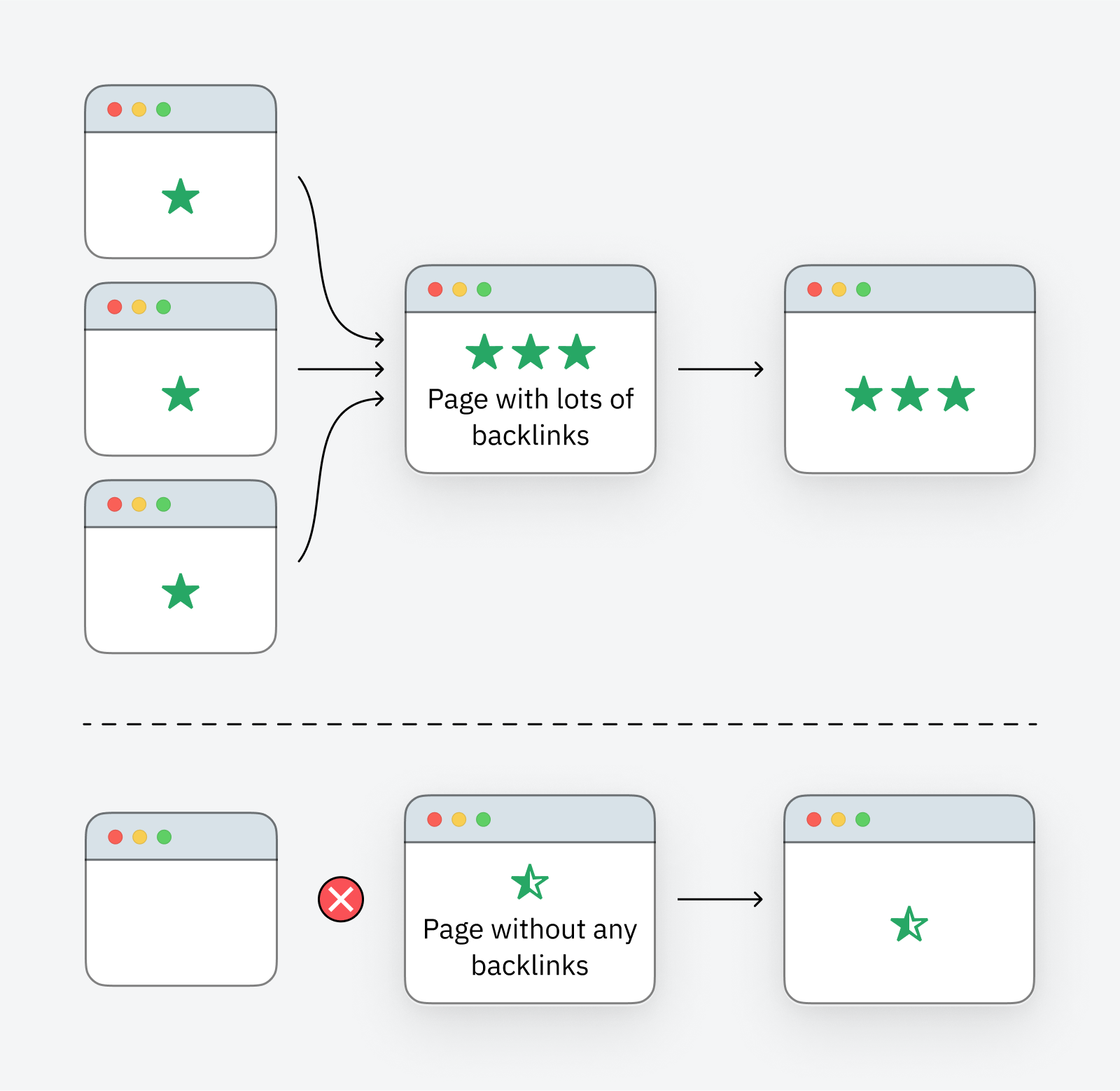
In simple terms, the PageRank algorithm is based on the premise that pages with more backlinks (and better ones) of their own cast a stronger “vote.”
Pages that have backlinks cast a stronger “vote” than those that don’t.
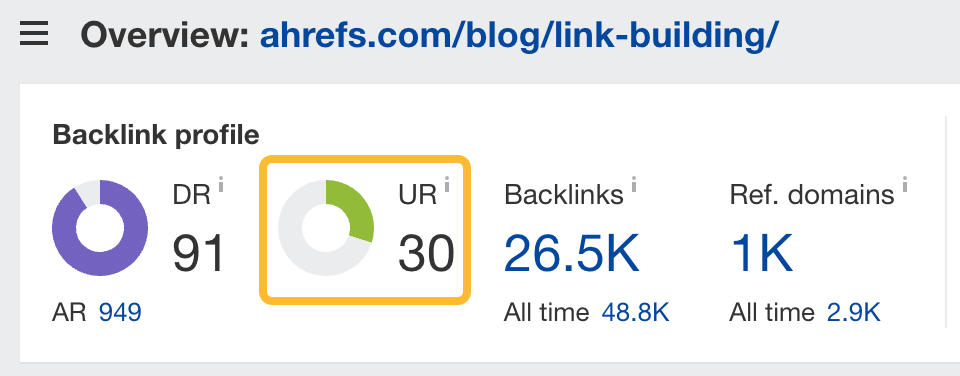
Here at Ahrefs, we have our own metric to measure the authority of the page. It’s called URL Rating (UR), and it is calculated in a fairly similar fashion to the original PageRank.
The UR of this very page that you’re reading is 30, and it has backlinks from over a thousand different websites (ref. domains):
And there’s one more thing you need to know about authority. If a backlink has a rel=”nofollow” attribute attached to it, it most likely doesn’t cast a “vote” toward a website that it links to.
2. Relevance
If you run a blog about health and fitness, links from other websites (and pages) on the same topic will have more weight in the eyes of Google compared to links from websites about cars or finances.
Here’s an excerpt from Google’s “How Search Works” guide that corroborates this theory (bolding is mine):
If other prominent websites on the subject link to the page, that’s a good sign that the information is of high quality.
But this doesn’t mean that you should avoid getting links from websites that aren’t on the same topic as yours. I can’t imagine any seasoned SEO saying: “No, please don’t link to my recipe website from dreamhost.com, a hosting website with DR 93.”
The thing is, whatever topic your website is about, there would be dozens of topics that are perfectly relevant while not the same.
For example, nutrition is very important for health and fitness. So it would be perfectly natural for fitness websites to link to articles about food. And if you want to work out regularly, you need to find time in your schedule for it, so linking to articles about time management wouldn’t be unnatural too.
In other words, relevance is a fairly malleable concept. Unless, of course, you try shoehorning links into places where they clearly don’t belong.
3. Anchor text
If you’re not already familiar with the term, “anchor text” is a clickable snippet of text that links to another page. In many cases, it succinctly describes what the linked page is about.
So it’s no surprise that Google uses the words in the anchor text to better understand what the referenced page is about and what keywords it deserves to rank for. In fact, Google’s original PageRank patent talks about this quite explicitly (bolding is mine):
Google employs a number of techniques to improve search quality including page rank, anchor text, and proximity information.
So how do you leverage anchor text when building links?
Well, it’s better that you don’t. The more you try to control how different pages link to you and shoehorn all the “right words” into the anchor text of your backlinks, the higher the chance that Google will suspect manipulation and penalize you for that. So it’s better to just let the author of the linking page decide how they want to reference your page.
4. Placement
Back in 2010, Bill Slawski brought to attention a Google patent that described a “Reasonable Surfer Model.” This model explains how the likelihood of a link being clicked may affect how much authority it transfers. And this likelihood is mostly determined by where the link is located on the page.
Let’s say there’s a webpage that consists of three blocks: content, sidebar, and footer. As a general rule, links in the content get more clicks because the content block gets the most attention from visitors.
Prominently placed links may transfer more “authority.”
One other thing that can affect the CTR of a link is how high on the page it appears. Readers are more likely to click the links at the very beginning of the article rather than the ones at its very end.
5. Destination
When building links to your website, there are three general destinations where you can point them:
Your homepage.
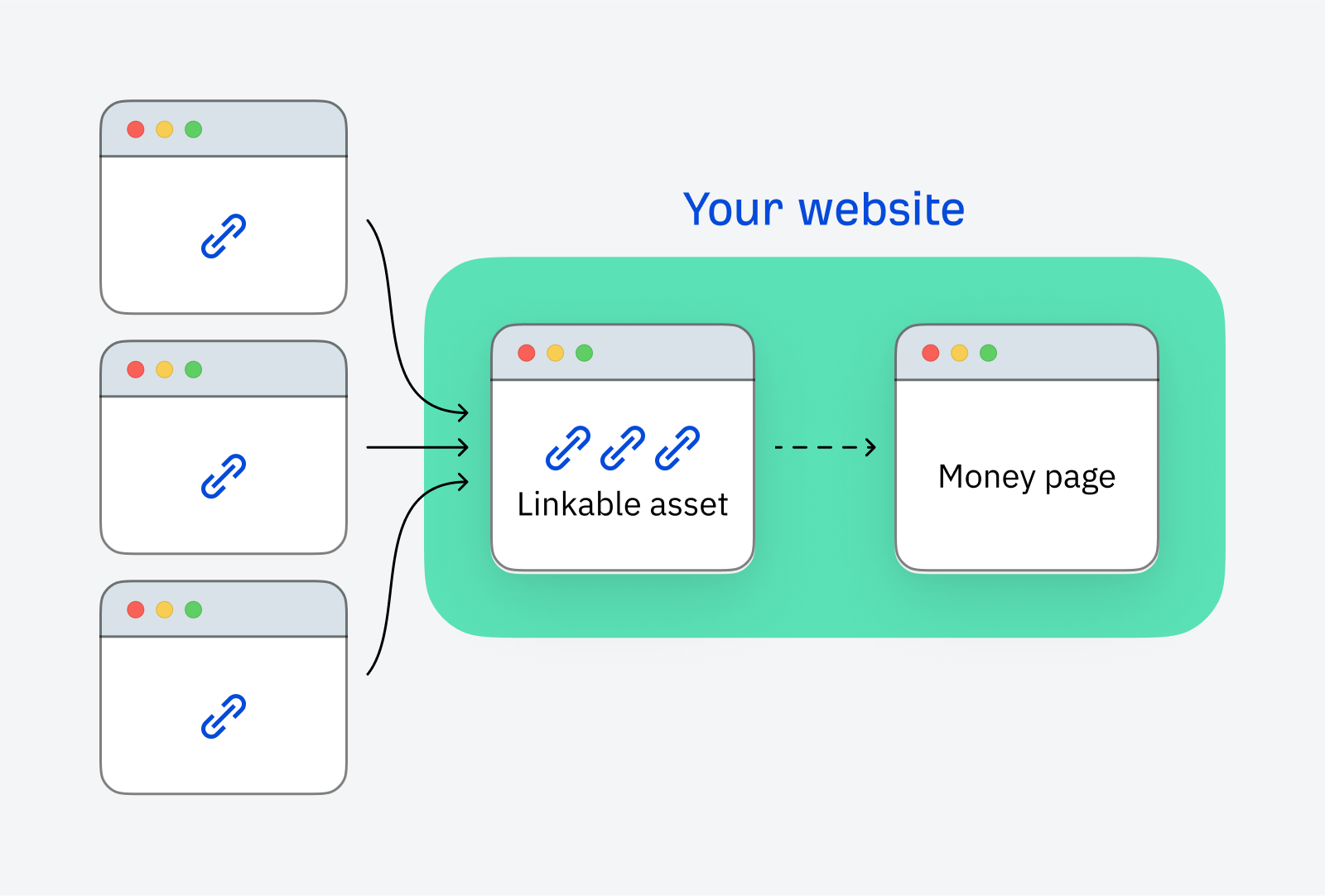
Your linkable assets.
The actual pages that you need to rank well in Google (usually called “money pages”).
And quite often, the pages that you need to rank well are also the hardest ones to get links to.
That’s because website owners generally prefer to link to informational pages where their audience can get value for free rather than commercial pages where their audience is likely to be pitched some product.
Thus, one of the most common questions in SEO is, “How to get links to boring pages?”
And the strategy that experienced SEOs usually suggest is to get lots of high quality links to your “linkable assets,” and then transfer some of that “link authority” to your “money pages” that you want to rank well in Google.
Use internal links to transfer authority to the “boring” pages that you need to rank well in Google.