The DELETE FROM command is used to delete records from the table.
Example
Delete employee from the table employees where city is Delhi.
Create a js file named “delete” in DBexample folder and put the following data into it:
var mysql = require('mysql');

var con = mysql.createConnection({

host: "localhost",

user: "root",

password: "12345",

database: "javatpoint"

});

con.connect(function(err) {

if (err) throw err;

var sql = "DELETE FROM employees WHERE city = 'Delhi'";

con.query(sql, function (err, result) {

if (err) throw err;

console.log("Number of records deleted: " + result.affectedRows);

});

});
Now open command terminal and run the following command:
Node delete.js
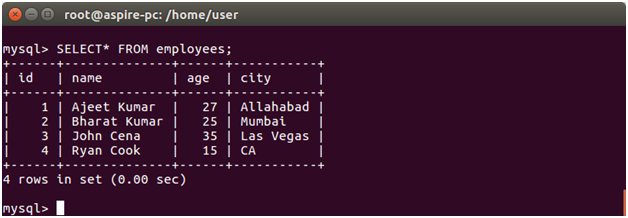
You can verify the deleted record by using SELECT statement:
Attention in Sequence-to-Sequence Models: Adding attention to sequence-to-sequence models allows the model to focus on different parts of the input sequence when generating output tokens.
CapsNet: Capsule Networks are an advanced neural network architecture that can represent spatial relationships between objects in an image better than CNNs.
The UPDATE command is used to update records in the table.
Example
Update city in “employees” table where id is 1.
Create a js file named “update” in DBexample folder and put the following data into it:
var mysql = require('mysql');

var con = mysql.createConnection({

host: "localhost",

user: "root",

password: "12345",

database: "javatpoint"

});

con.connect(function(err) {

if (err) throw err;

var sql = "UPDATE employees SET city = 'Delhi' WHERE city = 'Allahabad'";

con.query(sql, function (err, result) {

if (err) throw err;

console.log(result.affectedRows + " record(s) updated");

});

});
Now open command terminal and run the following command:
Node update.js
It will change the city of the id 1 is to Delhi which is prior Allahabad.
You can check the updated record in the new table:
In the old table city of “Ajeet Kumar” is Allahabad.
Collaborative Filtering with Neural Networks: Implementing a recommendation system using matrix factorization or deep neural networks to predict user preferences.
Sequence-to-Sequence Model (Seq2Seq): Neural machine translation using encoder-decoder architecture. The encoder processes the input sentence, and the decoder generates the translated sentence.
Autoencoder for Anomaly Detection: Training an autoencoder to detect anomalies in data. The autoencoder is trained to reconstruct normal data, and it will struggle to reconstruct anomalies, leading to higher reconstruction error for anomalies.
pythonCopy codefrom tensorflow.keras import layers, models

# Build autoencoder model
input_dim = 28 * 28
encoding_dim = 64

# Encoder
input_img = layers.Input(shape=(input_dim,))
encoded = layers.Dense(encoding_dim, activation='relu')(input_img)

# Decoder
decoded = layers.Dense(input_dim, activation='sigmoid')(encoded)

# Autoencoder model
autoencoder = models.Model(input_img, decoded)

# Compile model
autoencoder.compile(optimizer='adam', loss='mean_squared_error')

# Train on normal data
autoencoder.fit(normal_data, normal_data, epochs=50, batch_size=256, shuffle=True)
End-to-End Speech Recognition: Building an end-to-end speech recognition system with RNNs, LSTMs, or GRUs, where the input is a sequence of audio features (MFCC) and the output is the predicted transcription.
Automatic Speech Recognition with Connectionist Temporal Classification (CTC): Using CTC loss to handle the alignment between input and output sequences when they are of different lengths.
pythonCopy codeimport tensorflow as tf
from tensorflow.keras import layers

# Define a basic RNN model for speech recognition
def build_model(input_dim, output_dim):
model = tf.keras.Sequential([
    layers.Input(shape=(None, input_dim)),
    layers.LSTM(128, return_sequences=True),
    layers.LSTM(128, return_sequences=True),
    layers.Dense(output_dim, activation='softmax')
])
return model
model = build_model(input_dim=13, output_dim=29)  # Example with 13 MFCC features
model.compile(optimizer='adam', loss='ctc_loss')
YOLO (You Only Look Once): Using the YOLO model for object detection in images. YOLO is a real-time object detection model that predicts bounding boxes and class probabilities directly from full images in one evaluation.
RetinaNet for Object Detection: Keras also has an example for RetinaNet, an object detection model that uses a focal loss function to address class imbalance during training.
pythonCopy codefrom tensorflow.keras.applications import ResNet50
from tensorflow.keras import layers, models
# Load pre-trained ResNet50 model and use as a backbone for RetinaNet
backbone = ResNet50(include_top=False, input_shape=(224, 224, 3))
# Define custom RetinaNet layers on top of the backbone
model = models.Sequential([