Author: saqibkhan

  • What are Directives in Angular?

    Directives are attributes that allow the user to write new HTML syntax specific to their applications. They execute whenever the Angular compiler finds them in the DOM. Angular supports three types of directives.  

    1. Component Directives
    2. Structural Directives
    3. Attribute Directives 
  • What are Annotations in Angular?

    Annotations in Angular create an annotation array. They are the metadata set in the class that reflects the metadata library.

  • What are Templates in Angular?

    Angular Templates are written with HTML that contains Angular-specific elements and attributes. In combination with the model and controller’s information, these templates are further rendered to provide a dynamic view to the user.

  • What are the new updates with Angular10? 

    angular
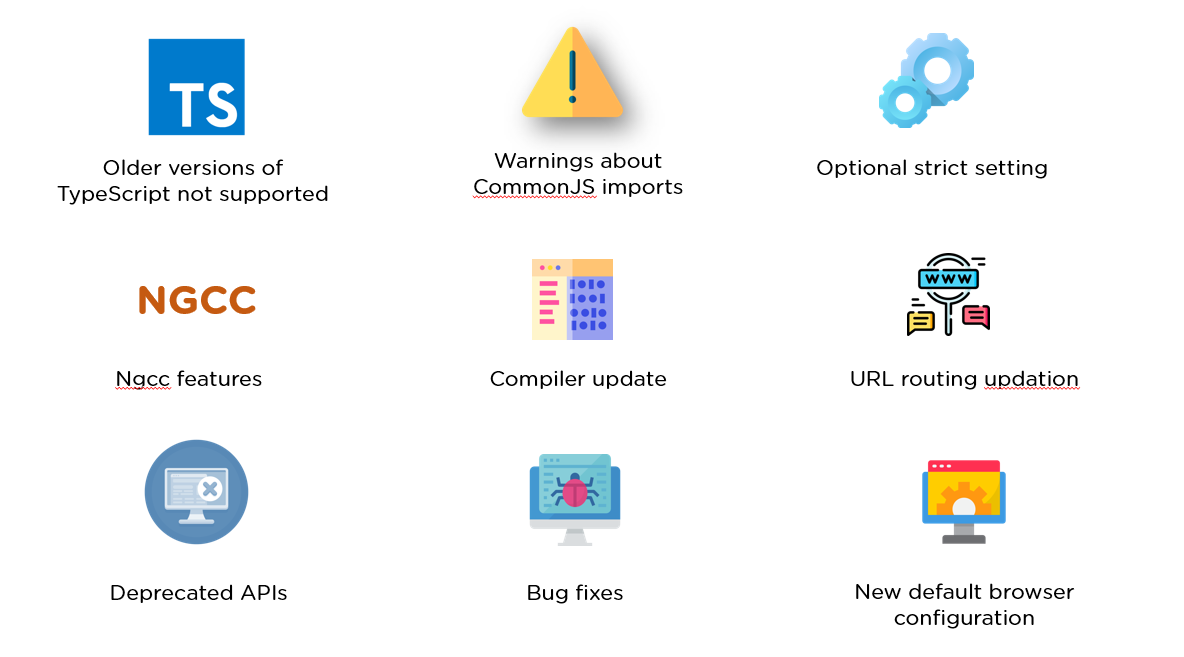
    • Older versions of TypeScript not supported – Previous versions of Angular supported typescript 3.6, 3.7, and even 3.8. But with Angular 10, TypeScript bumped to TypeScript 3.9.
    • Warnings about CommonJS imports – Logging of unknown property bindings or element names in templates is increased to the “error” level, which was previously a “warning” before.
    • Optional strict setting – Version 10 offers a stricter project setup when you create a new workspace with ng new command.

    ng new –strict

    NGCC Feature – Addition of NGCC features with a program based entry point finder. 

    • Updated URL routing
    • Deprecated APIs – Angular 10 has several deprecated APIs.
    • Bug fixes – With this Angular 10 version, there have been a number of bug fixes, important ones being the compiler avoiding undefined expressions and the core avoiding a migration error when a nonexistent symbol is imported.
    • New Default Browser Configuration – Browser configuration for new projects has been upgraded to outdo older and less used browsers. 
  • Mention some advantages of Angular.

    Some of the common advantages of Angular are – 

    1. MVC architecture – Angular is a full-fledged MVC framework. It provides a firm opinion on how the application should be structured. It also offers bi-directional data flow and updates the real DOM. 
    2. Modules: Angular consists of different design patterns like components, directives, pipes, and services, which help in the smooth creation of applications.
    3. Dependency injection: Components dependent on other components can be easily worked around using this feature. 
    4. Other generic advantages include clean and maintainable code, unit testing, reusable components, data binding, and excellent responsive experience.
  • What are decorators in Angular? 

    Decorators are a design pattern or functions that define how Angular features work. They are used to make prior modifications to a class, service, or filter. Angular supports four types of decorators, they are:

    1. Class Decorators
    2. Property Decorators
    3. Method Decorators
    4. Parameter Decorators
  • Differentiate between Angular and AngularJS

    The following table depicts the aspects of Angular vs AngularJS in detail:

    FeatureAngularJS Angular
    LanguageJavaScriptTypeScript
    ArchitectureSupports Model-View-Controller designUses components and directives
    Mobile supportNot supported by mobile browsersSupports all popular mobile browsers
    Dependency InjectionDoesn’t support Supports
    Routing@routeProvider is used to provide routing information@Route configuration is used to define routing information
    ManagementDifficult to manage with an increase in source code sizeBetter structured, easy to create and manage bigger applications
  • What are Single Page Applications (SPA)?

    Single-page applications are web applications that load once with new features just being mere additions to the user interface. It does not load new HTML pages to display the new page’s content, instead generated dynamically. This is made possible through JavaScript’s ability to manipulate the DOM elements on the existing page itself. A SPA approach is faster, thus providing a seamless user experience.

  • What is data binding? Which type of data binding does Angular deploy?

    Data binding is a phenomenon that allows any internet user to manipulate Web page elements using a Web browser. It uses dynamic HTML and does not require complex scripting or programming. We use data binding in web pages that contain interactive components such as forms, calculators, tutorials, and games. Incremental display of a webpage makes data binding convenient when pages have an enormous amount of data.

    Angular uses the two-way binding. Any changes made to the user interface are reflected in the corresponding model state. Conversely, any changes in the model state are reflected in the UI state. This allows the framework to connect the DOM to the Model data via the controller. However, this approach affects performance since every change in the DOM has to be tracked.
  • What is TypeScript?

    TypeScript is a superset of JavaScript that offers excellent consistency. It is highly recommended, as it provides some syntactic sugar and makes the code base more comfortable to understand and maintain. Ultimately, TypeScript code compiles down to JavaScript that can run efficiently in any environment.