Author: saqibkhan

  • Overview

    As you already know, Django is a Python web framework. And like most modern framework, Django supports the MVC pattern. First let’s see what is the Model-View-Controller (MVC) pattern, and then we will look at Django’s specificity for the Model-View-Template (MVT) pattern.

    MVC Pattern

    When talking about applications that provides UI (web or desktop), we usually talk about MVC architecture. And as the name suggests, MVC pattern is based on three components: Model, View, and Controller. Check our MVC tutorial here to know more.

    DJANGO MVC – MVT Pattern

    The Model-View-Template (MVT) is slightly different from MVC. In fact the main difference between the two patterns is that Django itself takes care of the Controller part (Software Code that controls the interactions between the Model and View), leaving us with the template. The template is a HTML file mixed with Django Template Language (DTL).

    The following diagram illustrates how each of the components of the MVT pattern interacts with each other to serve a user request −
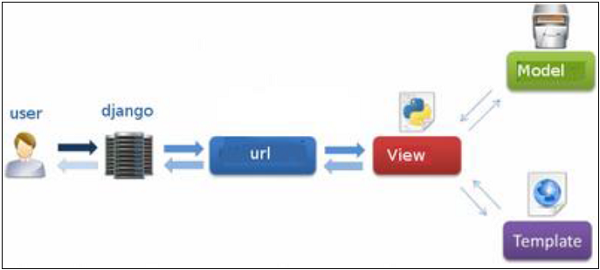
    DJANGO MVC - MVT Pattern

    The developer provides the Model, the view and the template then just maps it to a URL and Django does the magic to serve it to the user.

  • Community and Ecosystem

    Django has a large, active community that contributes to its development. This means there are plenty of resources, such as tutorials and forums, as well as a wide array of third-party packages and plugins available for extending the framework’s functionality.

  • Admin Interface

    Django automatically generates a powerful admin interface for managing application data. This feature saves time and provides a user-friendly way to interact with the database, enabling quick CRUD (Create, Read, Update, Delete) operations.

  • ORM (Object-Relational Mapping)

    Django’s ORM allows developers to interact with the database using Python code instead of writing raw SQL. This abstraction makes it easier to manage database schema changes and perform complex queries without deep SQL knowledge.

  • Security Features

    Django includes robust security features out of the box. It helps protect against common vulnerabilities, such as:

    • SQL Injection: Automatically escapes queries to prevent unauthorized database access.
    • Cross-Site Scripting (XSS): Escapes HTML by default, reducing the risk of malicious scripts.
    • Cross-Site Request Forgery (CSRF): Provides built-in protection against CSRF attacks.
  • Scalability

    Django is built to handle large amounts of traffic and can scale effectively as your application grows. This makes it suitable for both small projects and large-scale applications.

  • Rapid Development

    Django is designed to help developers build applications quickly. It comes with a lot of built-in functionalities, like user authentication and URL routing, which means you can focus more on developing your app rather than reinventing the wheel.

  • Basics

    Django is a high-level Python web framework that encourages rapid development and clean, pragmatic design. Django makes it easier to build better web apps quickly and with less code.

    Note − Django is a registered trademark of the Django Software Foundation, and is licensed under BSD License.

    History of Django

    • 2003 − Started by Adrian Holovaty and Simon Willison as an internal project at the Lawrence Journal-World newspaper.
    • 2005 − Released July 2005 and named it Django, after the jazz guitarist Django Reinhardt.
    • 2005 − Mature enough to handle several high-traffic sites.
    • Current − Django is now an open source project with contributors across the world.

    Django – Design Philosophies

    Django comes with the following design philosophies −

    • Loosely Coupled − Django aims to make each element of its stack independent of the others.
    • Less Coding − Less code so in turn a quick development.
    • Don’t Repeat Yourself (DRY) − Everything should be developed only in exactly one place instead of repeating it again and again.
    • Fast Development − Django’s philosophy is to do all it can to facilitate hyper-fast development.
    • Clean Design − Django strictly maintains a clean design throughout its own code and makes it easy to follow best web-development practices.

    Advantages of Django

    Here are few advantages of using Django which can be listed out here −

    • Object-Relational Mapping (ORM) Support − Django provides a bridge between the data model and the database engine, and supports a large set of database systems including MySQL, Oracle, Postgres, etc. Django also supports NoSQL database through Django-nonrel fork. For now, the only NoSQL databases supported are MongoDB and google app engine.
    • Multilingual Support − Django supports multilingual websites through its built-in internationalization system. So you can develop your website, which would support multiple languages.
    • Framework Support − Django has built-in support for Ajax, RSS, Caching and various other frameworks.
    • Administration GUI − Django provides a nice ready-to-use user interface for administrative activities.
    • Development Environment − Django comes with a lightweight web server to facilitate end-to-end application development and testing.
  • Codecourse

    • Website: codecourse.com
    • Codecourse offers video tutorials on Laravel and other web development topics. The content is aimed at beginners and intermediate developers.
  • Laravel News Podcast

    • Website: laravel-news.com/podcast
    • A podcast that discusses the latest in the Laravel community, including news, packages, and interviews with developers. It’s a great way to stay updated while on the go.