Django supports multiple languages, making it easier to develop applications for a global audience, including features for translation and localization.
Author: saqibkhan
-
Admin Interface:
Django automatically generates an admin interface for managing application data, allowing developers to quickly create a user-friendly backend without additional coding.
-
Robust Documentation:
Django is known for its comprehensive and well-organized documentation, making it easier for developers to learn and use the framework effectively.
-
Strong Community:
Django has a large and active community that contributes to its development, creates plugins, and provides support through forums, conferences, and documentation.
-
Cookies Handling
Sometimes you might want to store some data on a per-site-visitor basis as per the requirements of your web application. Always keep in mind, that cookies are saved on the client side and depending on your client browser security level, setting cookies can at times work and at times might not.
To illustrate cookies handling in Django, let’s create a system using the login system we created before. The system will keep you logged in for X minute of time, and beyond that time, you will be out of the app.
For this, you will need to set up two cookies, last_connection and username.
At first, let’s change our login view to store our username and last_connection cookies −
from django.template import RequestContext def login(request): username = "not logged in" if request.method == "POST":
if MyLoginForm.is_valid():#Get the posted form MyLoginForm = LoginForm(request.POST)
else:username = MyLoginForm.cleaned_data['username']
response = render_to_response(request, 'loggedin.html', {"username" : username},MyLoginForm = LoginForm()
response.set_cookie('last_connection', datetime.datetime.now()) response.set_cookie('username', datetime.datetime.now()) return responsecontext_instance = RequestContext(request))As seen in the view above, setting cookie is done by the set_cookie method called on the response not the request, and also note that all cookies values are returned as string.
Let’s now create a formView for the login form, where we won’t display the form if cookie is set and is not older than 10 second −
def formView(request): if 'username' in request.COOKIES and 'last_connection' in request.COOKIES:
else:username = request.COOKIES['username'] last_connection = request.COOKIES['last_connection'] last_connection_time = datetime.datetime.strptime(last_connection[:-7], "%Y-%m-%d %H:%M:%S") if (datetime.datetime.now() - last_connection_time).seconds < 10: return render(request, 'loggedin.html', {"username" : username}) else: return render(request, 'login.html', {})return render(request, 'login.html', {})</code></pre>As you can see in the formView above accessing the cookie you set, is done via the COOKIES attribute (dict) of the request.
Now let’s change the url.py file to change the URL so it pairs with our new view −
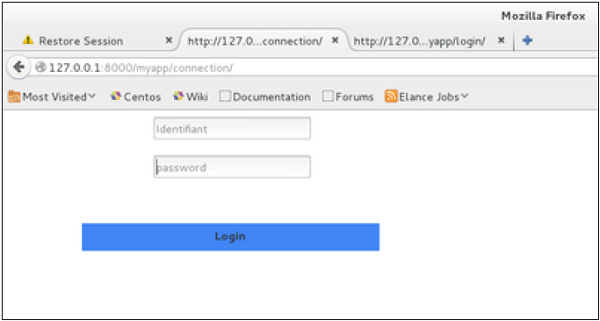
from django.conf.urls import patterns, url from django.views.generic import TemplateView urlpatterns = patterns('myapp.views', url(r'^connection/','formView', name = 'loginform'), url(r'^login/', 'login', name = 'login'))When accessing /myapp/connection, you will get the following page −
And you will get redirected to the following screen on submit −
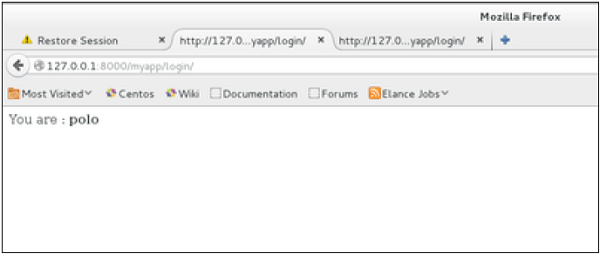
Now, if you try to access /myapp/connection again in the 10 seconds range, you will get redirected to the second screen directly. And if you access /myapp/connection again out of this range you will get the login form (screen 1).
-
Scalability:
Django is designed to handle high-traffic applications. Many large-scale websites, including Instagram and Pinterest, use Django, demonstrating its ability to scale effectively.
-
Security Features:
Django has built-in protections against many common web vulnerabilities, including SQL injection, cross-site scripting (XSS), and cross-site request forgery (CSRF). This makes it a secure choice for web applications.
-
Batteries-Included Philosophy:
Django follows a “batteries-included” approach, meaning it comes with a wide array of built-in features, such as an ORM, authentication system, and an admin interface, reducing the need for third-party libraries.
-
Mature Framework:
Django was first released in 2005 and has evolved significantly, making it a mature and stable framework suitable for production environments.
-
Written in Python:
Django is built on Python, a language known for its simplicity and readability. This makes Django accessible to new developers while allowing experienced developers to write complex applications efficiently.