Length of a string is the number of characters present in the string. These characters can be of the data type char, and these include all alphanumeric elements, symbols and miscellaneous characters. In C++ programming language, there are two types of strings- Character Arrays of C-Style type, and String objects which are built-in objects of <string> class.
The length of a string also includes white spaces, but in case a string includes a terminating character “\0”, the string ends at that character and the count of length is terminated just before that character.
There are many ways to find the length of a given string. Some of these methods are iterative, whereas some also use in-built functions and methods. These methods are explained clearly in the following parts of this chapter −
Using strlen() Method
Using string::length() Method of String Class
Using string::size() Method of String Class
Using Iterative for Loop
Using Iterative while Loop
String Length Using strlen() Method
Strings are defined as character arrays which are accessed using the pointer to the first iterator of the array. We can use strlen() method of C Library to calculate the length of C-type arrays.
Syntax
The following syntax shows how to use strlen() method to calculate the length of the string −
strlen(string_name);
Example
The following example shows how to calculate the length of the string using strlen() method −
Open Compiler
#include <bits/stdc++.h>usingnamespace std;intmain(){char s[]="I love TP !!!";
   cout<<"Length of string s : "<<strlen(s);return0;}
Output
Length of string s : 13
String Length Using string::size() Method
Most programmers commonly use string::size() method of string class when there is a need to calculate the length of a string in C++ programming language. It is the most basic method, and it is generally used while traversing a string object.
Syntax
The following syntax shows how to use size() method to calculate the length of the string −
string_object.size();
Example
The following example shows how to calculate the length of the string using size() method −
Open Compiler
#include <bits/stdc++.h>usingnamespace std;intmain(){
   string s="I love TP !!!\0 and others";

   cout<<"Length of string s : "<<s.size();return0;}
Output
Length of string s : 13
String Length Using string::length() Method
We can also use length() method of string class to determine the length of the given string. Both length() and size() methods are part of <string> header file, and these are called as methods to the string object.
Syntax
The following syntax shows how to use length() method to calculate the length of the string −
string_object.length();
Example
The following example shows how to calculate the length of the string using length() method −
Open Compiler
#include <bits/stdc++.h>usingnamespace std;intmain(){
   string s="I love TP !!!\0 and others";

   cout<<"Length of string s : "<<s.length();return0;}
Output
Length of string s : 13
String Length Using while Loop
We can use a simple while loop to iterate over the string and initialize a variable count to calculate the length of the string until we reach the end of the string. For each iteration, the count increases by one, hence the net result will be the length of the string.
Syntax
The following syntax shows how to use a while loop to calculate the length of the string −
while(s[i]!='\0'){[body]}
Example
The following example shows how to calculate the length of the string using a single while loop −
Open Compiler
#include <bits/stdc++.h>usingnamespace std;intmain(){
   string s="I love TP !!!\0 and others";int count=0, i=0;while(s[i]!='\0')
  count++, i++;
   cout<<"Length of string s : "<<count;return0;}
Output
Length of string s : 13
String Length Using a for Loop
We can use a simple for loop to iterate over the string and initialize a variable count to calculate the length of the string until we reach the end of the string. For each iteration, the count increases by one, hence the net result will be the length of the string.
Syntax
The following syntax shows how to use a for loop to calculate the length of the string −
for(int i=0;s[i]!='\0';i++){[body]}
Example
The following example shows how to calculate the length of the string using a single for loop −
Open Compiler
#include <bits/stdc++.h>usingnamespace std;intmain(){
string s="I love TP !!!\0 and others";int count=0;for(int i=0;s[i]!='\0';i++)
C++ provides following two types of string representations −
The C-style character string.
The string class type introduced with Standard C++.
The C-Style Character String
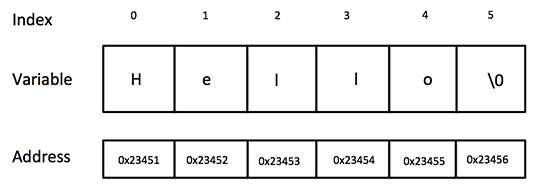
The C-style character string originated within the C language and continues to be supported within C++. This string is actually a one-dimensional array of characters which is terminated by a null character ‘\0’. Thus a null-terminated string contains the characters that comprise the string followed by a null.
The following declaration and initialization create a string consisting of the word “Hello”. To hold the null character at the end of the array, the size of the character array containing the string is one more than the number of characters in the word “Hello.”
If you follow the rule of array initialization, then you can write the above statement as follows −
char greeting[] = "Hello";
Following is the memory presentation of above defined string in C/C++ −
Actually, you do not place the null character at the end of a string constant. The C++ compiler automatically places the ‘\0’ at the end of the string when it initializes the array. Let us try to print above-mentioned string −
We can declare a String variable using the ‘string’ keyword. This is included in the <string> header file. The syntax of declaring a string is explained as follows −
Syntax
string variable_name =[value];
Here, [value] is an optional and can be used to assign value during the declaration.
Example
In the following examples, we are declaring a string variable, assigning a value to it.
We can traverse a string using for loops, while loops and do while loops using a pointer to the first and the last index in the string.
Using iterators
Using range based loops, we can iterate over the string using iterators. This is achieved using “:” operator while running a range based loop.
Example of Iterating a String
The following example code shows string traversal using both of these methods −
Open Compiler
#include <iostream>usingnamespace std;intmain(){
string s="Hey, I am at TP.";for(int i=0;i<s.length();i++){
cout<<s[i]<<" ";}
cout<<endl;for(char c:s){
cout<<c<<" ";}return0;}</code></pre>
Output
H e y , I a m a t T P .
H e y , I a m a t T P .
Accessing Characters of String
We can access the characters of a string using both iterators and pointer to the indices of the string.
Example
The following example code shows how we can access the characters in a string −
Open Compiler
#include <iostream>usingnamespace std;intmain(){
string s="Hey, I am at TP.";
cout<<s<<endl;for(int i=0;i<s.length();i++){
s[i]='A';}
cout<<s<<endl;for(char&c:s){
c='B';}
cout<<s<<endl;return0;}
Output
Hey, I am at TP.
AAAAAAAAAAAAAAAA
BBBBBBBBBBBBBBBB
String Functions
String is an object of the <string> class, and hence, it has a variety of functions that users can utilize for a variety of operations. Some of these functions are as follows −
Function
Description
length()
This function returns the length of the string.
swap()
This function is used to swap the values of 2 strings.
size()
Used to find the size of string
resize()
This function is used to resize the length of the string up to the given number of characters.
find()
Used to find the string which is passed in parameters
push_back()
This function is used to push the character at the end of the string
pop_back()
This function is used to pop the last character from the string
clear()
This function is used to remove all the elements of the string.
find()
This function is used to search for a certain substring inside a string and returns the position of the first character of the substring.
replace()
This function is used to replace each element in the range [first, last) that is equal to old value with new value.
This function is used to compare two strings and returns the result in the form of an integer.
erase()
This function is used to remove a certain part of a string.
Length of a String
The length of a string is the number of characters present in the string. Hence, the string "apple" has a length of 5 characters and the string "hello son" has a length of 9 characters (including empty spaces). This can be accessed using the length() method in <string> header file.
String concatenation is a way to add two strings together. This can be done using two ways −
Addition Operator
The addition operator is used to add two elements. In case of strings, the addition operator concatenates the two strings. This is clearly explained in the following example −
Example
Open Compiler
#include <iostream>#include <string>usingnamespace std;intmain(){
string x ="10";
string y ="20";
cout<<x+y<<endl;return0;}
Output
1020
This is different from integer addition. When we take two integers and add them using addition operator, we get the sum of the two numbers instead.
This is clearly explained in the following example −
Example
Open Compiler
#include <iostream>#include <string>usingnamespace std;intmain(){int x =10;int y =20;
cout<<x+y<<endl;return0;}
Output
30
Using string append() method
C++ is an object oriented programming language, and hence a string is actually an object, which contain functions that can perform certain operations on strings. We can use string append() method to append one string to another.
The syntax of this operation is as follows −
Syntax
string_1.append(string_2);
The usage of this method is depicted clearly in the following example −
Strings can be taken as an input to the program, and the most common way to do this is by using cin method.
There are three methods to take a string as an input, and these methods are given as follows −
cin
getline()
stringstream
Using cin Method
This is the simplest way to take a string as an input. The syntax is given as follows −
Syntax
cin>>string_name;
Example
#include <iostream>usingnamespace std;intmain(){
string s;
cout <<"Enter custom string : "<<endl;//enter the string here
cin>>s;
cout<<"The string is : "<<s;}
Using getline() Method
The getline() method can be used to read a string from an input stream. This is defined in the <string> header file. The syntax of the above method is given as follows −
Syntax
getline(cin, string_name);
Example
#include <iostream>usingnamespace std;intmain(){
string s;
cout <<"Enter String as input : "<< endl;getline(cin, s);//enter the string here
cout <<"Printed string is : "<< s << endl;return0;}
Using stringstream
The stringstream class is used to take multiple strings as input, all at once. The syntax of the above method is given as follows −
Syntax
Stringstream object_name(string_name);
Example
Open Compiler
#include <iostream>#include <sstream>#include <string>usingnamespace std;intmain(){
string s ="Hey, I am at TP";
stringstream object(s);
string newstr;// >> operator will read from the stringstream objectwhile(object >> newstr){
C++ enables direct manipulation of hardware and memory, which is essential for system-level programming, drivers, and performance-critical applications.
C++ allows developers to create abstract data types, which can hide the implementation details and expose only the necessary functionalities, promoting code encapsulation.
Through templates and function overloading, C++ supports compile-time polymorphism, which can improve performance by resolving method calls at compile time instead of runtime.
C++11 and later versions offer built-in support for multithreading, making it easier to write concurrent applications that can take advantage of modern multi-core processors.