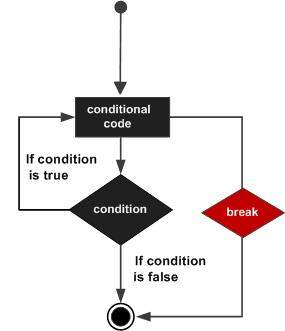
Python break statement is used to terminate the current loop and resumes execution at the next statement, just like the traditional break statement in C.
The most common use for Python break statement is when some external condition is triggered requiring a sudden exit from a loop. The break statement can be used in both Python while and for loops.
If you are using nested loops in Python, the break statement stops the execution of the innermost loop and start executing the next line of code after the block.
Syntax of break Statement
The syntax for a break statement in Python is as follows −
looping statement:
   condition check:break
Learn Python in-depth with real-world projects through our Python certification course. Enroll and become a certified expert to boost your career.
Flow Diagram of break Statement
Following is the flowchart of the break statement −
break Statement with for loop
If we use break statement inside a for loop, it interrupts the normal flow of program and exit the loop before completing the iteration.
Example
In this example, we will see the working of break statement in for loop.
Open Compiler
for letter in'Python':if letter =='h':breakprint("Current Letter :", letter)print("Good bye!")
When the above code is executed, it produces the following result −
Current Letter : P
Current Letter : y
Current Letter : t
Good bye!
break Statement with while loop
Similar to the for loop, we can use the break statement to skip the code inside while loop after the specified condition becomes TRUE.
Example
The code below shows how to use break statement with while loop.
Open Compiler
var =10while var >0:print('Current variable value :', var)
   var = var -1if var ==5:breakprint("Good bye!")
On executing the above code, it produces the following result −
Current variable value : 10
Current variable value : 9
Current variable value : 8
Current variable value : 7
Current variable value : 6
Good bye!
break Statement with Nested Loops
In nested loops, one loop is defined inside another. The loop that enclose another loop (i.e. inner loop) is called as outer loop.
When we use a break statement with nested loops, it behaves as follows −
When break statement is used inside the inner loop, only the inner loop will be skipped and the program will continue executing statements after the inner loop
And, when the break statement is used in the outer loop, both the outer and inner loops will be skipped and the program will continue executing statements immediate to the outer loop.
Example
The following program demonstrates the use of break in a for loop iterating over a list. Here, the specified number will be searched in the list. If it is found, then the loop terminates with the “found” message.
Open Compiler
no =33
numbers =[11,33,55,39,55,75,37,21,23,41,13]for num in numbers:if num == no:print('number found in list')breakelse:print('number not found in list')
The above program will produce the following output −
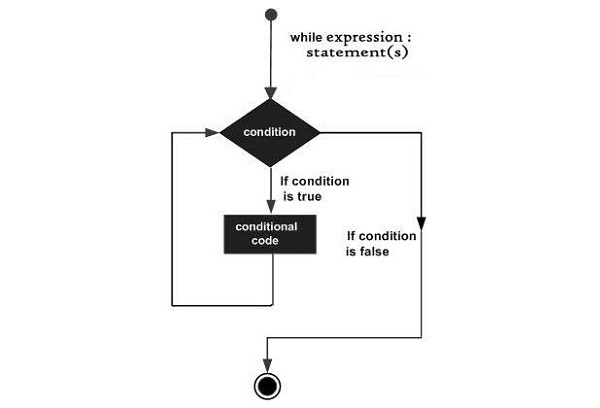
A while loop in Python programming language repeatedly executes a target statement as long as the specified boolean expression is true. This loop starts with while keyword followed by a boolean expression and colon symbol (:). Then, an indented block of statements starts.
Here, statement(s) may be a single statement or a block of statements with uniform indent. The condition may be any expression, and true is any non-zero value. As soon as the expression becomes false, the program control passes to the line immediately following the loop.
If it fails to turn false, the loop continues to run, and doesn’t stop unless forcefully stopped. Such a loop is called infinite loop, which is undesired in a computer program.
Syntax of while Loop
The syntax of a while loop in Python programming language is −
while expression:
   statement(s)
In Python, all the statements indented by the same number of character spaces after a programming construct are considered to be part of a single block of code. Python uses indentation as its method of grouping statements.
Flowchart of While loop
The following flow diagram illustrates the while loop −
Example 1
The following example illustrates the working of while loop. Here, the iteration run till value of count will become 5.
Open Compiler
count=0while count<5:
   count+=1print("Iteration no. {}".format(count))print("End of while loop")
On executing, this code will produce the following output −
Iteration no. 1
Iteration no. 2
Iteration no. 3
Iteration no. 4
Iteration no. 5
End of while loop
Example 2
Here is another example of using the while loop. For each iteration, the program asks for user input and keeps repeating till the user inputs a non-numeric string. The isnumeric() function returns true if input is an integer, false otherwise.
var ='0'while var.isnumeric()==True:
   var ="test"if var.isnumeric()==True:print("Your input", var)print("End of while loop")
On running the code, it will produce the following output −
enter a number..10
Your input 10
enter a number..100
Your input 100
enter a number..543
Your input 543
enter a number..qwer
End of while loop
Python Infinite while Loop
A loop becomes infinite loop if a condition never becomes FALSE. You must be cautious when using while loops because of the possibility that this condition never resolves to a FALSE value. This results in a loop that never ends. Such a loop is called an infinite loop.
An infinite loop might be useful in client/server programming where the server needs to run continuously so that client programs can communicate with it as and when required.
Example
Let’s take an example to understand how the infinite loop works in Python −
var =1while var ==1:# This constructs an infinite loop
   num =int(input("Enter a number :"))print("You entered: ", num)print("Good bye!")
On executing, this code will produce the following output −
Enter a number :20
You entered: 20
Enter a number :29
You entered: 29
Enter a number :3
You entered: 3
Enter a number :11
You entered: 11
Enter a number :22
You entered: 22
Enter a number :Traceback (most recent call last):
File "examples\test.py", line 5, in
num = int(input("Enter a number :"))
KeyboardInterrupt
The above example goes in an infinite loop and you need to use CTRL+C to exit the program.
Learn Python in-depth with real-world projects through our Python certification course. Enroll and become a certified expert to boost your career.
Python while-else Loop
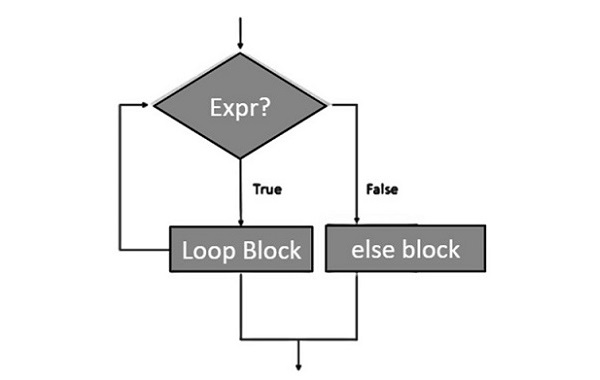
Python supports having an else statement associated with a while loop. If the else statement is used with a while loop, the else statement is executed when the condition becomes false before the control shifts to the main line of execution.
Flowchart of While loop with else Statement
The following flow diagram shows how to use else statement with while loop −
Example
The following example illustrates the combination of an else statement with a while statement. Till the count is less than 5, the iteration count is printed. As it becomes 5, the print statement in else block is executed, before the control is passed to the next statement in the main program.
Open Compiler
count=0while count<5:
   count+=1print("Iteration no. {}".format(count))else:print("While loop over. Now in else block")print("End of while loop")
On running the above code, it will print the following output −
Iteration no. 1
Iteration no. 2
Iteration no. 3
Iteration no. 4
Iteration no. 5
While loop over. Now in else block
End of while loop
Single Statement Suites
Similar to the if statement syntax, if your while clause consists only of a single statement, it may be placed on the same line as the while header.
Example
The following example shows how to use one-line while clause.
Open Compiler
flag =0while(flag):print("Given flag is really true!")print("Good bye!")
When you run this code, it will display the following output −
Good bye!
Change the flag value to “1” and try the above program. If you do so, it goes into infinite loop and you need to press CTRL+C keys to exit.
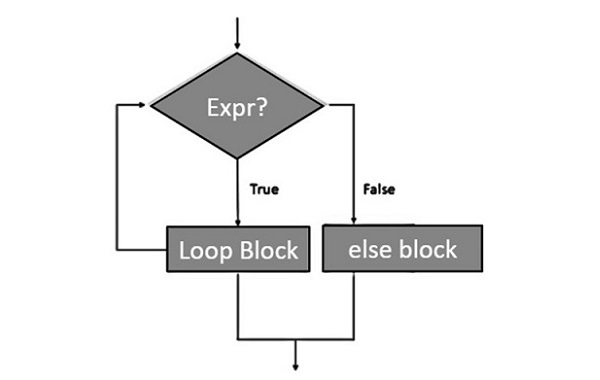
Python supports an optional else block to be associated with a for loop. If a else block is used with a for loop, it is executed only when the for loop terminates normally.
The for loop terminates normally when it completes all its iterations without encountering a break statement, which allows us to exit the loop when a certain condition is met.
Flowchart of For Else Loop
The following flowchart illustrates use of for-else loop −
Syntax of For Else Loop
Following is the syntax of for loop with optional else block −
for variable_name in iterable:#stmts in the loop...else:#stmts in else clause..
Example of For Else Loop
The following example illustrates the combination of an else statement with a for statement in Python. Till the count is less than 5, the iteration count is printed. As it becomes 5, the print statement in else block is executed, before the control is passed to the next statement in the main program.
Open Compiler
for count inrange(6):print("Iteration no. {}".format(count))else:print("for loop over. Now in else block")print("End of for loop")
On executing, this code will produce the following output −
Iteration no. 1
Iteration no. 2
Iteration no. 3
Iteration no. 4
Iteration no. 5
for loop over. Now in else block
End of for loop
For-Else Construct without break statement
As mentioned earlier in this tutorial, the else block executes only when the loop terminates normally i.e. without using break statement.
Example
In the following program, we use the for-else loop without break statement.
Open Compiler
for i in['T','P']:print(i)else:# Loop else statement# there is no break statement in for loop, hence else part gets executed directlyprint("ForLoop-else statement successfully executed")
On executing, the above program will generate the following output −
T
P
ForLoop-else statement successfully executed
Learn Python in-depth with real-world projects through our Python certification course. Enroll and become a certified expert to boost your career.
For-Else Construct with break statementIn case of forceful termination (by using break statement) of the loop, else statement is overlooked by the interpreter and hence its execution is skipped.
Example
The following program shows how else conditions work in case of a break statement.
Open Compiler
for i in['T','P']:print(i)breakelse:# Loop else statement# terminated after 1st iteration due to break statement in for loopprint("Loop-else statement successfully executed")
On executing, the above program will generate the following output −
T
For-Else with break statement and if conditions
If we use for-else construct with break statement and if condition, the for loop will iterate over the iterators and within this loop, you can use an if block to check for a specific condition. If the loop completes without encountering a break statement, the code in the else block is executed.
Example
The following program shows how else conditions works in case of break statement and conditional statements.
Open Compiler
# creating a function to check whether the list item is a positive# or a negative numberdefpositive_or_negative():# traversing in a listfor i in[5,6,7]:# checking whether the list element is greater than 0if i>=0:# printing positive number if it is greater than or equal to 0print("Positive number")else:# Else printing Negative number and breaking the loopprint("Negative number")break# Else statement of the for loopelse:# Statement inside the else blockprint("Loop-else Executed")# Calling the above-created function
positive_or_negative()
On executing, the above program will generate the following output −
Positive number
Positive number
Positive number
Loop-else Executed
The for loop in Python provides the ability to loop over the items of any sequence, such as a list, tuple or a string. It performs the same action on each item of the sequence. This loop starts with the for keyword, followed by a variable that represents the current item in the sequence. The in keyword links the variable to the sequence you want to iterate over. A colon (:) is used at the end of the loop header, and the indented block of code beneath it is executed once for each item in the sequence.
Syntax of Python for Loop
for iterating_var in sequence:
   statement(s)
Here, the iterating_var is a variable to which the value of each sequence item will be assigned during each iteration. Statements represents the block of code that you want to execute repeatedly.
Before the loop starts, the sequence is evaluated. If it’s a list, the expression list (if any) is evaluated first. Then, the first item (at index 0) in the sequence is assigned to iterating_var variable.
During each iteration, the block of statements is executed with the current value of iterating_var. After that, the next item in the sequence is assigned to iterating_var, and the loop continues until the entire sequence is exhausted.
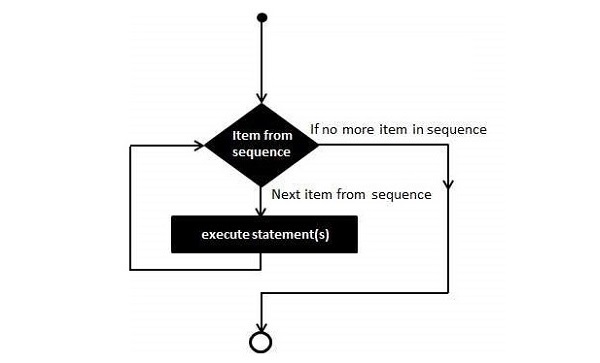
Flowchart of Python for Loop
The following flow diagram illustrates the working of for loop −
Learn Python in-depth with real-world projects through our Python certification course. Enroll and become a certified expert to boost your career.
Python for Loop with Strings
A string is a sequence of Unicode letters, each having a positional index. Since, it is a sequence, you can iterate over its characters using the for loop.
Example
The following example compares each character and displays if it is not a vowel (‘a’, ‘e’, ‘i’, ‘o’, ‘u’).
Open Compiler
zen ='''
Beautiful is better than ugly.
Explicit is better than implicit.
Simple is better than complex.
Complex is better than complicated.
'''for char in zen:if char notin'aeiou':print(char, end='')
On executing, this code will produce the following output −
Btfl s bttr thn gly.
Explct s bttr thn mplct.
Smpl s bttr thn cmplx.
Cmplx s bttr thn cmplctd.
Python for Loop with Tuples
Python’s tuple object is also an indexed sequence, and hence you can traverse its items with a for loop.
Example
In the following example, the for loop traverses a tuple containing integers and returns the total of all numbers.
Open Compiler
numbers =(34,54,67,21,78,97,45,44,80,19)
total =0for num in numbers:
   total += num
print("Total =", total)
On running this code, it will produce the following output −
Total = 539
Python for Loop with Lists
Python’s list object is also an indexed sequence, and hence you can iterate over its items using a for loop.
Example
In the following example, the for loop traverses a list containing integers and prints only those which are divisible by 2.
Open Compiler
numbers =[34,54,67,21,78,97,45,44,80,19]
total =0for num in numbers:if num%2==0:print(num)
When you execute this code, it will show the following result −
34
54
78
44
80
Python for Loop with Range Objects
Python’s built-in range() function returns an iterator object that streams a sequence of numbers. This object contains integers from start to stop, separated by step parameter. You can run a for loop with range as well.
Syntax
The range() function has the following syntax −
range(start, stop, step)
Where,
Start − Starting value of the range. Optional. Default is 0
Stop − The range goes upto stop-1
Step − Integers in the range increment by the step value. Option, default is 1.
Example
In this example, we will see the use of range with for loop.
Open Compiler
for num inrange(5):print(num, end=' ')print()for num inrange(10,20):print(num, end=' ')print()for num inrange(1,10,2):print(num, end=' ')
When you run the above code, it will produce the following output −
0 1 2 3 4
10 11 12 13 14 15 16 17 18 19
1 3 5 7 9
Python for Loop with Dictionaries
Unlike a list, tuple or a string, dictionary data type in Python is not a sequence, as the items do not have a positional index. However, traversing a dictionary is still possible with the for loop.
Example
Running a simple for loop over the dictionary object traverses the keys used in it.
Open Compiler
numbers ={10:"Ten",20:"Twenty",30:"Thirty",40:"Forty"}for x in numbers:print(x)
On executing, this code will produce the following output −
10
20
30
40
Once we are able to get the key, its associated value can be easily accessed either by using square brackets operator or with the get() method.
Example
The following example illustrates the above mentioned approach.
Open Compiler
numbers ={10:"Ten",20:"Twenty",30:"Thirty",40:"Forty"}for x in numbers:print(x,":",numbers[x])
It will produce the following output −
10 : Ten
20 : Twenty
30 : Thirty
40 : Forty
The items(), keys() and values() methods of dict class return the view objects dict_items, dict_keys and dict_values respectively. These objects are iterators, and hence we can run a for loop over them.
Example
The dict_items object is a list of key-value tuples over which a for loop can be run as follows −
Open Compiler
numbers ={10:"Ten",20:"Twenty",30:"Thirty",40:"Forty"}for x in numbers.items():print(x)
Python supports to have an else statement associated with a loop statement. However, the else statement is executed when the loop has exhausted iterating the list.
Example
The following example illustrates the combination of an else statement with a for statement that searches for prime numbers from 10 to 20.
Open Compiler
#For loop to iterate between 10 to 20for num inrange(10,20):#For loop to iterate on the factors for i inrange(2,num):#If statement to determine the first factorif num%i ==0:#To calculate the second factor
     j=num/i
     print("%d equals %d * %d"%(num,i,j))#To move to the next numberbreakelse:print(num,"is a prime number")break</code></pre>


When the above code is executed, it produces the following result −


10 equals 2 * 5
11 is a prime number
12 equals 2 * 6
13 is a prime number
14 equals 2 * 7
15 equals 3 * 5
16 equals 2 * 8
17 is a prime number
18 equals 2 * 9
19 is a prime number
Python loops allow us to execute a statement or group of statements multiple times.
In general, statements are executed sequentially: The first statement in a function is executed first, followed by the second, and so on. There may be a situation when you need to execute a block of code several number of times.
Programming languages provide various control structures that allow for more complicated execution paths.
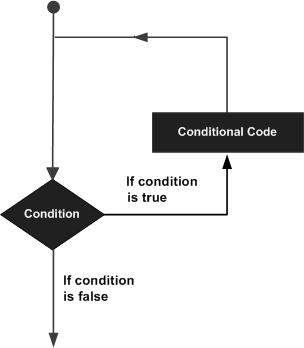
Flowchart of a Loop
The following diagram illustrates a loop statement −
Learn Python in-depth with real-world projects through our Python certification course. Enroll and become a certified expert to boost your career.
Types of Loops in Python
Python programming language provides following types of loops to handle looping requirements −
Sr.No.
Loop Type & Description
1
while loopRepeats a statement or group of statements while a given condition is TRUE. It tests the condition before executing the loop body.
2
for loopExecutes a sequence of statements multiple times and abbreviates the code that manages the loop variable.
3
nested loopsYou can use one or more loop inside any another while, for or do..while loop.
Python Loop Control Statements
Loop control statements change execution from its normal sequence. When execution leaves a scope, all automatic objects that were created in that scope are destroyed.
Python supports the following control statements. Click the following links to check their detail.
Let us go through the loop control statements briefly
Sr.No.
Control Statement & Description
1
break statementTerminates the loop statement and transfers execution to the statement immediately following the loop.
2
continue statementCauses the loop to skip the remainder of its body and immediately retest its condition prior to reiterating.
3
pass statementThe pass statement in Python is used when a statement is required syntactically but you do not want any command or code to execute.
A Python match-case statement takes an expression and compares its value to successive patterns given as one or more case blocks. Only the first pattern that matches gets executed. It is also possible to extract components (sequence elements or object attributes) from the value into variables.
With the release of Python 3.10, a pattern matching technique called match-case has been introduced, which is similar to the switch-case construct available in C/C++/Java etc. Its basic use is to compare a variable against one or more values. It is more similar to pattern matching in languages like Rust or Haskell than a switch statement in C or C++.
Syntax
The following is the syntax of match-case statement in Python –
match variable_name:case'pattern 1': statement 1case'pattern 2': statement 2...case'pattern n': statement n
Example
The following code has a function named weekday(). It receives an integer argument, matches it with all possible weekday number values, and returns the corresponding name of day.
Open Compiler
defweekday(n):match n:case0:return"Monday"case1:return"Tuesday"case2:return"Wednesday"case3:return"Thursday"case4:return"Friday"case5:return"Saturday"case6:return"Sunday"case_:return"Invalid day number"print(weekday(3))print(weekday(6))print(weekday(7))
On executing, this code will produce the following output −
Thursday
Sunday
Invalid day number
The last case statement in the function has “_” as the value to compare. It serves as the wildcard case, and will be executed if all other cases are not true.
Combined Cases in Match Statement
Sometimes, there may be a situation where for more than one cases, a similar action has to be taken. For this, you can combine cases with the OR operator represented by “|” symbol.
Example
The code below shows how to combine cases in match statement. It defines a function named access() and has one string argument, representing the name of the user. For admin or manager user, the system grants full access; for Guest, the access is limited; and for the rest, there’s no access.
On running the above code, it will show the following result −
Full access
Limited access
No access
Learn Python in-depth with real-world projects through our Python certification course. Enroll and become a certified expert to boost your career.
List as the Argument in Match Case Statement
Since Python can match the expression against any literal, you can use a list as a case value. Moreover, for variable number of items in the list, they can be parsed to a sequence with “*” operator.
Example
In this code, we use list as argument in match case statement.
On executing, this code will produce the following output −
Good Morning Ravi!
Good Afternoon Guest!
Good Evening Kajal!
Good Evening Praveen!
Good Evening Lata!
Using “if” in “Case” Clause
Normally Python matches an expression against literal cases. However, it allows you to include if statement in the case clause for conditional computation of match variable.
Example
In the following example, the function argument is a list of amount and duration, and the intereset is to be calculated for amount less than or more than 10000. The condition is included in the case clause.
Python supports nested if statements which means we can use a conditional if and if…else statement inside an existing if statement.
There may be a situation when you want to check for additional conditions after the initial one resolves to true. In such a situation, you can use the nested if construct.
Additionally, within a nested if construct, you can include an if…elif…else construct inside another if…elif…else construct.
Syntax of Nested if Statement
The syntax of the nested if construct with else condition will be like this −
if boolean_expression1:
statement(s)if boolean_expression2:
statement(s)</code></pre>
Flowchart of Nested if Statement
Following is the flowchart of Python nested if statement −
Learn Python in-depth with real-world projects through our Python certification course. Enroll and become a certified expert to boost your career.
Example of Nested if Statement
The below example shows the working of nested if statements −
Open Compiler
num =36print("num = ", num)if num %2==0:if num %3==0:print("Divisible by 3 and 2")print("....execution ends....")
When you run the above code, it will display the following result −
num = 36
Divisible by 3 and 2
....execution ends....
Nested if Statement with else Condition
As mentioned earlier, we can nest if-else statement within an if statement. If the if condition is true, the first if-else statement will be executed otherwise, statements inside the else block will be executed.
Syntax
The syntax of the nested if construct with else condition will be like this −
Now let's take a Python code to understand how it works −
Open Compiler
num=8print("num = ",num)if num%2==0:if num%3==0:print("Divisible by 3 and 2")else:print("divisible by 2 not divisible by 3")else:if num%3==0:print("divisible by 3 not divisible by 2")else:print("not Divisible by 2 not divisible by 3")
When the above code is executed, it produces the following output −
num = 8
divisible by 2 not divisible by 3
num = 15
divisible by 3 not divisible by 2
num = 12
Divisible by 3 and 2
num = 5
not Divisible by 2 not divisible by 3
The if-else statement in Python is used to execute a block of code when the condition in the if statement is true, and another block of code when the condition is false.
Syntax of if-else Statement
The syntax of an if-else statement in Python is as follows −
if boolean_expression:# code block to be executed# when boolean_expression is trueelse:# code block to be executed# when boolean_expression is false
If the boolean expression evaluates to TRUE, then the statement(s) inside the if block will be executed otherwise statements of the else block will be executed.
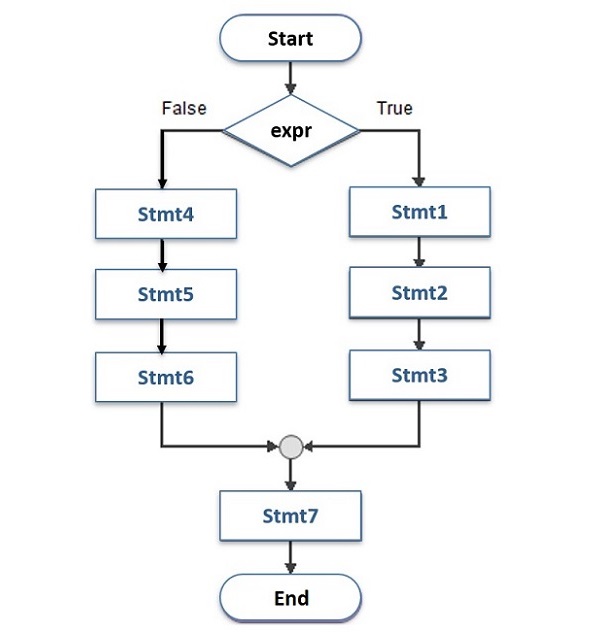
Flowchart of if-else Statement
This flowchart shows how if-else statement is used −
If the expr is True, block of stmt1, 2, 3 is executed then the default flow continues with stmt7. However, if the expr is False, block stmt4, 5, 6 runs then the default flow continues.
Python implementation of the above flowchart is as follows −
if expr==True:
   stmt1
   stmt2
   stmt3
else:
   stmt4
   stmt5
   stmt6
Stmt7
Python if-else Statement Example
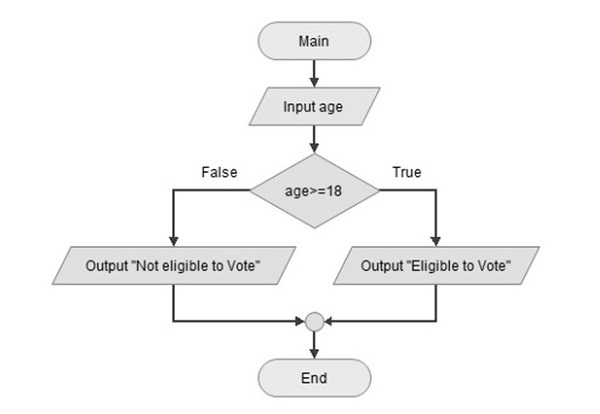
Let us understand the use of if-else statements with the following example. Here, variable age can take different values. If the expression age > 18 is true, then eligible to vote message will be displayed otherwise not eligible to vote message will be displayed. Following flowchart illustrates this logic −
Now, let’s see the Python implementation the above flowchart.
Open Compiler
age=25print("age: ", age)if age >=18:print("eligible to vote")else:print("not eligible to vote")
On executing this code, you will get the following output −
age: 25
eligible to vote
To test the else block, change the age to 12, and run the code again.
age: 12
not eligible to vote
Python if elif else Statement
The if elif else statement allows you to check multiple expressions for TRUE and execute a block of code as soon as one of the conditions evaluates to TRUE.
Similar to the else block, the elif block is also optional. However, a program can contains only one else block whereas there can be an arbitrary number of elif blocks following an if block.
Syntax of Python if elif else Statement
if expression1:
   statement(s)elif expression2:
   statement(s)elif expression3:
   statement(s)else:
   statement(s)
How if elif else Works?
The keyword elif is a short form of else if. It allows the logic to be arranged in a cascade of elif statements after the first if statement. If the first if statement evaluates to false, subsequent elif statements are evaluated one by one and comes out of the cascade if any one is satisfied.
Last in the cascade is the else block which will come in picture when all preceding if/elif conditions fails.
Example
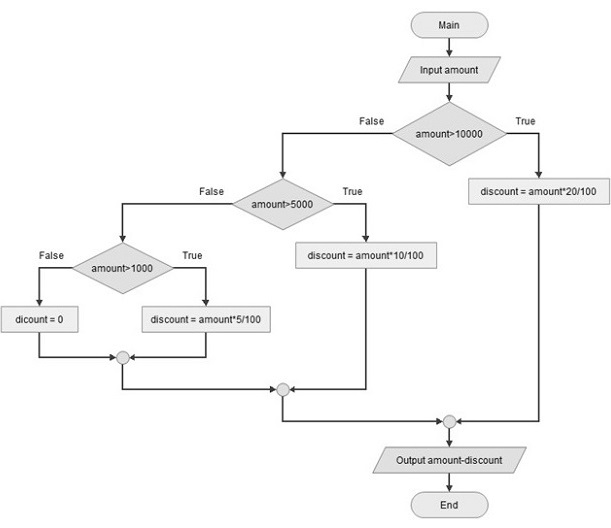
Suppose there are different slabs of discount on a purchase −
20% on amount exceeding 10000,
10% for amount between 5-10000,
5% if it is between 1 to 5000.
no discount if amount<1000
The following flowchart illustrates these conditions −
We can write a Python code for the above logic with if-else statements −
While the code will work perfectly fine, if you look at the increasing level of indentation at each if and else statement, it will become difficult to manage if there are still more conditions.
Python if elif else Statement Example
The elif statement makes the code easy to read and comprehend. Following is the Python code for the same logic with if elif else statements −
The if statement in Python evaluates whether a condition is true or false. It contains a logical expression that compares data, and a decision is made based on the result of the comparison.
Syntax of the if Statement
if expression:
   # statement(s) to be executed
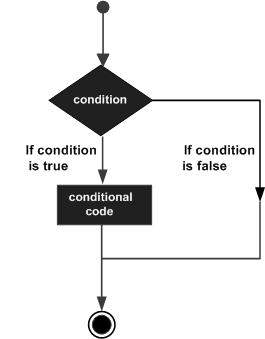
If the boolean expression evaluates to TRUE, then the statement(s) inside the if block is executed. If boolean expression evaluates to FALSE, then the first set of code after the end of the if block is executed.
Learn Python in-depth with real-world projects through our Python certification course. Enroll and become a certified expert to boost your career.
Flow Diagram (Flowchart) of the if Statement
The below diagram shows flowchart of the if statement −
Example of Python if Statement
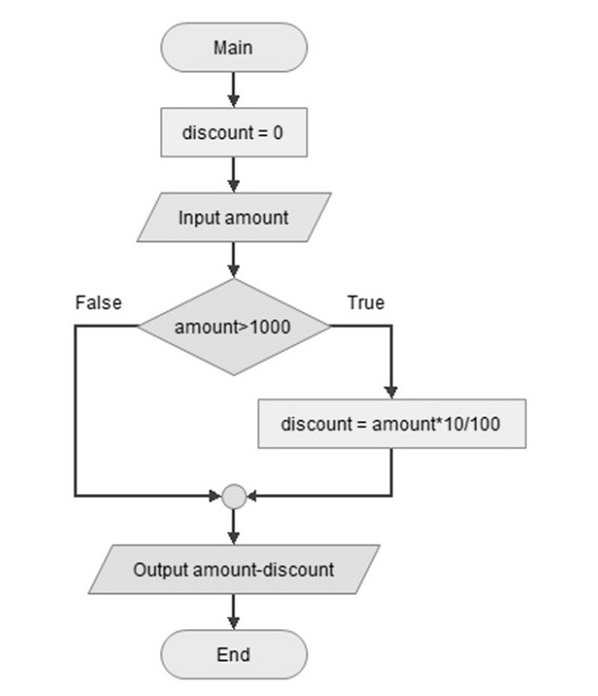
Let us consider an example of a customer entitled to 10% discount if his purchase amount is > 1000; if not, then no discount is applicable. The following flowchart shows the whole decision making process −
First, set a discount variable to 0 and an amount variable to 1200. Then, use an if statement to check whether the amount is greater than 1000. If this condition is true, calculate the discount amount. If a discount is applicable, deduct it from the original amount.
Python code for the above flowchart can be written as follows −
Python’s decision making functionality is in its keywords − if..elif…else. The if keyword requires a boolean expression, followed by colon (:) symbol. The colon (:) symbol starts an indented block. The statements with the same level of indentation are executed if the boolean expression in if statement is True. If the expression is not True (False), the interpreter bypasses the indented block and proceeds to execute statements at earlier indentation level.
Decision structures evaluate multiple expressions which produce TRUE or FALSE as outcome. You need to determine which action to take and which statements to execute if outcome is TRUE or FALSE otherwise.
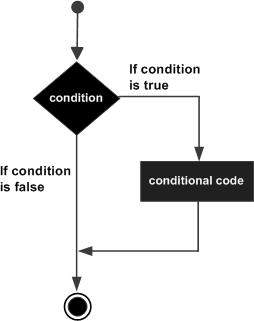
Following is the general form of a typical decision making structure found in most of the programming languages −
Python programming language assumes any non-zero and non-null values as TRUE, and if it is either zero or null, then it is assumed as FALSE value.
Types of Decision Making Statements in Python
Python programming language provides following types of decision making statements. Click the following links to check their detail.
Sr.No.
Statement & Description
1
if statementsAn if statement consists of a boolean expression followed by one or more statements.
2
if…else statementsAn if statement can be followed by an optional else statement, which executes when the boolean expression is FALSE.
3
nested if statementsYou can use one if or else if statement inside another if or else if statement(s).
Let us go through each decision making briefly −
Single Statement Suites
If the suite of an if clause consists only of a single line, it may go on the same line as the header statement.
Example
Here is an example of a one-line if clause −
Open Compiler
var =100if( var ==100):print("Value of expression is 100")print("Good bye!")
When the above code is executed, it produces the following result −
Value of expression is 100
Good bye!
Learn Python in-depth with real-world projects through our Python certification course. Enroll and become a certified expert to boost your career.
if…else statement
In this decision making statement, if the if condition is true, then the statements within this block are executed, otherwise, the else block is executed.
The program will choose which block of code to execute based on whether the condition in the if statement is true or false.
Example
The following example shows the use of if…else statement.
Open Compiler
var =100if( var ==100):print("Value of var is equal to 100")else:print("Value of var is not equal to 100")
On running the above code, it will show the following output −
Value of var is equal to 100
Nested if statements
A nested if is another decision making statement in which one if statement resides inside another. It allows us to check multiple conditions sequentially.
Example
In this example, we will see the use of nested-if statement.
Open Compiler
var =100if( var ==100):print("The number is equal to 100")if var %2==0:print("The number is even")else:print("The given number is odd")elif var ==0:print("The given number is zero")else:print("The given number is negative")
On executing the above code, it will display the below output −