Author: saqibkhan

  • Libraries

    Overview of Angular Libraries

    Many applications face similar challenges, like providing a consistent user interface, displaying data, and enabling data input. To resolve this issue, developers create universal solutions for specific domains that can be customized and reused across different applications.

    Such a solution can be built as Angular libraries and these libraries can be published and shared as npm packages.

    An Angular library is a collection of reusable code, components, services, and modules that are packaged together for easy integration into Angular applications. A library is designed to provide functionality that must be imported and used in an application to work.

    Unlike the Angular application, a library can not run individual, we need to import and use in our Angular application.

    Note! Libraries extend Angular base features. For example, to add reactive forms to our angular application, add the library package using the ng add @angular/forms command, then import the ReactiveFormsModule from the @angular/forms library in your application code.

    Why use a Library in Angular?

    Using libraries in Angular provides several advantages which are:

    • Code Reusability: Libraries allow developers to write reusable code, making it easier to maintain and update across multiple applications.
    • Modularity: Libraries help keep applications modular by encapsulating specific functionality, which can be imported only when needed.
    • Ready-to-use Code: Libraries provide ready-to-use code, which saves developers time, especially when building large-scale and complex applications.

    List of Libraries used with Angular Project

    Here, we have listed a few of Angular and other libraries which were commonly used with Angular projects:

    Using Angular Material in Angular

    Angular Material is a UI library developed by the Angular team to integrate easily with Angular applications. This library is specific to the Angular framework, providing global and accessible components for everyone. It is well-tested to ensure performance and reliability.

    It is also provides tools that help developers to build their own custom components with common interaction patterns. The Angular applications developed using Angular Material components ensure “responsiveness” across various screen sizes, such as “phones”, “tablets”, and “laptops”.

    Before proceeding with the example, the Angular Material library should be installed in your Angular project. See how to install?

    Example

    Here is a basic example of using the Angular Material input component.

    Step 1: Import the material component API in your component or module where you want to use it (e.g., import in the app module or component):

    import{ Component}from'@angular/core';import{MatInputModule}from'@angular/material/input';@Component({
      selector:'app-root',
      standalone:true,
      imports:[MatInputModule],
      templateUrl:'./app.component.html',
      styleUrl:'./app.component.css'})exportclassAppComponent{
      title ='my-crud-app';}

    Step 2: Use the Material input component in your template (e.g. app.component.html):

    <h3>Angular Material Input Component Example</h3><label for="">Favorite Fruit:</label><mat-form-field class="example-full-width"><input matInput placeholder="Ex. Apple"></mat-form-field>

    Output

    The output will appear as follows:
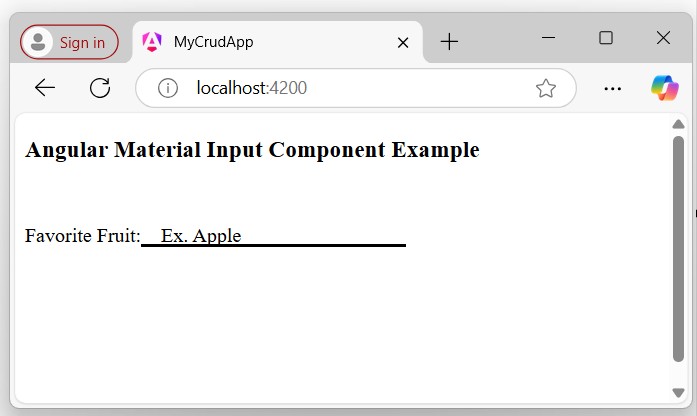
    material input component

    Using PrimeNG in Angular

    PrimeNG is a popular UI component library for Angular. Similar to Angular Material, it provides a wide range of ready-to-use, customizable UI components designed to help developers build modern, responsive, and featured web applications quickly.

    PrimeNG includes components like “buttons”, “data tables”, “form controls”, “charts”, and more, making it a universal choice for Angular development.

    Before proceeding with the example, the PrimeNG library should be installed in your Angular project. See how to install?

    To properly add the necessary PrimeNG styles in your angular.json file, you should add the following in the styles sections under the build options

    "styles":["@angular/material/prebuilt-themes/indigo-pink.css","src/styles.css","node_modules/primeng/resources/themes/lara-light-indigo/theme.css","node_modules/primeng/resources/primeng.min.css","node_modules/primeicons/primeicons.css"],

    Example

    The following example will add an input PrimeNG component to your Angular project. For that, we need to import the necessary dependencies as follows:

    import{ Component }from'@angular/core';import{ CommonModule }from'@angular/common';import{ RouterOutlet }from'@angular/router';import{ InputTextModule }from'primeng/inputtext';@Component({
      selector:'app-root',
      standalone:true,
      imports:[CommonModule, RouterOutlet, InputTextModule],
      templateUrl:'./app.component.html',
      styleUrl:'./app.component.css'})exportclassAppComponent{
      title ='myApp';}

    Add the input component to your template (e.g., app.component.html):

    <h1>Welcome to Angular Application</h1><p>This is the example of primeng input component</p><input type="text" pInputText />

    Output

    The output of the added component will appear as follows:
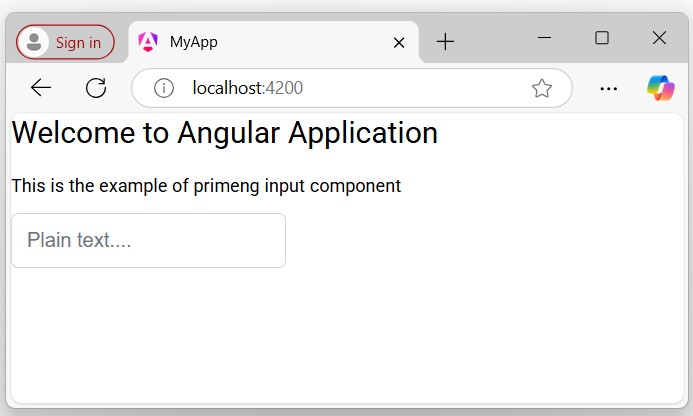
    primeng input component

    Using RxJS in Angular

    The RxJS stands for “Reactive Extensions for JavaScript”, which is a library for “reactive programming” using observable’s that make easier to compose “asynchronous” or “callback-based” code.

    In addition, the RxJS library is used to compose the “asynchronous” and “event-based” programs by using observable sequences. It provides one core type, the “Observable”, “satellite” types (Observer, Schedulers, Subjects), and “operators” inspired by Array methods (map, filter, reduce, every, etc) to allow handling asynchronous events as collections.

    Note!

    1. Asynchronous data refers to data that is processed or retrieved at different times, rather than in a sequential or synchronous manner.

    2. The RxJS (Reactive Extensions for JavaScript) is not an Angular library, but it is heavily used within Angular.

    Example

    Here is a simple example that will help you understand reactive programming:

    Let’s add an event listener the way you normally register in JavaScript:

    document.addEventListener('click',()=>console.log('You Clicked!'));

    Here, let’s see how we can add the same event listener using the “RxJS library”:

    import{ fromEvent }from'rxjs';fromEvent(document,'click').subscribe(()=>console.log('You Clicked!'));

    As you can see in JavaScript, you directly tell the browser what to do when an event happens (like clicking), while in RxJS, you create an “event stream” that you can “subscribe” to, allowing more flexibility and easier management of events.

    The RxJS library also makes it easier to handle complex event scenarios, such as filtering or modifying events and automatically cleans up after itself when no longer needed, unlike regular event listeners where you manually need to handle memory and cleanup.

  • Observer Pattern

    What is RxJS?

    The RxJS is a library that stands for Reactive Extensions JavaScript. It allows you to work with the synchronized data stream.

    It is used for “reactive programming”, which is a way to develop an application that reacts to changes instead of explicitly writing code to handle them.

    What is Observer Pattern in Angular?

    In Angular, the Observer Pattern is a design pattern that allows an object to called the observable from RxJS library to send notifications to multiple observer objects that are interested in the state changes of the observable. This design pattern is useful in managing asynchronous data streams in Angular applications.

    The following diagram of the observer pattern will provide you with a clear understanding of how the “publisher” (service) returns the “observable”. The “observable” emits data, and the “subscriber” subscribes to the data to react to changes or updates.

    Obser pattern

    Note: You can have multiple subscribers listening to the same observable

    Here,

    • The publisher is a service that generates data or events. It is responsible for creating and maintaining the Observable.
    • The observable is an entity that emits the data or events. It represents the data stream that other components can subscribe to.
    • The subscription is a process by which other components subscribe to the Observable to receive updates. Each subscriber gets notified whenever the Observable emits new data.
    • The subscriber is a component that subscribes and reacts to the data emitted by the Observable.

    Advantages of Observer Pattern

    Following is a list of advantages of the Angular Observer Pattern −

    • Reactive Programming
    • Event Handling
    • Error Handling
    • Improved Testablity

    Implementation

    Follow the process below to implement the observer pattern in an Angular application:

    Application Setup

    Let’s set up an angular application using CLI (command line interace) to implement the observer pattern from scratch within this newly created application.Use the steps given below to create a new Angular application:

    Step 1: Open the node.js command or code editor (e.g., VS code) terminal and go to your favorite workspace as:

    cd /favourite/workspace/ folder_name
    

    Step 2: Install Angular CLI using the following command (see more):

    npm install @angular/cli
    

    Step 3: Create a new angular application, myApp as follows:

    ng new myApp
    

    Note: Once you hit the above command, it will ask you a few questions and reply with the default answers.

    Step 4: Open the AppComponent (app.component.html) file remove everything and place the code below:

    <h2>Welcome to Angular Observer Design Pattern</h2>

    Step 5: Navigate to your “application directory” as:

    cd myApp
    

    Step 6: Run the application to verify it is created successfully:

    ng serve
    

    Step 7: Open your preferred browser (e.g., chrome) and navigate to localhost:4200 URL to see the output:

    observer pattern

    Create Observable Service

    Let’s create an Observable service to implement the Observable from the RxJS library. This service will allow you to share data across different components in the application.

    Step 1: Create a serviceobserver, as follows:

    ng generate service observer
    

    Once the above command is executed successfully, you might be able to see “two new files” within your application:

    observer pattern

    Here,

    • The first file, observer.service.spec.ts, is a unit testing file (we typically do not make changes in this file).
    • The second file, observer.service.ts, is where we write all the “logic” and “functionalities”.

    Implement Observable in Service

    We will define a method, getRandColors() within the service class, which returns an observable. This method will pick and return a random color from the given array when this method is called in the component each time.

    Step 1: Open the observer.service.ts file in your code editor and implement the getRandColors() method:

    import{ Injectable }from'@angular/core';import{ Observable }from'rxjs';@Injectable({
      providedIn:'root'})exportclassObserverService{constructor(){}getRandColors(): Observable<string>{returnnewObservable<string>(observer =>{let colors =["red","green","black","yellow","blue","pink","gray"];let rand = Math.floor(Math.random()* colors.length); 
    
      observer.next(colors[rand]);
      observer.complete();});}}</pre>

    Note: To work with the Observable pattern, make sure the RxJS library is imported into your service class.

    Use the Observable Service in Component

    As we have implemented the observable in the service class, we will now use the observable service within our root component to access its methods to retrieve the observer value.

    Step 1: Open the app.component.ts file, import, and inject the observable service.

    import{ Component }from'@angular/core';import{ CommonModule }from'@angular/common';import{ RouterOutlet }from'@angular/router';import{ ObserverService }from'./observer.service';@Component({
      selector:'app-root',
      standalone:true,
      imports:[CommonModule, RouterOutlet],
      templateUrl:'./app.component.html',
      styleUrl:'./app.component.css'})exportclassAppComponent{constructor(private myService: ObserverService){}}

    Step 2: As the service is already injected via Dependency Injection, now define a method, changeBackground(), access the service method within it, and assign the returned color value to the variable background:

    import{ Component }from'@angular/core';import{ CommonModule }from'@angular/common';import{ RouterOutlet }from'@angular/router';import{ ObserverService }from'./observer.service';@Component({
      selector:'app-root',
      standalone:true,
      imports:[CommonModule, RouterOutlet],
      templateUrl:'./app.component.html',
      styleUrl:'./app.component.css'})exportclassAppComponent{constructor(private myService: ObserverService){}//variable to store the color
      background:any;changeBackground(){this.myService.getRandColors().subscribe(color =>{//assigning valuethis.background = color;});}}

    Update the Template

    Now, let's update the template (app.component.html) to display the observer value initially when the component loads and update it dynamically when the value changes.

    Step 1: Open the app.component.html file in your code editor, bind the background variable with the div element using style binding, and create a button to change the background on click:

    <div [ngStyle]="{background: background}"><h2>Welcome to Angular Observer Design Pattern</h2><button (click)="changeBackground()">Change Background</button><p>Color (Observer value): {{background}}</p></div>

    Step 2: Open the app.component.css file and place the given code below in it:

    div{height: 95vh;padding: 0;margin: 0;font-family: sans-serif;color:rgb(32, 76, 76);padding: 10px;}button{padding: 15px 50px;cursor: pointer;background-color: antiquewhite;border: 1px solid white;color:rgb(30, 76, 11);border-radius: 5px;font-weight: bold;font-size: 18px;}

    Display the Observer value in Template

    We have used the observable service in our app component. Now, let's run the application to display the observer value in the template.

    Step 1: Run the application using the following command:

    ng serve
    

    Step 2: Open your preferred browser (e.g., Chrome) and navigate to the http://localhost:4200 URL.

    Once you navigate to the above URL, you will be able to see the following:

    observer pattern
  • Singleton Pattern

    What is Singleton Pattern in Angular?

    In Angular, the singleton pattern is a design pattern having a single instance of a class throughout the entire application and provide the global point of access to it.

    This design pattern is useful when you want to share a single resource to the entire application such as without recreating it; such as services.

    Singleton Services

    In Angular, a singleton service is a class defined with the @Injectable decorator, which marks the class as a service in Angular. It is used to share “common logic”, “data”, and “functionality” across various components and services.

    This angular feature “enhances” the application performance by reusing the existing code for “common logic” rather than defining the logic in multiple places, and it also decreases the redundancy of code.

    To use the singleton service in another component within the same application, we need to use Dependency Injection (another design pattern) to inject and use the service.

    Advantages of Singleton Service

    Following is a list of advantages of a Angular Singleton Service −

    • Enhance Application Performance
    • Globally Access
    • Dependency Injection Friendly
    • Resource Management
    • Easy to Share Data

    Implementation

    Following is a list of “objectives” that you need to follow to implement the “singleton pattern”:

    Application Setup

    Let’s create a “new application” using CLI from scratch to implement the singleton pattern (singleton service). This will help you understand the concept better.

    Use the steps given below to create a new Angular application:

    Step 1: Open the node.js command or code editor (e.g., VS code) terminal and go to your favorite workspace as:

    cd /favourite/workspace/ folder_name
    

    Step 2: Install Angular CLI using the following command:

    npm install @angular/cli
    

    Step 3: Create a new angular application, myApp as follows:

    ng new myApp
    

    Note: Once you hit the above command, it will ask you a few questions and reply with the default answers.

    Step 4: Open the app.component.html file remove everything and place the code below:

    <h2>Welcome to Angular Singleton Design Pattern</h2>

    Step 5: Navigate to your “application directory” as:

    cd myApp
    

    Step 6: Run the application to verify it is created successfully:

    ng serve
    

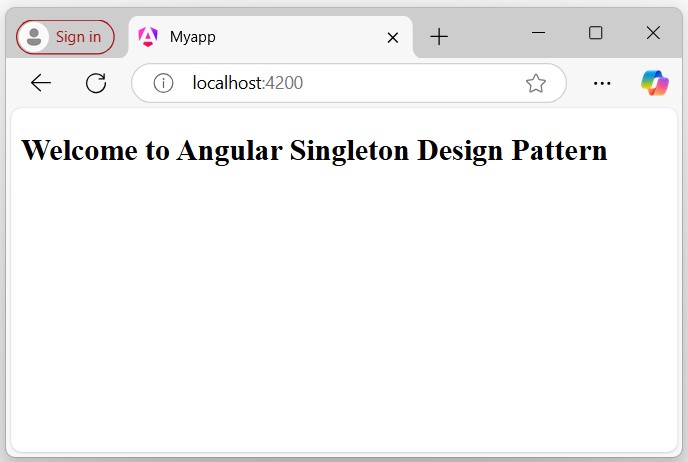
    Step 7: Open your preferred browser (e.g., chrome) and navigate to localhost:4200 to see the output:

    Singleton Pattern

    Create a Singleton Service

    In Angular, a service is a class defined with the @Injectable decorator, which identifies it as a service in Angular. Additionally, services are a feature of a mechanism used to share common logic, data, and functionality that can be used across multiple components, directives, and other services.

    Services are also used to communicate with servers via RESTful web services.

    We will create an Angular service that has a single instance throughout the entire application, which is commonly known as a singleton service (or the singleton pattern).

    Step 1: Create a service, myCalc in your angular application as follows:

    ng generate service myCalc
    

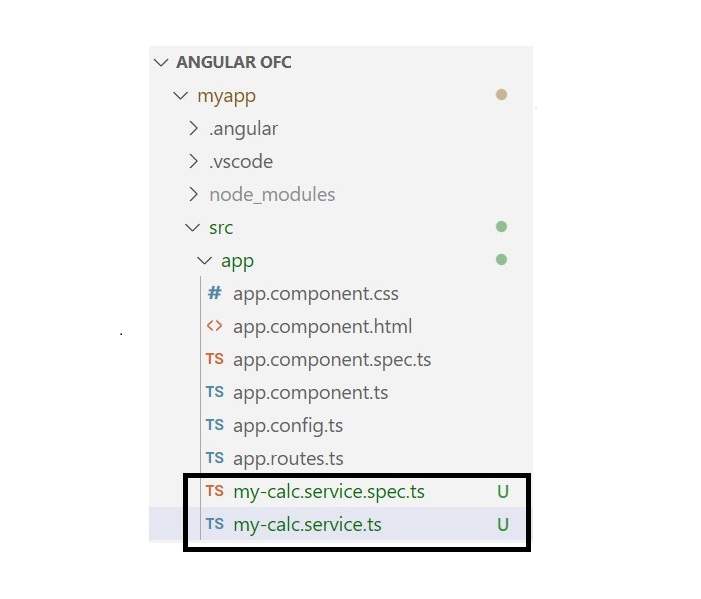
    Once the above command is executed successfully, you will able to see “two new files” in your Angular application:

    Singleton Pattern

    Here,

    • The first file, my-calc.service.spec.ts, is a unit testing file (we typically do not make changes in this file).
    • The second file, my-calc.service.ts, is where we write all the “logic” and “functionalities”.

    Step 2: Open the my-calc.service.ts file and update with the given code below:

    import{ Injectable }from'@angular/core';@Injectable({
      providedIn:'root'})exportclassMyCalcService{constructor(){}add(n1:number, n2:number){return n1 + n2;}subtract(n1:number, n2:number){return n1 - n2;}multiply(n1:number, n2:number){return n1 * n2;}divide(n1:number, n2:number){return n1 / n2;}}

    Here,

    • The @Injectable makes it a service class.
    • The providedIn: ‘root’, specifies that this service class has root-level access within the application.

    Create a Component

    Let’s create a component, where we will inject our singleton service class via DI to use its functionality which was defined in the “service class”.

    Step 1: Create a component, Calculator, as follows:

    ng generate component Calculator
    

    Step 2: Open the calculator.component.html file and place the code below:

    <div class="calc"><h3>My Calculator</h3><form><input type="number" placeholder="First number" [(ngModel)]="n1" name="n1"><input type="number" placeholder="Second number" [(ngModel)]="n2" name="n2"></form><div class="btns"><button (click)="add()">Add</button><button (click)="subtract()">Subtarct</button><button (click)="multiply()">Multiply</button><button (click)="divide()">Divide</button></div><div class="result" *ngIf="result">
    
    {{result}}
    </div></div>

    Step 3: Open the calculator.component.css file and place the code below:

    .calc{width: 60%;padding: 10px;background-color: beige;border-radius: 10px;font-family: sans-serif;}.calc h3{text-align: center;font-size: 25px;}.calc input{width: 90%;padding: 10px;margin: 10px auto;display: flex;font-size: 20px;}.btns{width: 90%;margin: 10px auto;}.btns button{padding: 10px 32px;border-radius: 5px;border: none;background-color: green;color: white;margin: 10px 10px;cursor: pointer;font-size: 16px;}.result{text-align: center;margin: 20px auto;background-color:rgb(200, 210, 206);padding: 10px;width: 90%;border-radius: 5px;}

    Inject Via Dependency Injection

    The Dependency Injection (DI) is also a design pattern in Angular used to inject the other “dependencies” into a module or a component rather than creating them individually for each module or component.

    Let’s inject the singleton service via Dependency Injection (DI) into our myCalc component to use its functionality, as this component requires its dependencies.

    Step 1: Open the calculator.component.ts file in your code editor and place the code below:

    import{ CommonModule }from'@angular/common';import{ Component }from'@angular/core';import{ MyCalcService }from'../my-calc.service';import{ FormsModule }from'@angular/forms';@Component({
      selector:'app-calculator',
      standalone:true,
      imports:[CommonModule, FormsModule],
      templateUrl:'./calculator.component.html',
      styleUrl:'./calculator.component.css'})exportclassCalculatorComponent{//injecting serviceconstructor(private myservice: MyCalcService){}
      n1:number=0;
      n2:number=0;
      result :any="";add(){this.result ="Sum is (n1+n2): "+this.myservice.add(this.n1,this.n2);}subtract(){this.result ="Subtraction is(n1-n2): "+this.myservice.subtract(this.n1,this.n2);}multiply(){this.result ="Multiplication is(n1xn2): "+this.myservice.multiply(this.n1,this.n2);}divide(){this.result ="Division is(n1/n2): "+this.myservice.divide(this.n1,this.n2);}}

    Step 2: Open the app.component.html file and update it with the code below

    <h2>Welcome to Angular Singleton Design Pattern</h2><app-calculator></app-calculator>

    Step 3: Now run the application using the following command to see the changes:

    ng serve
    

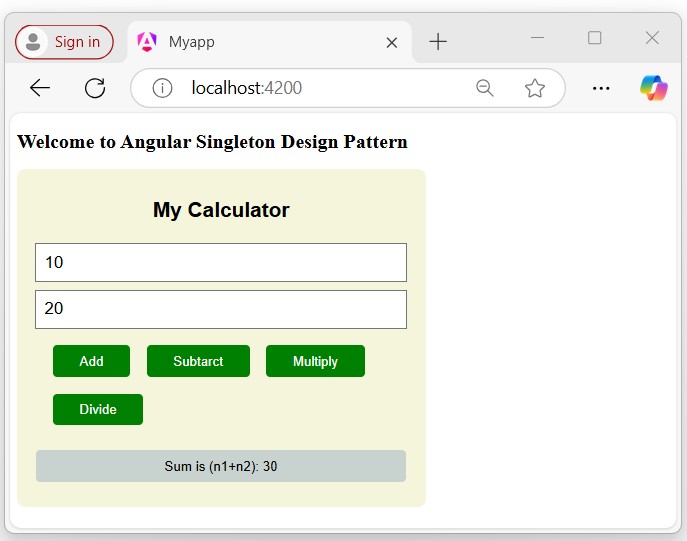
    Here is the first expression of the application:

    Singleton Pattern

    Here, we calculate the “addition” of “two numbers” by clicking on the add button:

    Singleton Pattern
  • Lazy Loading

    Lazy Loading in Angular

    In Angular, Lazy Loading is a design pattern developed by the google angular team to “enhance the application performance”. The lazy-loading technique loads only the required components and module at a time rather than loading all together.

    For example, suppose you have an Angular application with multiple feature modules, like a dashboarduser profilesettings, and reports. Instead of loading all these modules when the application starts, you can “configure lazy loading” to load these modules only when the user navigates to them.

    Implementing Lazy Loading in Angular Project

    To implement lazy loading in your project, follow the steps given below:

    Application Setup

    Follow the steps given below to create an angular application to implement the lazy-loading.

    Step 1: Open the node.js command or code editor (e.g., VS code) and go to your favorite workspace as follows:

    cd /favourite/workspace/ folder_name
    

    Step 2: Install CLI using the following command:

    npm install @angular/cli
    

    Step 3: Use the command below to create a new angular application:

    ng new myApp
    

    Here,

    • myApp is your application name.

    Note: Once you hit the above command, it will ask you a few questions and reply with the “default answer”.

    Step 4: Go to your application directory as follows:

    cd myApp
    

    Step 5: Open the app.component.html file, remove everything, and update with the code below:

    <h2>Welcome to Angular Lazy-loading Application</h2>

    Step 6: Run the application to verify whether it was created correctly:

    ng serve
    

    Step 7: Open your friendly browser and navigate to URL localhost:4200 to verify the application has been created successfully.

    Create Feature Module with Routing

    In Angular, a feature module is a “special module” that organizes reliable blocks of functionality, such as components, directives, services, and pipes, along with their separate routing configurations.

    This modularity helps in lazy loading, “improving application performance” by loading feature “modules only when needed”.

    Step 1: Create a feature module, auth as follows:

    ng generate module auth --routing
    

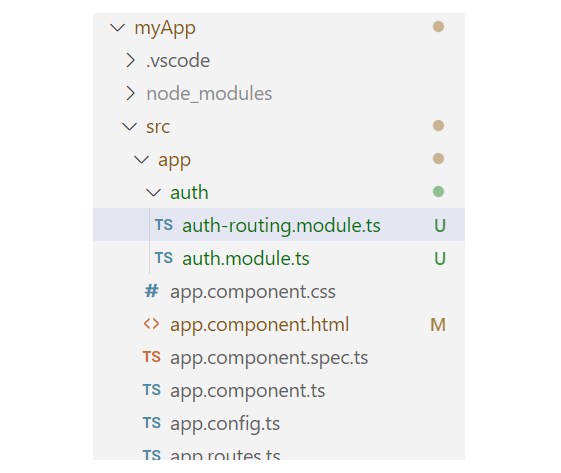
    Here, the –routing flag enables “individual routing” for the Auth module. Once the above command is executed successfully, you will see two files within the auth folder:

    Lazy loading

    Step 2: Create a component, login within the Auth module as:

    ng generate component login
    

    Create another Feature Module with Routing

    Let’s create one more feature module, Dashboard, to observe the changes when we load different modules.

    Step 1: Create another feature module, dashboard as follows:

    ng generate module dashboard --routing
    

    Step 2: Create a component, home within the dashboard module:

    ng generate component login
    

    Handling UI

    To make it more understandable, let’s add some UI for different components that belong to individual feature modules.

    Step 1: Open the app.component.html file and place the code below:

    <h2>Welcome to Angular Lazy-loading Application</h2><a routerLink="/auth">Login</a><a routerLink="/dashboard">Home</a><hr><router-outlet></router-outlet>

    Step 2: Open the app.component.css file and place the code below:

    a{text-decoration: none;margin: 0px 10px;background-color: green;color: white;border-radius: 10px;padding: 10px 20px;font-family: sans-serif;}

    Configure Routing

    Enable lazy loading in Angular, you need to configure routing for both individual components within the feature module and the root routing for the feature modules.

    To lazy load Angular modules, use the loadChildren property (instead of component) in your AppRoutingModule (e.g., app.routes.ts file) routes configuration as follows:

    Step 1: Open the app.routes.ts file and define the routes for both the feature modules:

    import{ Routes }from'@angular/router';exportconst routes: Routes =[{path:'auth',loadChildren:()=>import('./auth/auth.module').then(m => m.AuthModule)},{path:'dashboard',loadChildren:()=>import('./dashboard/dashboard.module').then(m => m.DashboardModule)}];

    Here, the loadChildren property is a router configuration option that allows you to lazily load a module.

    Step 2: Define the routes for the LoginComponent within the AuthModule as follows:

    import{ NgModule }from'@angular/core';import{ RouterModule, Routes }from'@angular/router';import{ LoginComponent }from'./login/login.component';const routes: Routes =[{path:'', component: LoginComponent}];@NgModule({
      imports:[RouterModule.forChild(routes)],
      exports:[RouterModule]})exportclassAuthRoutingModule{}

    Step 3: Define the routes for the HomeComponent within the DashboardModule as follows:

    import{ NgModule }from'@angular/core';import{ RouterModule, Routes }from'@angular/router';import{ HomeComponent }from'./home/home.component';const routes: Routes =[{path:'', component: HomeComponent}];@NgModule({
      imports:[RouterModule.forChild(routes)],
      exports:[RouterModule]})exportclassDashboardRoutingModule{}

    Step 4: Run the application using the following command:

    ng serve
    

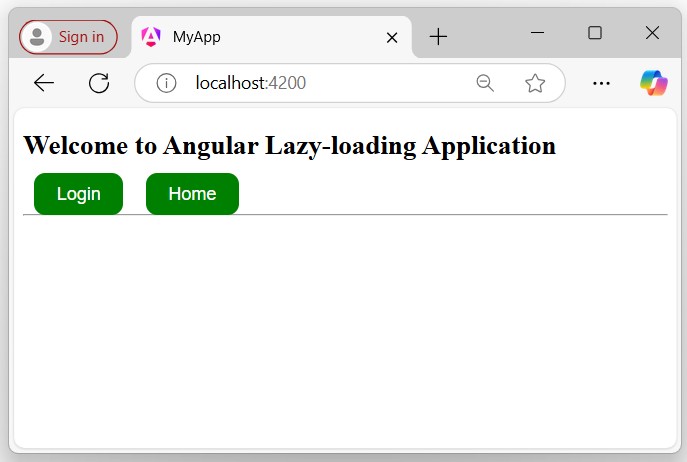
    Step 5: Open your friendly browser and navigate to the URL localhost:4200 to get the first look of your application:

    Lazy Loading

    Verify Lazy-loading

    To verify lazy loading, you need to follow a few steps in your browser where your application is currently running:

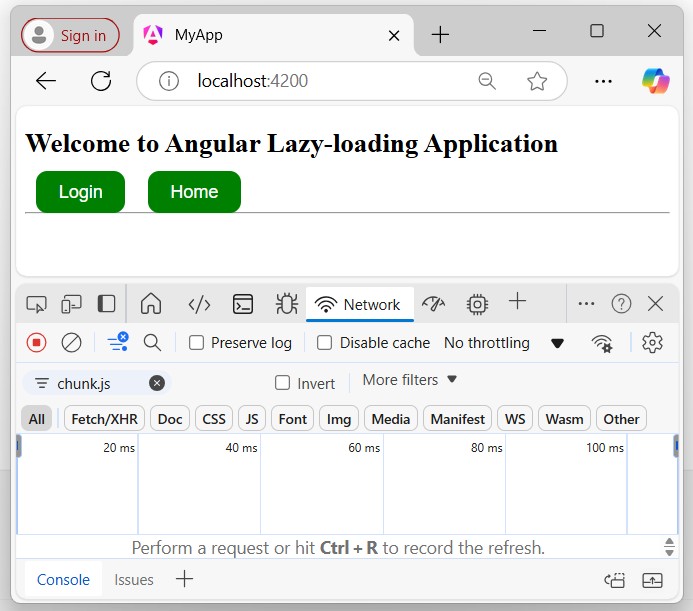
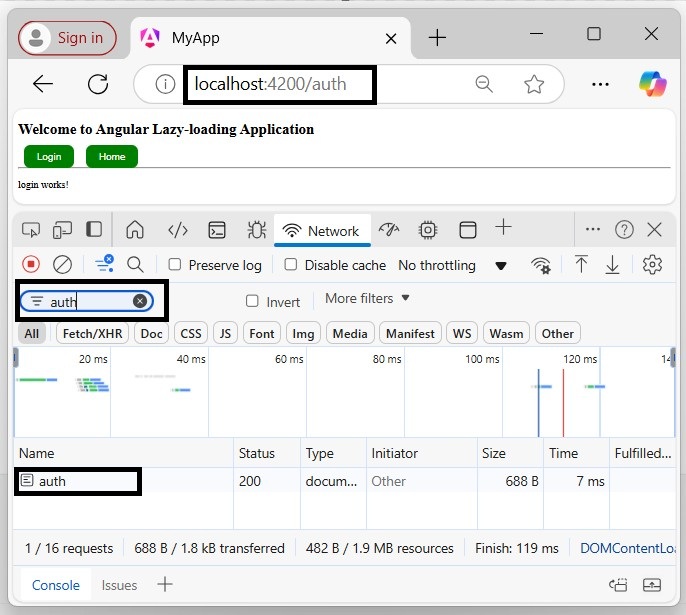
    Step 1: Inspect (right-click on your page and click on inspect) the browser page where your application is running and navigate to the Network tab as follows:

    Lazy Loading

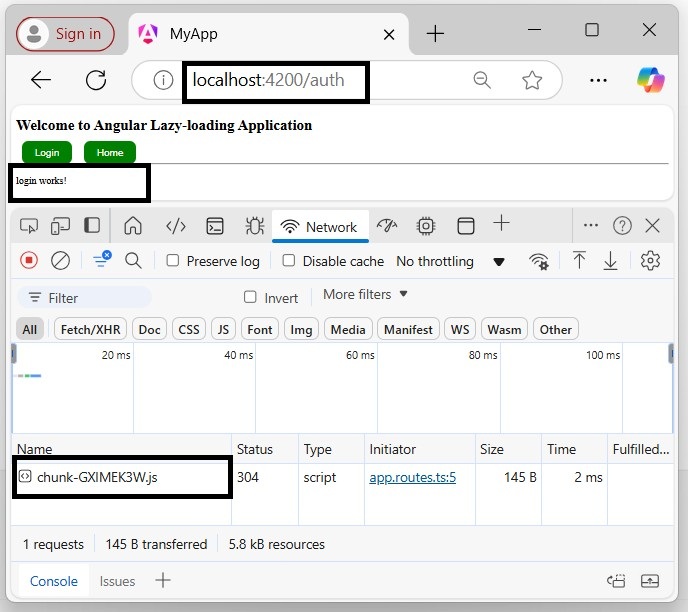
    Click on the Login or Home button. If you see a chunk (chunk.js) appear, everything is wired up properly, and the feature module is lazy-loaded. A chunk should appear for “Login” and “Home”, but only once for each.

    Step 2: Click the login button and recognize the changes:

    Lazy Loading

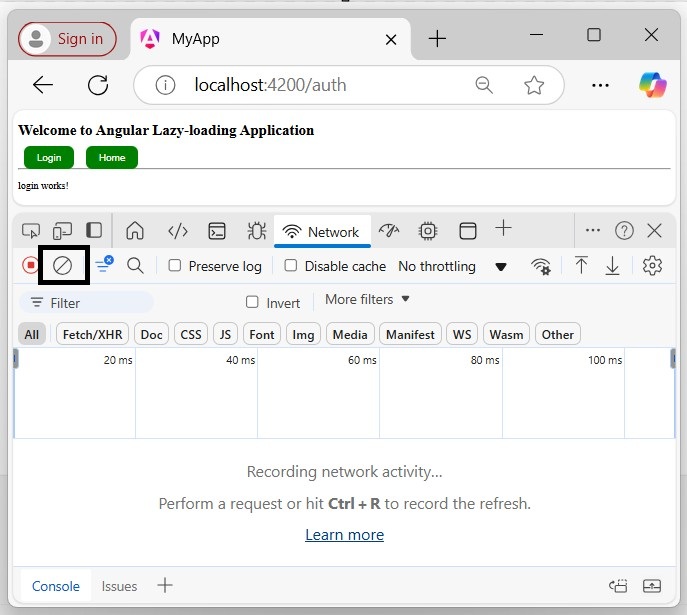
    To see it again or to test after making changes, click the circle with a line through it in the upper left of the Network Tab:

    Lazy Loading

    Then reload with “Cmd+r” or “Ctrl+r”, depending on your platform.

    If you try to filter the module, only the current loaded module will appear in the network section:

    Lazy Loading

    forRoot() and forChild()

    The forRoot() function is not available in standalone applications. Because, instead of creating an app-routing.module.ts file, the standalone applications generate an app.routes.ts file, which does not require forRoot() function.

    The forRoot() function specifies that this is the root routing module. It configures all the routes you pass to it, provides access to the router directives, and registers the Router service. Use forRoot() “only once” in your application within the AppRoutingModule.

    The Angular CLI also adds RouterModule.forChild(routes) to your feature routing modules. This way, Angular knows that the route list is only responsible for providing extra routes and is intended for feature modules. You can use forChild() in “multiple” modules.

  • Design Patterns

    Design Patterns

    In software engineering, design patterns are like a reusable blueprint or a template for solving common problems in software design. A few of them might also known as a “software design pattern”.

    Design patterns help developers to apply best practices in software development, which enhance the performance, maintainability, and scalability of software applications. By using the specified design patterns, developers can solve common design problems more easily, which can lead to higher-quality software.

    Let’s take a simple scenario in an Angular application to understand it better.

    Scenario: Singleton Pattern in an Angular Application

    Suppose you are developing an Angular application that needs to create a service. You want to ensure that only one instance of the service class is created and used throughout the application. This is where the Singleton pattern comes into action.

    Design Patterns in Angular

    In Angular, design patterns are known methods (or techniques) for solving common design problems. Applications built using design patterns are more scalable and reliable. Additionally, design patterns also improve the application’s performance by decreasing redundancy and loading components and modules when they are required.

    We will discuss some important design patterns in the further chapters in detail, including their usage, syntax to create, advantages, implementation examples, etc.

    Types of Design Patterns in Angular

    Below is a list of commonly used Design Patterns in Angular application:

    Let’s discuss them briefly with a simple code snippet one by one.

    Dependency Injection (DI)

    In Angular, Dependency Injection (in short, DI) is a “design pattern” in which a class receives its dependencies from an external source instead of creating them itself.

    This approach helps applications achieve loose coupling and reduce tight coupling between different parts of the application. By injecting dependencies, applications become more flexible and adaptable to changes.

    Example

    In the following example, you can see that the CalculatorComponent injects the MyCalcService dependencies rather than creating them itself. This service already exists in the application, so we use the Dependency Injection design pattern, which allows us to use this pre-existing dependency.

    import{ CommonModule }from'@angular/common';import{ Component }from'@angular/core';import{ MyCalcService }from'../my-calc.service';import{ FormsModule }from'@angular/forms';@Component({
      selector:'app-calculator',
      standalone:true,
      imports:[CommonModule, FormsModule],
      templateUrl:'./calculator.component.html',
      styleUrl:'./calculator.component.css'})exportclassCalculatorComponentimplementsOnInit{//injecting serviceconstructor(private myservice: MyCalcService){}
      n1:number=10;
      n2:number=20;
      add:number=0;
      subtract:number=0;
      multiply:number=0;
      divide:number=0;ngOnInit():void(){this.add =this.myservice.add(this.n1,this.n2);this.subtract =this.myservice.subtract(this.n1,this.n2);this.multiply =this.myservice.multiply(this.n1,this.n2);this.divide =this.myservice.divide(this.n1,this.n2);}}

    Click the link to read in more detail

    Lazy Loading

    In Angular, the Lazy-loading is a “design pattern” developed by the google angular team to “enhance the application performs”. The “lazy-loading” technique loads only the required component and module at a time rather than loading all together.

    For example, suppose you have an Angular application with multiple feature modules, like a “dashboard”, “user profile”, “settings”, and “reports”. Instead of loading all these modules when the application starts, you can configure lazy loading to load these modules only when the user navigates to them.

    Example

    In this example, we will define routes for the modules, “Auth” and “Dashboard”. By using the loadChildren property, we will set them as lazy-loaded modules, so they will only load when the relevant route is active in the URL.

    For example, if the URL localhost:4200/auth is active, only the “Auth” module will be loaded, and same for localhost:4200/dashboard URL.

    import{ Routes }from'@angular/router';exportconst routes: Routes =[{path:'auth',loadChildren:()=>import('./auth/auth.module').then(m => m.AuthModule)},{path:'dashboard',loadChildren:()=>import('./dashboard/dashboard.module').then(m => m.DashboardModule)}];

    Click the link to read in more detail

    Singleton Pattern

    In Angular, the Singleton Pattern is a “design pattern” having a single instance of a class throughout the entire application and provide the global point of access to it.

    This design pattern is useful when you want to share a common (or single) resource to the entire application without recreating it; such as Angular services.

    Example

    In the following example, we create a service class (i.e., a class defined by the @Injectable decorator) named MyCalcService, which has root-level access throughout the application.

    The “MyCalcService” service class has a single instance within the entire application, which uses the singleton design pattern to share common logic throughout the entire application at the root level.

    import{ Injectable }from'@angular/core';@Injectable({
      providedIn:'root'})exportclassMyCalcService{constructor(){}add(n1:number, n2:number){return n1 + n2;}subtract(n1:number, n2:number){return n1 - n2;}multiply(n1:number, n2:number){return n1 * n2;}divide(n1:number, n2:number){return n1 / n2;}}

    Click the link to read in more detail

    Observer Pattern

    In Angular, the Observer Pattern is a “design pattern” that allows an object to called the observable from RxJS library to “send notifications” to multiple observer objects that are interested in the state changes of the observable. This design pattern is useful in managing asynchronous data streams in Angular applications.

    Example

    In the example below, we will define a method, getRandColors() within the service class, which returns an observable.

    It uses the Observer design pattern, which involves an “observable” (subject) and one or more “observers” (subscribers) that react to changes or updates when ever the method is called in the component.

    import{ Injectable }from'@angular/core';import{ Observable }from'rxjs';@Injectable({
      providedIn:'root'})exportclassObserverService{constructor(){}getRandColors(): Observable<string>{returnnewObservable<string>(observer =>{let colors =["red","green","black","yellow","blue","pink","gray"];let rand = Math.floor(Math.random()* colors.length); 
    
      observer.next(colors[rand]);
      observer.complete();});}}</pre>

    Click the link to read in more detail

    Advantages of Angular Design Patterns

    Below is a list of some advantages of Angular Design Patterns −

    • Scalability: Web applications developed using design patterns will be more scalable,
    • Reliability: Angular design patterns help to ensure that web applications are reliable, reducing the risk of errors and improving overall stability.
    • Maintainability: Angular design patterns promote code reusability and modularity, making it easier to maintain and update the application.
  • NgModules

    Angular NgModule

    In Angular, the NgModule is a class marked (or defined) with the @NgModule decorator, which specifies it as an Angular module. This decorator provides metadata that tells Angular how to compile and run the module code and configure the DI (dependency injection).

    Here is the snippet of the @NgModule in Angular:

    import{ NgModule }from'@angular/core';import{ BrowserModule }from'@angular/platform-browser';import{ AppComponent }from'./app.component';import{ MyFeatureModule }from'./my-feature/my-feature.module';import{ MyService }from'./my-service.service';@NgModule({
      declarations:[
    
    AppComponent,],
    imports:[
    BrowserModule,       
    MyFeatureModule
    ], providers:[
    MyService            
    ], bootstrap:[
    AppComponent    
    ]})exportclassAppModule{}

    Note: The NgModule has two main responsibilities:

    • Declaring components, directives, and pipes that belong to the NgModule
    • Add providers to the injector for components, directives, and pipes that import the NgModule

    Important Properties of @NgModule

    The @NgModule class has several important properties which are:

    • Declarations
    • Imports
    • Exports
    • Providers
    • Bootstrap

    Declarations

    The declarations are an array, that contains the list of componentsdirectives, and pipes that belong to this module.

    @NgModule({// Signup and Login are components.
      declarations:[Signup, Login],})exportclassAuthModule{}

    In the example above, the components SignupComponent and LoginComponent belong to AuthModule.

    Note: If Angular finds any components, directives, or pipes declared in more than one NgModule, it reports an error.

    Any components, directives, or pipes must be explicitly marked as standalone: false, to be declared in an NgModule.

    @Component({// mark is false so that it can be declared in @NgModule
      standalone:false,})exportclassCustomMenu{}

    Imports

    The imports are an array, which lists out the other modules whose exported classes are needed by the components in this module.

    The components may depend on other components, directives, and pipes. Add these dependencies in the imports property of @NgModule.

    @NgModule({
      imports:[CommomModule, AppRoutingModule],// Signup and Login are components.
      declarations:[Signup, Login],})exportclassAuthModule{}

    The imports array accepts other NgModules, as well as standalone components, directives, and pipes.

    Exports

    The exports are an array, which defines the componentsdirectives, and pipes that can be used in the templates of other modules.

    @NgModule({
      imports:[CommomModule, AppRoutingModule],// Signup and Login are components.
      declarations:[Signup, Login],
      exports:[Login, Signup]})exportclassAuthModule{}

    The exports property is not limited to declarations. However, a NgModule can also export any other components, directives, pipes, and NgModules that it imports.

    NgModule Providers

    The providers are also an array, which lists out the services that are available to the injector and can be used throughout the module.

    @NgModule({// Signup and Login are components.
      declarations:[Signup, Login],
      providers:[MyService],})exportclassAuthModule{}@NgModule({
      imports [AuthModule],
      declarations:[UserProfile],
      providers:[UserData],})exportclassUserProfileModule{}

    Here, in the example above:

    • The AuthModule provides the MyService.
    • The Login and SignUp components can inject MyService because they’re declared in AuthModule.
    • UserProfile can inject MyService because its NgModule imports AuthModule.
    • UserData can inject MyService because its NgModule imports AuthModule.

    The forRoot and forChild Pattern

    In Angular, a few NgModule define a static forRoot() method that accepts some configuration and returns an array of providers.

    If any providers are included this way will be eagerly loaded, and increases the JavaScript bundle size of your first loaded page.

    boorstrapApplication(AppComponent,{
      providers:[
    
    AuthModule.forRoot(/* configuration */),],});</pre>

    Similarly, some NgModules may define a staticforChild() methodthat indicates the providers are considered to be added to components within your application hierarchy.

    @Component({
      providers:[
    
    CustomMenuModule.forChild(/*configuration */),],})exportclassUserProfile{}</pre>

    Bootstrapping Application

    In Angular, the@NgModuledecorator accepts an optionalbootstraparray that may contain one or more components.

    You can use thebootstrapModule()method from eitherplatformBrowser (i.e., a client)orplatformServer (i.e., a server)to start an Angular application.

    import{ BrowserModule }from'@angular/platform-browser';@NgModule({
      bootstrap:[AppComponent],})exportclassAppModule{}BrowserModule().bootstrapModule(AppModule);
  • Routing Module

    Routing Module in Angular

    In Angular, a Routing Module is a special module that handles the configuration and management of routes within an application. It defines the routes (paths) for the various components to navigate between views or components.

    You can define application routing logic separately from the rest of the application, which will react to the user interaction.

    Important Points of Routing Module

    Following are a few important points about the Routing Module you must know:

    • In older angular version, the CLI automatically created a routing module named as app-routing.module.ts while creating a new application, where you can define routes to navigate between various components.
    • In latest angular version, the CLI does not automatically create a routing module but instead creates a file named app.routes.ts to define the routes but it is not a routing module.
    • This file contains the route configuration array, which is then imported into a separate routing module, such as AppRoutingModule, to configure the RouterModule.

    Important! The following creation steps of the routing module will be followed as per the “latest Angular version“.

    Creating Routing Module in Angular

    To create a routing module in your existing or new Angular application, follow and implement the steps given below:

    Step 1: Open or Create a new Angular project

    Open any existing angular project in your preferred code editor (e.g., vs code) or create a new application by running the following command:

    ng new myapp
    

    Step 2: Create app.routes.ts

    Create a new file named app.routes.ts within the src/app folder (if it is not already created by Angular CLI):

    src/app -> app.routes.ts
    

    Step 3: Update the app.routes.ts

    Open the app.routes.ts file in your code editor. If it is empty, add the given code below:

    import{ Routes }from'@angular/router';exportconst routes: Routes =[];

    Step 4: Create Standalone Components

    Create two standalone components named Home and About using the following commands:

    ng generate component Home
    ng generate component About
    

    Step 5: Define routes

    Update the app.routes.ts to define the routing paths for the new components:

    import{ Routes }from'@angular/router';import{ HomeComponent }from'./home/home.component';import{ AboutComponent }from'./about/about.component';exportconst routes: Routes =[{path:'home', component: HomeComponent},{path:'about', component: AboutComponent}];

    How to use Routing Module in Angular?

    We have created a routing module and defined the routes for the Home and About components to navigate when the URL changes. As the routing module is ready to use, we need to import some necessary modulesdirectives, and components to use it in our application.

    Follow the steps given below to make it ready for use in your application:

    Step 1: Configure routing in AppConfiguration

    Open the app.config.ts file in your code editor import routes and add the same in the providers array:

    import{ ApplicationConfig }from'@angular/core';import{ provideRouter }from'@angular/router';import{ routes }from'./app.routes';exportconst appConfig: ApplicationConfig ={
      providers:[provideRouter(routes)]};

    Step 2: Update the app.component.ts

    Open the app.component.ts file in your code editor import the necessary modules (e.g., RouterModuleRouterOutlet directive, and components), and add the same within the imports array:

    import{ Component }from'@angular/core';import{ CommonModule }from'@angular/common';import{RouterModule, RouterOutlet }from'@angular/router';import{ HomeComponent }from'./home/home.component';import{ AboutComponent }from'./about/about.component';@Component({
      selector:'app-root',
      standalone:true,
      imports:[
    
     CommonModule, 
     RouterOutlet, 
     RouterModule, 
     HomeComponent, 
     AboutComponent
    ], templateUrl:'./app.component.html', styleUrl:'./app.component.css'})exportclassAppComponent{ title ='myApp';}

    Step 3: Update the app.component.html

    Open the app.component.html file and update it with the following code:

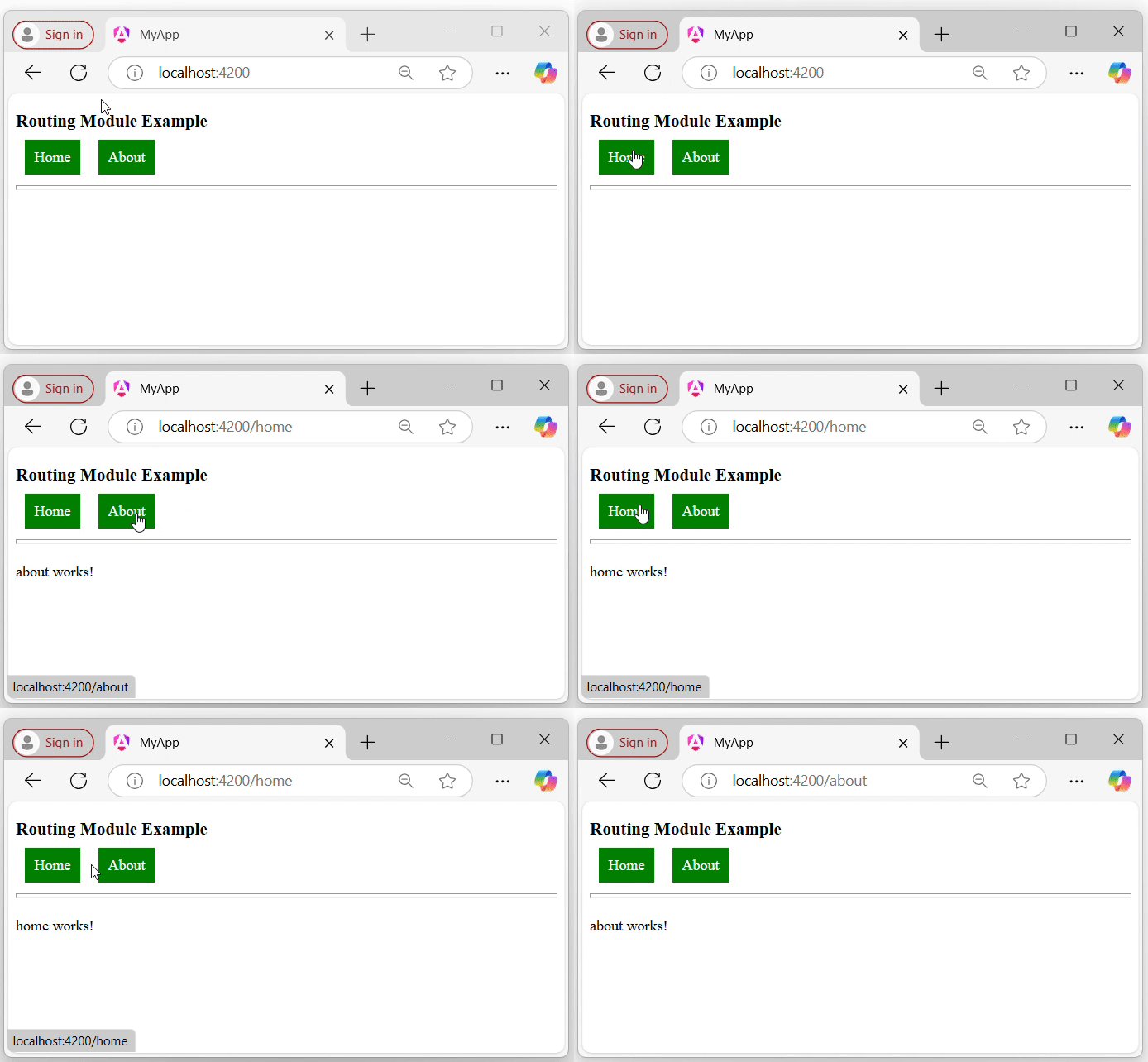
    <h3>Routing Module Example</h3><a routerLink="home">Home</a><a routerLink="about">About</a><hr><router-outlet></router-outlet>

    Step 4: Update the app.component.css

    Open the app.component.css file and place the code below:

    a{text-decoration: none;margin: 10px 10px;background-color: green;padding: 10px ;color: white;}hr{margin: 20px 0px;padding: 2px;}

    Step 5: Run the Application:

    Now open your preferred browser (e.g., chrome) and navigate to the localhost:4200 URL to see the output:

    Routing Module
  • Shared Module

    Shared Module in Angular

    In Angular, the Shared Module is a custom module designed or created by the developer based on the requirements of the application. The Shared module allows developers to access its componentsdirectivespipes, etc., throughout the application.

    Module itself is not a shared module until it is properly exported and imported into other modules where its components are needed.

    Creating a Shared Module

    Creating a shared module allows you to organize and simplify your code, reducing the redundancy of repeating the same things within the same application.

    Use the following command to create a module in your Angular application, and this module will be used as a shared module in the application. We import export this module within the other module where it’s component are needed.

    Step 1: Open the project

    Open your application in any code editor (such as VS code).

    Step 2: Navigate to the Application Directory

    Open the code editor terminal and navigate to your application directory as follows:

    cd your_application_directory
    
    e.g.
    cd myapp
    

    Step 3: Create a new module (i.e., consider it a shared module) named Shared as follows:

    ng generate module shared
    

    Once the above command is executed successfully, you should be able to see the shared folder. Within this folder, there will be a file named shared.module.ts with a default code:

    import{ NgModule }from'@angular/core';import{ RouterModule, Routes }from'@angular/router';const routes: Routes =[];@NgModule({
      imports:[RouterModule.forRoot(routes)],
      exports:[RouterModule]})exportclassAppRoutingModule{}

    How to Use Shared Module?

    To use the Shared Module in our Angular application, the first step is to import it into our root module, which is named AppModule in our application.

    Step 1: Open the app.module.ts file and import the shared module as follows:

    import{ NgModule }from'@angular/core';import{ BrowserModule, provideClientHydration }from'@angular/platform-browser';import{ AppRoutingModule }from'./app-routing.module';import{ AppComponent }from'./app.component';import{ SharedModule }from'./shared/shared.module';@NgModule({
      declarations:[
    
    AppComponent
    ], imports:[
    BrowserModule,
    AppRoutingModule, 
    SharedModule
    ], providers:[provideClientHydration()], bootstrap:[AppComponent]})exportclassAppModule{}

    We have already created a shared module in our Angular application and imported it into the AppModule (i.e., root module). Now, let’s create two components within the Shared Module to use throughout the entire application.

    Step 2: Create a Header Component

    Create a new component, Header within the shared module as follows:

    ng generate component shared/header
    

    Step 3: Open the header.component.ts file and place the below code:

    <h2>This his Header</h2><p>A component from Shared Module</p>

    Step 4: Create another component, Footer.

    Create one more component, Footer within the shared module as follows:

    ng generate component shared/footer
    

    Step 5: Open the footer.component.ts file and place the below code:

    <h2>This his Footer</h2><p>A component from Shared Module</p>

    Step 6: Update the Shared Module

    To use the “components” of the Shared Module outside of this module, you need to export the Header and Footer components in the shared.module.ts file as follows:

    import{ NgModule }from'@angular/core';import{ CommonModule }from'@angular/common';import{ HeaderComponent }from'./header/header.component';import{ FooterComponent }from'./footer/footer.component';@NgModule({
      declarations:[
    
    HeaderComponent,
    FooterComponent
    ], imports:[
    CommonModule
    ], exports:[HeaderComponent, FooterComponent]})exportclassSharedModule{}

    Step 7: Update AppComponent

    Open the app.component.html and place the code below:

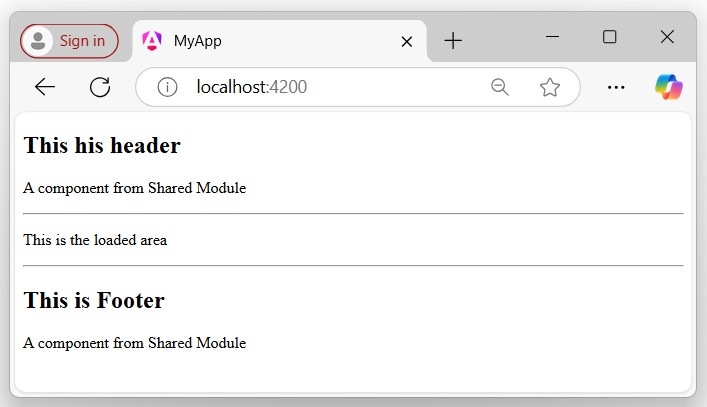
    <app-header></app-header><hr><p>This is the loaded area</p><hr><app-footer></app-footer>

    Step 8: Run the application using the following command:

    ng serve
    

    Step 9: Open your friendly browser (chrome) and navigate to localhost:4200:

    Shared Module

    Advantages of Shared Module

    The following is a list of the advantages of the Shared Modules:

    • It increases application performance by using “reusable” components, directives, etc.
    • Organizes the application, streamlining the code.
    • Increases application modularity.
    • Decreases redundancy.
  • Feature Module

    Feature Module in Angular

    In Angular, a feature module is a “custom module” created by “developers” once the application is built or initiated. This module helps partition the application into focused areas for better organization. It shares a common features or functionalities across the application.

    You can create different feature modules for various functionalities. For example, an authentication module to handle user “login” and “signup”, while an admin module provides a separate dashboard for “user management”. Additionally, a shared module can include common elements like the “header” and “footer”.

    Important! To use the feature module in your application, make sure that the feature module is imported into the root module (older version) and AppComponent (latest version).

    Feature Module vs Root Module

    Here are the few differences between the feature and root modules −

    Feature ModuleRoot Module
    It is mostly created by Users to organize the application structure.Generally automatically created by Angular CLI while creating the application (in older version).
    It provides a way to organize code into a structured way of the related functionality.Serves as the application entry point and sets a basic structure and configuration.
    Can be a lazy-loaded module that enhances the application performance.Eagerly loaded as it is required to bootstrapping the application.
    It contains various declarations such as directivescomponents, and pipes.It contains the declarations, imports, and root-level providers which are necessary for running the application.

    Important! As per the latest angular version, the application are created as standalone, so the applications are no more depend on the root module (i.e., AppModule).

    How to Create a Feature Module in Angular?

    To create a feature module in your Angular application, you need to create a “custom module” and generate some components, directives, services, and routing that belong to this module. So this module can share its features throughout the entire application.

    Follow and implement the steps given below in any existing application, if not create a new application and implement the same.

    Step 1: Open any existing project in your preferred code editor (e.g., vs code) or create a new project using the following command:

    ng new myApp
    

    Redirect to the application directory by using the cd myApp command.

    Step 2: Create a Module

    Create a new module (that will be considered as a feature module), Admin using the following command:

    ng generate module admin --routing
    

    Here,

    The –routing flag will create its own routing file, where you can define routes for all its related components.

    Let’s create the components and services within the admin module, which will include the related functionality for the admin.

    Step 3: Create Components

    Create two components, About and Contact using the following command:

    ng generate component admin/About 
    ng generate component admin/Contact 
    

    Here,

    The admin/ path specifies that the component will be created within the Admin module.

    Step 3: Create a Service

    Create a service class, adminService, using the following command:

    ng generate service adminService
    

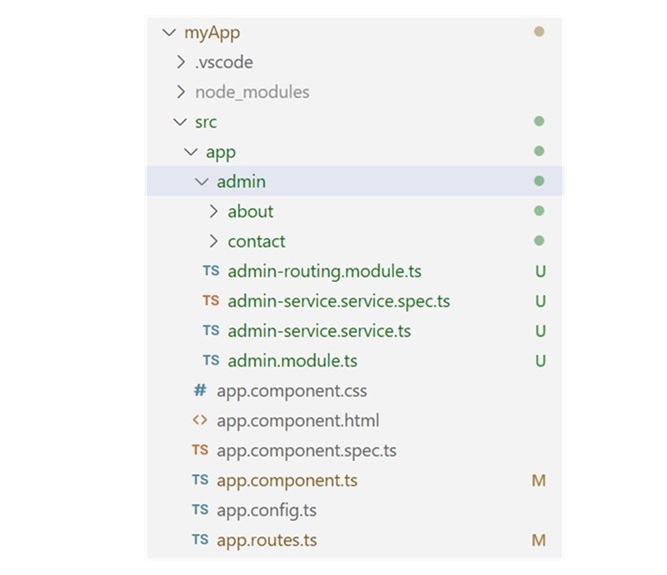
    Note: After executing all the above “components” and ‘services” within the admin module, you will be able to see all the admin-related components, services, and routing functionalities organized within the admin module. This will give you a clear understanding of the application structure.

    Feature Module1

    Step 4: Define routes

    Open the admin-routing.module.ts file and define the routes to navigate the admin components:

    import{ NgModule }from'@angular/core';import{ RouterModule, Routes }from'@angular/router';import{ AboutComponent }from'./about/about.component';import{ ContactComponent }from'./contact/contact.component';const routes: Routes =[{path:'about', component: AboutComponent},{path:'contact', component: ContactComponent}];@NgModule({
      imports:[RouterModule.forChild(routes)],
      exports:[RouterModule]})exportclassAdminRoutingModule{}

    Let’s see how to use the created feature module in our angular application, myApp.

    How to use a Feature Module in Angular?

    In this section, we will discuss how to use the Admin feature module we created in our Angular application.

    Step 1: Importing Feature Module

    Open the app.component.ts file in your code editor, import the AdminModule, and add it to the imports array:

    import{ Component }from'@angular/core';import{ CommonModule }from'@angular/common';import{ RouterModule, RouterOutlet }from'@angular/router';import{ AdminModule }from'./admin/admin.module';@Component({
      selector:'app-root',
      standalone:true,
      imports:[CommonModule, RouterOutlet, AdminModule, RouterModule],
      templateUrl:'./app.component.html',
      styleUrl:'./app.component.css'})exportclassAppComponent{
      title ='myApp';}

    Step 2: Define Routes for Admin Module

    Open the app-routing.module.ts file and define routes for the Admin module to navigate through its components when the admin route is active:

    import{ Routes }from'@angular/router';exportconst routes: Routes =[{ 
    	path:'admin',loadChildren:()=>import('./admin/admin.module').then(m => m.AdminModule)}];

    Important! The above routing strategy performs lazy loading, which means it will load the individual admin components only when required.

    Step 3: Rendering Feature module Component Template

    Open the app.component.html file and create links to click to navigate to the respective component template:

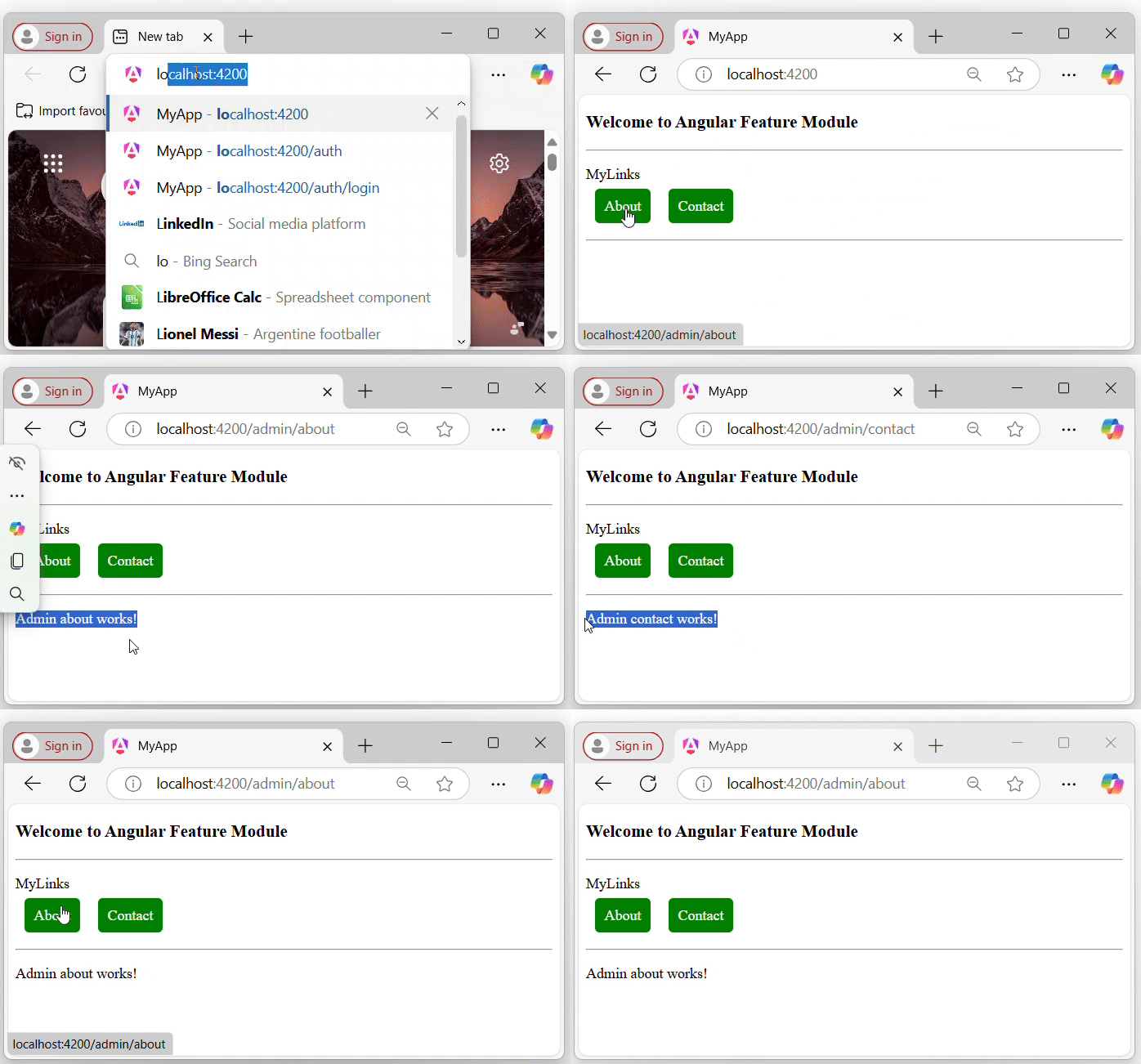
    <h3>Welcome to Angular Feature Module</h3><hr><p>MyLinks</p><a routerLink="admin/about">About</a><a routerLink="admin/contact">Contact</a><br><br><hr><router-outlet></router-outlet>

    Step 4: Run the application using the following command:

    ng serve
    

    Step 5: Open your preferred browser and navigate to the localhost:4200 URL.

    The application will look like:

    Feature Module

    Advantages of Feature Module

    Here are some of the advantages of the feature module:

    • Reusability: Feature modules can be reused across different applications or in different parts of the same application.
    • Organized structure: By partitioning the application into different parts based on roles and functionalities, you can create a well-organized application structure.
    • Improved testing: Testing becomes more straightforward by using feature modules.
    • Consistent Dependencies: Each module can manage its own dependencies.
  • Root Module

    Angular Root Module

    In Angular, the root module is named AppModule, which is the entry point of the angular application. It is a class defined with decorator @NgModule, which provides metadata (data about data) to configure the module.

    In addition, the AppModule is a place or container where we group all the other modulescomponentsdirectivespipesservices, etc.

    Note: In the latest Angular version, applications are standalone by default and no longer depend on @NgModule. However, if you choose to use “@NgModule” in your application, ensure that neither the “application nor the components” are “standalone”.

    What is Standalone Application?

    In Angular, a standalone application is an application that does not contain the @NgModule, in which all the “components”, “directives”, and “services” are independent. If the project is standalone, the app.module.ts file will not be available in your Angular application.

    If your Angular application is no-standalone, you will be able to see the AppModule within your Angular application, but if not, you may not be able to see it. However, you can create your custom module using the command “ng generate module module_name”. But that will not be considered a root module.

    Creating No Standalone Application

    In case to work with the root module or AppModule, we need to create a no standalone application. Use the following command to create a “no-standalone” angular application:

    ng new myApp --no-standalone
    

    Once you hit the above command in your code editor terminal, it will ask you a few questions and reply with a default answer.

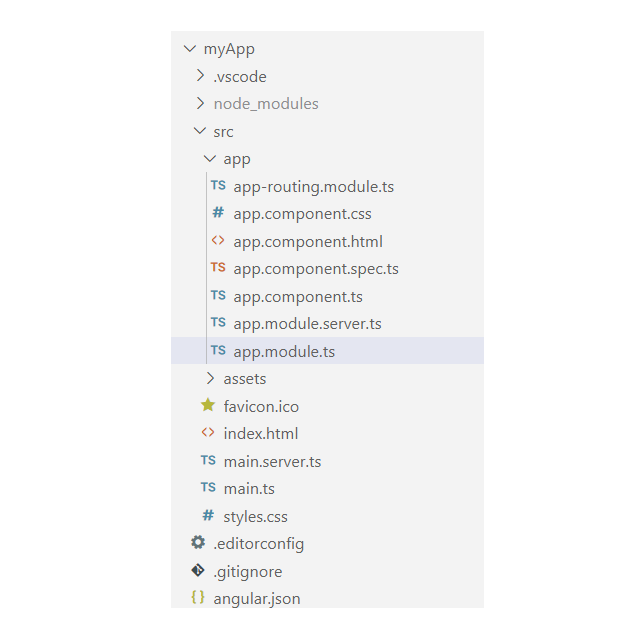
    Go to your src->app folder, you will able to see the app.module.ts file as follows:

    app module

    Open the app.module.ts file in your code editor; you may able to see the code below:

    import{ NgModule }from'@angular/core';import{ BrowserModule, provideClientHydration }from'@angular/platform-browser';import{ AppRoutingModule }from'./app-routing.module';import{ AppComponent }from'./app.component';@NgModule({
      declarations:[
    
    AppComponent
    ], imports:[
    BrowserModule,
    AppRoutingModule
    ], providers:[provideClientHydration()], bootstrap:[AppComponent]})exportclassAppModule{}

    The above code is the default code, automatically added when a new application (no standalone) is created. Let’s discuss a few of the key parts of the root module, which are:

    • Declarations
    • Imports
    • Providers
    • Bootstrap

    Declarations

    The declarations are an array that contains a list of componentsdirectives, and pipes that belong to this module. For example, the AppComponent is a part of this module, so it is included in the declarations.

    Imports

    The imports are an array, which lists out all the other modules whose exported classes are needed by the components in this module. As you can see, the imports contain the AppRoutingModule and BrowserModule.

    Providers

    Theprovidersare anarray, which lists the services available to the injector and can be used throughout the module.

    Bootstrap

    The bootstrap is also an array in @NgModule, it specifies the root component that Angular should create and insert into the index.html host web page.As you can see, the AppComponent is listed within the bootstrap array, which specifies that it is the application’s root component.

    bootstrap:[AppComponent]