Author: saqibkhan

  • Complexity in Structure

    Creating and maintaining the structure of HTML documents is complex, mainly for large-scale projects. As webpages grow in complexity, managing nested HTML elements is challenging. This complexity may lead to errors.

    Some web developers opt for more structured approaches using template engines like Handlebars or libraries like JSX (for React). These tools offer a cleaner way to organize HTML-like code within JavaScript.
  • Static Nature

    HTML is a static language. It defines the structure and presentation of web content but cannot produce dynamic interactions by itself. As a result, creating interactive web applications, like online games or real-time chat systems, can be challenging with HTML alone. For dynamic functionalities, Web developers often turn to JavaScript, a scripting language that complements HTML’s static nature. 

    Developers often use JavaScript frameworks to develop dynamic web applications,

  • Data Storage

    HTML extends its capabilities to data storage with technologies like XML. It enables the structured storage of data within web documents, making it retrievable and usable by applications. This data accessibility is vital in modern web development. 

    As Tim Bray, co-editor of the XML specification, said, “XML is a widely-used standard for representing structured data.”

  • Speed and Efficiency

    HTML’s lightweight nature ensures fast loading times for web pages By reducing the loading time, HTML saves time for users.

  • Flexibility

    HTML’s loose syntax grants developers flexibility. It allows for creative experimentation and adapts to various content types. This versatility is crucial for crafting diverse web experiences. 

    Jeff Atwood, co-founder of Stack Overflow, noted, “HTML is the canvas of the web. It’s the foundation for the entire web experience.”

  • Easy to Learn

    HTML is simple and easy to learn. It is so easy to learn that school students can use HTML to create their own basic website with images and colors. 

    Vincent Tan, a web developer, aptly puts it, “HTML is like building with Lego bricks; it’s easy to grasp and lets you create beautiful structures quickly.”

  • Cost-Efficient

    One of HTML’s important advantages is its cost-efficiency. Developers don’t need to purchase licenses or additional software to create HTML content.

    This cost-effectiveness has led to HTML being the foundation of the web, as observed by Marc Andreessen, co-founder of Netscape: “HTML is precisely what we were trying to prevent—a rich programming environment for developing custom applications on top of a general-purpose computer.”

  • Browser Compatibility

    HTML enjoys widespread browser support, making it a universal language for web content. Web browsers like Chrome, Firefox, Safari, and Internet Explorer obey HTML standards so that their web pages look the same on all different platforms.

    As Tim Berners-Lee, the inventor of the World Wide Web, said, “HTML is the lingua franca for publishing on the Web.

    Lingua Franca: A language that is adopted as a common language between speakers whose native languages are different.

  • Color Code Builder

    HTML Color Picker

    You can use this HTML color picker tool to choose and customize colors for your web projects. You can get HEX, RGB, and HSL color values instantly by picking the color from the given color wheel.

    Pick and Preview Colors

    You can make any colors using combinations of RED, GREEN, and BLUE. If you set the maximum intensity of all three colors, then the resulting color will be white. Similarly, if you give zero intensity for all RGB values, you will get black color.

    Current Color Values:

    Hex: #fff 

    RGB: 255, 255, 255 

    RGBA: 255, 255, 255, 1 

    HSL: 0, 0%, 100%Hex:RGB:RGBA:HSL:

  • Validation

    An HTML validator is a tool that parses each line of code in order to find syntax errors and to check whether the HTML and CSS codes comply with the latest standards set by the World Wide Consortium (W3C).

    The most frequently used validators are as follows −

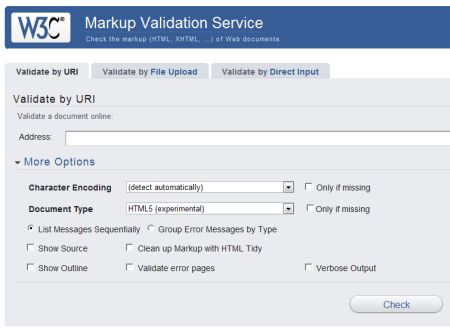
    The W3C Markup Validator

    The W3C Markup Validator checks the markup validity of Web documents in HTML, XHTML, SMIL, MathML, etc. This validator is part of Unicorn, W3C’s unified validator service.

    To use this validator for HTML, you need to use More Options and select Document Type as HTML (experimental) as shown below.

    W3C Markup Validation

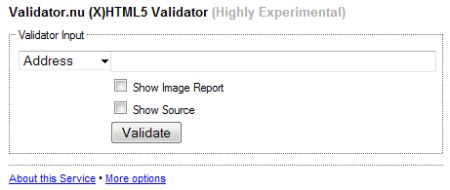
    The Validator.nu (X)HTML Validator

    Here is the another currently known HTML5 validators: Henri’s Validator.nu (X)HTML5 Validator (Highly Experimental) −

    Validator.nu Validator