Iterator pattern is very commonly used design pattern in Java and .Net programming environment. This pattern is used to get a way to access the elements of a collection object in sequential manner without any need to know its underlying representation.
Iterator pattern falls under behavioral pattern category.
Implementation
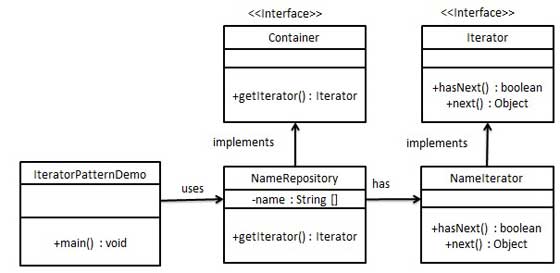
We’re going to create a Iterator interface which narrates navigation method and a Container interface which retruns the iterator . Concrete classes implementing the Container interface will be responsible to implement Iterator interface and use it
IteratorPatternDemo, our demo class will use NamesRepository, a concrete class implementation to print a Names stored as a collection in NamesRepository.
Step 1
Create interfaces.
Iterator.java
public interface Iterator {
   public boolean hasNext();
   public Object next();
}
Container.java
public interface Container {
   public Iterator getIterator();
}
Explore our latest online courses and learn new skills at your own pace. Enroll and become a certified expert to boost your career.
Step 2
Create concrete class implementing the Container interface. This class has inner class NameIterator implementing the Iterator interface.
NameRepository.java
public class NameRepository implements Container {
   public String names[] = {"Robert" , "John" ,"Julie" , "Lora"};

   @Override
   public Iterator getIterator() {
  return new NameIterator();   }

   private class NameIterator implements Iterator {

  int index;
  @Override
  public boolean hasNext() {

     if(index < names.length){
        return true;
     }
     return false;
  }
  @Override
  public Object next() {

     if(this.hasNext()){
        return names[index++];
     }
     return null;
  }		   }
}
Step 3
Use the NameRepository to get iterator and print names.
IteratorPatternDemo.java
public class IteratorPatternDemo {

   public static void main(String[] args) {
  NameRepository namesRepository = new NameRepository();
  for(Iterator iter = namesRepository.getIterator(); iter.hasNext();){
     String name = (String)iter.next();
     System.out.println("Name : " + name);
  } 	   }
}
Step 4
Verify the output.
Name : Robert
Name : John
Name : Julie
Name : Lora
Leave a Reply